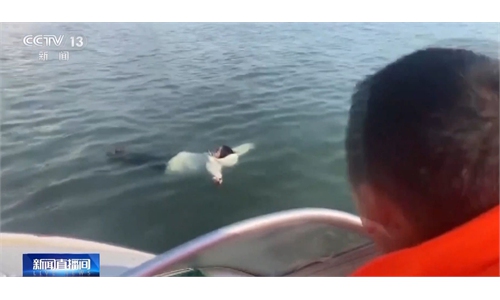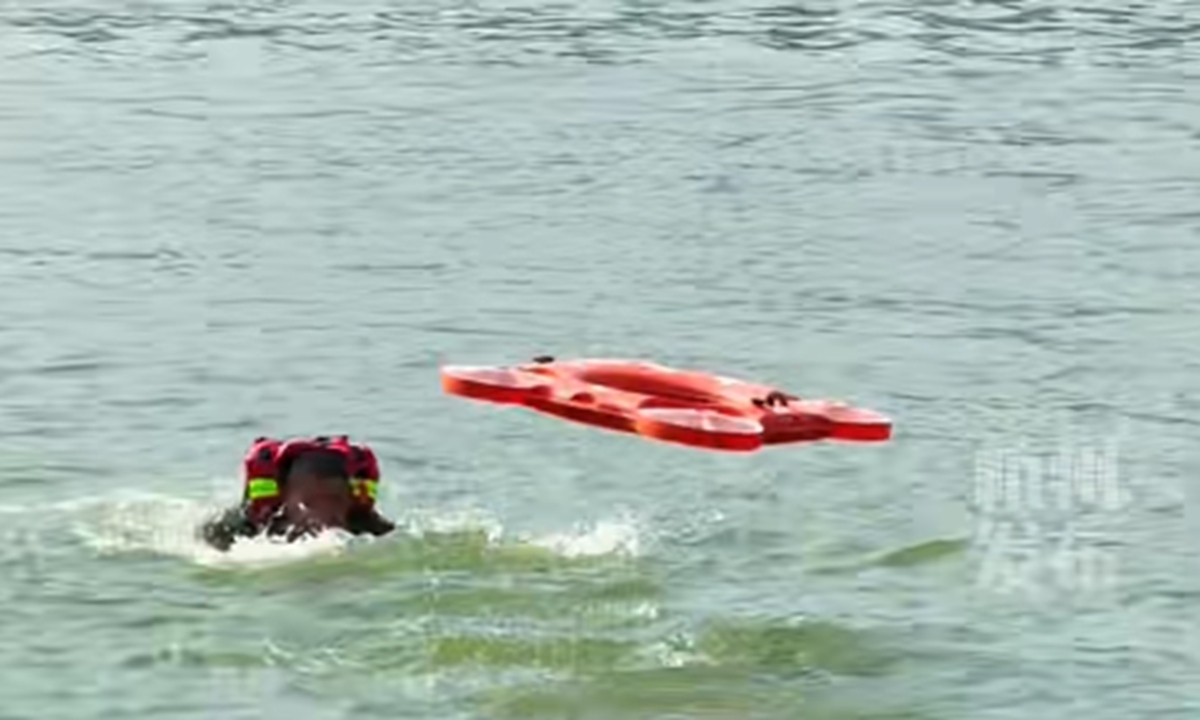
The "flying lifebuoy" debuts during a water rescue drill in Hangzhou, East China's Zhejiang Province. Photo: Official WeChat account of the Hangzhou government
A "flying lifebuoy" recently made its debut during a water rescue drill organized by police in Hangzhou, East China's Zhejiang Province, as the city explores multiple high-tech solutions to improve emergency response in water accidents. The device received praise from a Chinese Foreign Ministry spokesperson.According to a report posted on the official WeChat account of Hangzhou, an orange lifebuoy took off from the shore during the drill, flew toward a person who had fallen into the water, and landed on the water surface. Even when the person climbed onto it, the device remained stable and continued to float.
Minutes later, rescuers arrived and brought the person to safety. The lifebuoy then took off again and returned to its original location.
The device, officially called an AI intelligent flying rescue robot, is designed to provide rapid assistance in open waters where rescue boats may take time to arrive. Equipped with an autonomous navigation system, it can fly to people in distress, provide buoyancy support, and return automatically after completing its mission.
The drill featured multiple water rescue scenarios and tested several intelligent rescue technologies. Drones were used to drop inflatable lifebuoys above people in distress, which quickly inflate upon hitting the water to provide temporary buoyancy.
Another system combined an unmanned boat and drone for rescue operations in dangerous waters. The drone searches and locates people in need, while the boat navigates autonomously to assist the rescue. The drone can also provide lighting for nighttime searches, according to the report.
Chinese Foreign Ministry spokesperson Lin Jian highlighted in a social media post on August 14 that the AI-powered device is "technology that could help save lives."
Global Times
RELATED ARTICLES