ARTS / CULTURE & LEISURE
Chinese club AG.AL wins 2026 Esports World Cup as Macron hands over the trophy, 25 years after China’s first esports gold
Industry ecosystem becoming more mature: expert
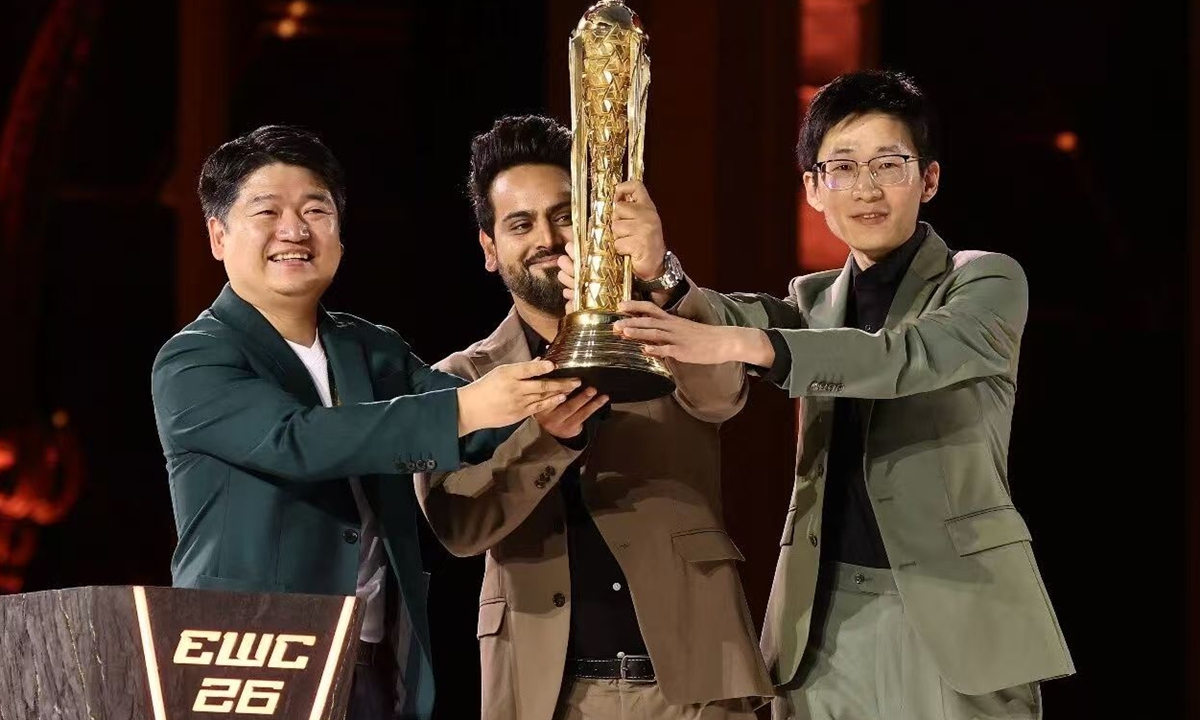
Photo: Courtesy of AG.AL
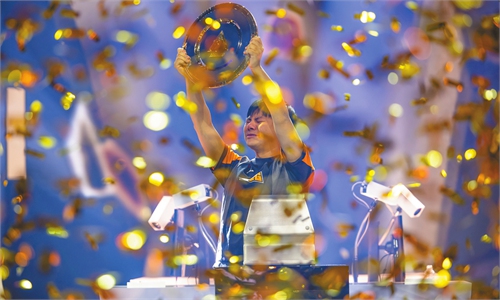
The 2026 Esports World Cup (EWC) concluded in Paris on Sunday local time, with Chinese esports club AG.AL (under Chengdu AG Esports Club) claiming the overall club championship. It became the first Chinese club to win the title since the tournament's launch, with French President Emmanuel Macron presenting the championship trophy.AG.AL's victory was not decided until the final stage of the competition. In the last event, Trackmania, French player Gwen held his nerve under pressure to claim the title, helping AG.AL overtake Saudi Arabian club Team Falcons in the standings and secure the overall championship.
This victory reflects a new trend in global esports competition: competition among top clubs is no longer determined solely by one popular game or a single star player, but by a club's overall capabilities in multi-title strategy, talent development and global operations.
For AG, the title was not just a last-minute breakthrough, but the result of a global strategy that had been developed over years.
"Although the tournament itself lasted only around two months, we had been preparing for it for more than two years," Chen Longsheng (EDDY), AG.AL VP&COO, told the Global Times on Monday. He said AG began expanding its overseas esports operations around the EWC in 2024, selecting promising players from around the world and now covering more than 20 esports titles.
This multi-title strategy is also closely linked to EWC's unique competition format. Unlike traditional esports tournaments that often focus on a single major game, EWC adopts a club-based ranking system covering multiple titles, including Honor of Kings, CrossFire, and Trackmania. AG.AL competed in more than 10 events, accumulating points across different competitions before completing its comeback in the final stage, according to AG.
Chen said the format has also changed how clubs evaluate the value of different esports titles.
"From our perspective, there is no absolute distinction between major and minor titles. As long as players in a game have the ability and passion, they can help the club earn valuable points," he said.
He noted that titles such as Tekken and Trackmania may have smaller audiences compared with some mainstream esports games, but outstanding players in these fields can still become important contributors to a club's championship ambitions because they offer the same opportunity to earn crucial points.
Under this new competitive environment, esports clubs are also shifting from building teams around a single title toward developing more diverse talent systems.
However, for an esports club competing on the global stage, finding the right players is only the first step. Building a stable team among players from different countries and regions, while ensuring smooth operations at international tournaments, also tests a club's management capabilities.
"Cross-border operations involve challenges including language communication, contract arrangements, legal regulations, and player support," Chen said. "Different countries have different legal environments and salary systems, and coordinating all of these issues is actually very complicated."
According to AG, during this year's EWC, staff members followed the teams throughout the process, from players' arrival in Paris, to training arrangements, communication with tournament organizers, post-match interviews and their departure.
"Fans see the players on stage, but behind them there are many operations staff ensuring that the entire team runs smoothly," Chen said.
AG's own development journey also reflects the changes that have taken place in China's esports industry over the past two decades.
In 2001, AG's predecessor won the StarCraft title at the World Cyber Games (WCG) Grand Finals, earning China's first world-level esports gold medal. Twenty-five years later, AG once again reached the top of an international competition. But the way esports is contested has changed dramatically - from battles centered around individual games to competition among global clubs based on talent, operations, and broader ecosystems.
"Over the past two decades, Chinese esports have gradually moved beyond the era when success depended mainly on individual players or a single game title, and developed into a more mature ecosystem involving clubs, professional leagues, content creation, commercial partnerships, and international exchanges," Shanghai-based esports commentator Natto told the Global Times on Monday.
According to Natto, the growing international presence of Chinese esports clubs also reflects a broader change in how the industry views overseas markets.
"Going global is not only about sending teams abroad to compete," Natto said. "It also means understanding different audiences, building communication channels and allowing more people to see the diversity of Chinese esports."
RELATED ARTICLES