Day 3 of World Humanoid Robot Games highlights speed, agility, stability
Rapid advances pave way for real-world applications
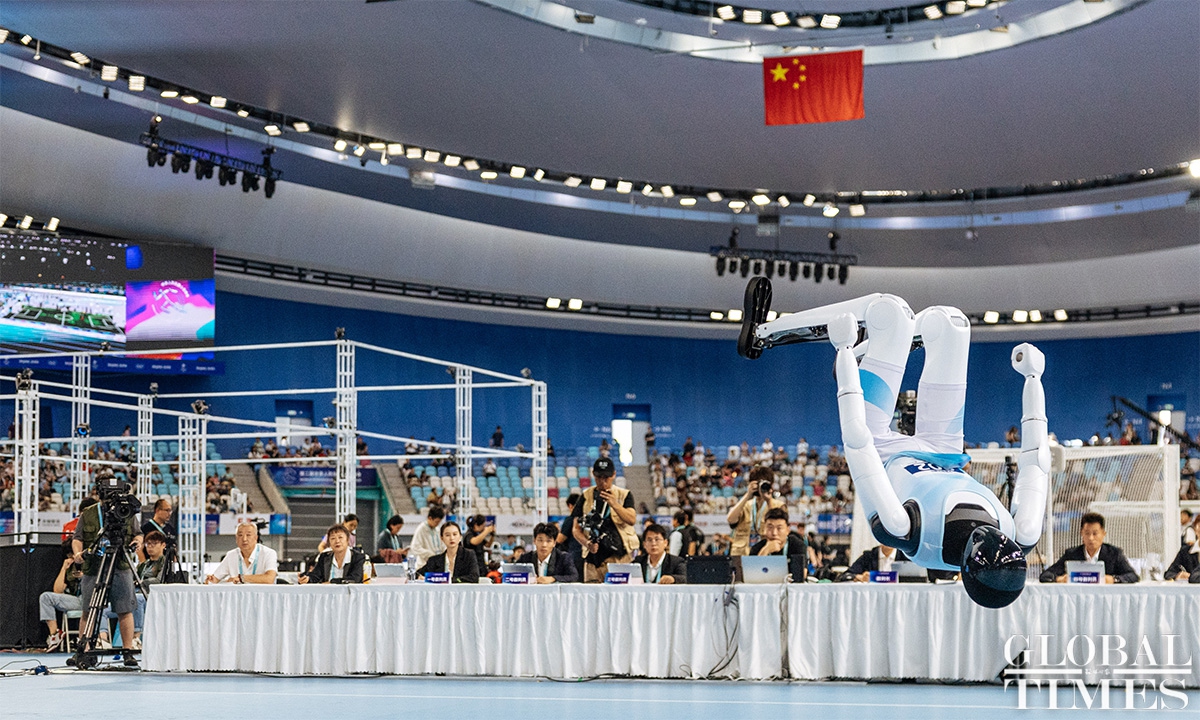
Photo: Li Hao/GT
The 2nd World Humanoid Robot Games (WHRG) continued in Beijing on Monday, with intense competitions across a wide range of sports - from obstacle races and gymnastics to table tennis and freestyle fighting - highlighting advances in the speed, agility, and stability of humanoid robots.
The highlights include TianGong Omni claiming another championship, while Tianjiao team won the 400-meter obstacle race in 4:11.44, following its victory in the 400-meter race a day earlier with its now-viral "shy face-covering" run. The Tianjiao team, powered by the Beijing Humanoid Robot Innovation Center, took the gold, followed by Shanghai-based AgiBot in second and the Tiangong team, also from the Beijing center, in third place.
Guo Yijie, head of the Innovation Humanoid Robotics Division at the Beijing Humanoid Robot Innovation Center and research and development (R&D) lead for TianGong Ultra and TianGong Omni, told the Global Times on Monday that after last year's Yizhuang Half Marathon, the team upgraded both the robots' hardware and software, with a focus on motion-control algorithms and training data to improve stability in complex environments.
The biggest challenge in the obstacle race is full-body control based on environmental perception, Guo said. The team trains the robots with human motion data, allowing them to adjust their posture based on their surroundings and recover from disturbances. Falling is normal in competition, he said, adding that the robot's ability to quickly get back on its feet after a fall is also part of its training.
Besides the 400-meter obstacle race, the freestyle gymnastics final also saw a gold medal awarded, with the Galaxea team taking first place, followed by Ningxia AgiBot and Beijing AgiBot. Meanwhile, competitors in table tennis, a sport that made its debut at this year's Games, advanced from the group stage to the knockout rounds.
Tang Minqin, head of the table tennis competition organizing committee, told the Global Times that table tennis was introduced as a formal event because it presents an unusually high challenge for humanoid robots. A robot has to perceive, predict, make decisions and swing within about 0.3 seconds, making the sport a strong test of both its "brain" and motion-control capabilities.
Tang said that all 12 teams competed using the same 1.73-meter humanoid robot platform, putting the focus on algorithms and artificial intelligence (AI) decision-making rather than hardware. With no remote control, scripts or preset actions, the robots had to make decisions autonomously during matches. The teams had less than three months to train after the event was officially added in June, making this year's competition particularly challenging.
Tang said that the value of robot table tennis goes beyond the sport itself. Training robots to perceive a fast-moving ball, make split-second decisions and coordinate their movements can also help develop their capabilities for real-world tasks. "If these training methods can teach a robot to play table tennis, they can also potentially be transferred to industrial scenarios," Tang said.
At the freestyle fighting competition, multiple finals were held in the 58-kilogram and 40-kilogram categories. The Global Times observed intense and fierce bouts, with some robots suffering damaged limbs, including broken arms and legs, yet still getting back up and continuing to fight. Interestingly, some robots appeared to be "knocked out" — after getting back on their feet, they struggled to locate their opponents and ended up wandering out of the arena.
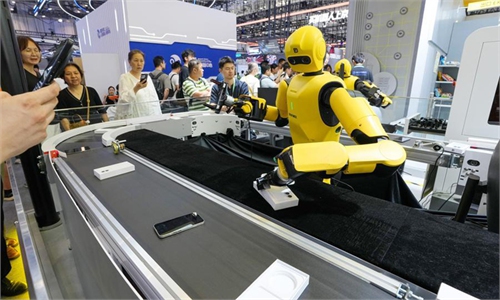
Beyond sports, robots are also being put to work. In the scenario-based events, dexterous hands compete in tasks such as fastening and unpacking, while robots take on packaging and warehouse stocking in industrial settings and a range of service tasks in office environments.
Liu Shaoshan, executive director of the Embodied Intelligence Center Shenzhen Institute of Artificial Intelligence and Robotics for Society, told the Global Times that this year's gains in humanoid robots' athletic performance reflect advances in joint power density, lightweight design, dynamic balance, whole-body control and high-speed movement.
"Last year's best 100-meter time was 21.50 seconds. This year, robots have entered the nine-second range. The pace of iteration is remarkable," he said, adding that robots are also becoming faster and more stable in obstacle events.
But competition results do not equal commercial readiness, Liu said. "A robot running 100 meters in under 10 seconds doesn't mean it can work reliably in a factory for eight hours. Commercialization ultimately comes down to reliability, task success, generalization, safety and cost - not peak demo performance."
Li Jian, a professor of the School of Intelligent Engineering and Automation at Beijing University of Posts and Telecommunications, told the Global Times that many humanoid robots are still mainly used for competition and demonstrations, with high upfront R&D investment and relatively high unit costs.
Widespread adoption will require lower costs, greater robustness and clearer regulatory pathways. Real-world environments are far more complex than competitions, and robots must withstand long-term operation and unexpected situations. "It will still take time for humanoid robots to truly enter homes on a large scale," said Li.
RELATED ARTICLES