Nvidia wants to ‘copy China’s homework’ and we welcome it: Global Times editorial
Nvidia Photo: VCG
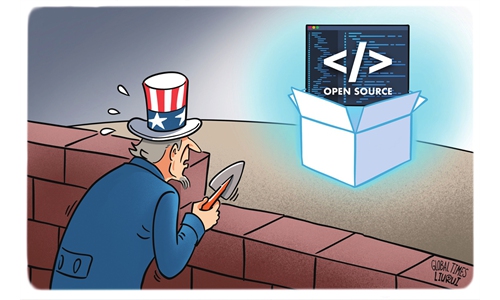
While the US is still debating whether "openness is safe," China is building an open, low-cost and decentralized AI ecosystem around the world. This openness reflects a deeper understanding of the very nature of technology. In this sense, if Nvidia treats open source merely as a marketing tool for generating chip orders rather than genuinely committing to building an open, collaborative ecosystem, then the "American DeepSeek" may well turn out to be nothing more than an expensive shell.
Several US media outlets recently reported that Nvidia is spending $6 billion to build one of the world's most powerful open-weight AI models, in a bid to compete with Chinese heavyweight models such as DeepSeek and Kimi K3. One of the key contexts behind this move is that most US AI giants have poured far more resources into closed AI models, while the tremendous success of China's open-source models has sparked significant anxiety within the US, making "whether to pivot to open source" a heated topic of debate in the industry. Therefore, Nvidia's turn toward open-weight models has attracted attention.
Admittedly, Nvidia's primary motivation is to enter the open-source arena in the face of intense competition, support startups, and thereby secure more chip orders. But objectively speaking, the move is also a sign that the myth of closed-source AI in the US is being further shattered. Previously, the US AI industry was dominated by closed models, with OpenAI, Anthropic, and Google controlling the closed-source ecosystem. Before the emergence of China's DeepSeek, the market firmly believed that closed source AI is the future.
When Chinese open-source models burst onto the scene with low cost, customizability, and local deployability, developers and businesses worldwide suddenly woke up to just how significant the drawbacks of the closed-source models really are. Thus, Nvidia's $6 billion bet on open-source models has led some media to dub it an attempt to build an "American DeepSeek."
Notably, the debate over open versus closed source within the US is evolving from a dispute over technical approaches into a contest over strategic direction. Some US political elites and security bureaucrats still cling to the Cold War mentality that "control means security," trying to lock AI technology within their own camp through export controls and investment screening.
OpenAI and Anthropic are lobbying vigorously in Washington, urging restrictions on Chinese open-source models and hyping the false narrative of "distillation" - essentially using national security as an excuse to mask their commercial monopoly interests. Because once open-source models match or even surpass closed-source models in performance, their subscription models and application programming interface businesses on which they depend on will face a fundamental challenge.
However, faced with China's open-source approach and its increasingly strong capacity for independent innovation, a growing number of people in the US technology industry are realizing that the containment strategy will not only fail to curb the growth of China's open-source ecosystem, but will also cause the US to lose its own competitive edge.
Not long ago, Nvidia CEO Jensen Huang took the rare step of spearheading an open letter on the social media platform in support of open source, prompting Microsoft, Google, Meta and other major players in the industry to publicly voice their support. Several US tech companies have also established the Open Secure AI Alliance (OSAA), which reportedly now has more than 230 members. All of this reflects a broader shift in thinking across the US tech industry.
In a sense, Nvidia's $6 billion bet on open source is essentially adding fuel to the open-source movement in the US tech industry. From the attention sparked by DeepSeek to the debut of flagship models such as GLM-5.2 and Kimi K3, the global open-source AI ecosystem, driven largely by Chinese companies, has demonstrated the resilience of this approach and the strength of its development capabilities.
In the long run, a thriving open-source community depends on broad participation, transparent mechanisms for collaboration and low barriers to access - not monopolistic investment by any single tech giant. For Nvidia, therefore, whether this money is well spent will depend on chip sales in the short term, model performance in the medium term, and, in the long term, whether it can truly understand the logic of open source. If Nvidia treats open source merely as a marketing tool for generating chip orders rather than genuinely committing to building an open, collaborative ecosystem, then the "American DeepSeek" may well turn out to be nothing more than an expensive shell.
Even so, we welcome Nvidia "copying the homework." The value of AI technology lies in making it widely accessible, not keeping it locked away. While the US is still debating whether "openness is safe," China is building an open, low-cost and decentralized AI ecosystem around the world. This openness reflects a deeper understanding of the very nature of technology. Today, open-source models have attracted an ever-growing number of developers worldwide, while countries across the globe are developing their own large language models based on open-source technologies from China. China has demonstrated through concrete actions that openness does not weaken competitiveness; on the contrary, it can give technology greater vitality. As more and more countries choose to join the open ecosystem, the "small yard, high fence" approach will ultimately be swept away by the tide of the times.
The ultimate significance of AI lies in enabling every individual and every country to share equally in the benefits of technological progress. From this perspective, open source is not merely a technological approach, but also a choice of values.
In the race of open source, the judges are not a handful of Silicon Valley giants, but are the choices of countless developers and users around the world. Nvidia's decision to "copy China's homework" is certainly worth watching, but what matters even more is that a growing number of participants are proving through their actions that openness is the future of AI.
RELATED ARTICLES