US so-called ‘overcapacity’ tariffs can’t fix productivity woes: Chinese experts
Washington should look inward rather than blame China: analysts
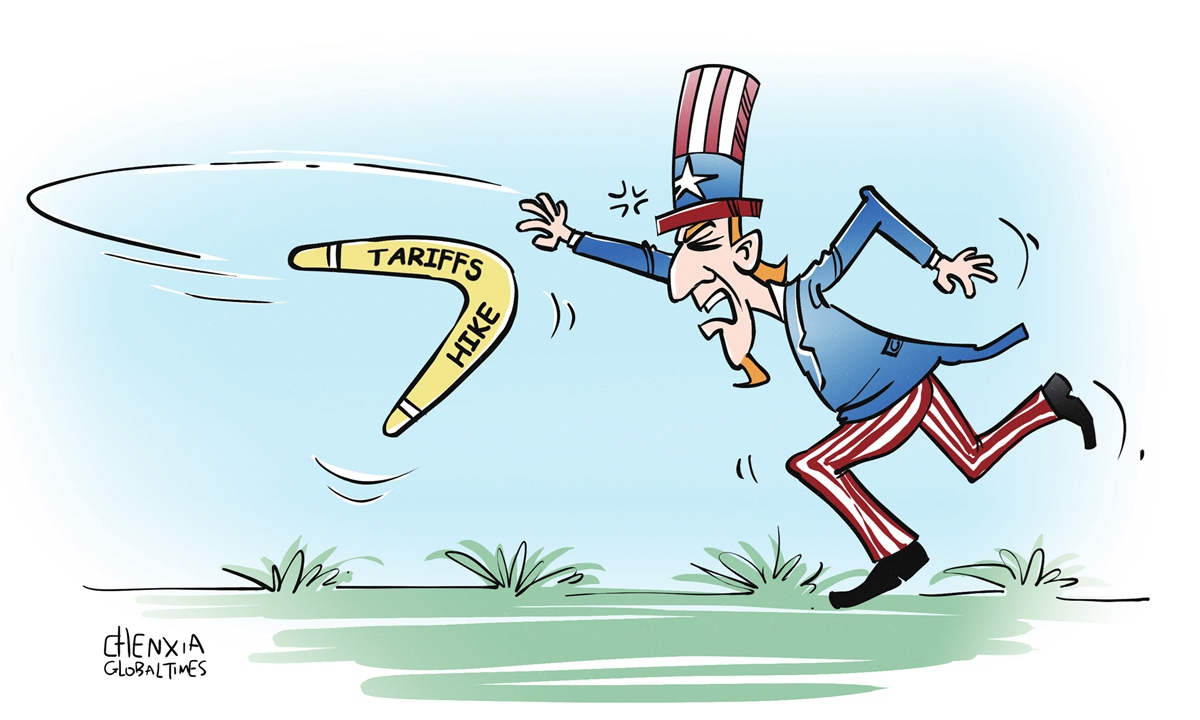
Illustration: Chen Xia/GT
Chinese experts on Tuesday urged the US to recognize the basic economic reality that tariff barriers cannot solve its productivity problems and to allow US companies to share in the opportunities created by China's manufacturing development. They said the US' sizable trade deficits with multiple major trading partners should prompt Washington to recognize that the problem lies at home, rather than continue hyping the so-called issue of Chinese "overcapacity."
The remarks came as Washington was reportedly considering another 7.5 percent tariff on Chinese goods under the pretext of so-called "overcapacity," a move that would once again put Washington at odds with the interests of both US consumers and industries.
According to a report by Bloomberg on Monday, the US is set to impose a 7.5 percent tariff on Chinese goods over allegations of so-called excess manufacturing capacity again, according to people familiar with the matter.
Notably, the reported additional tariff would bring US tariffs on Chinese goods to the ceiling Washington committed to during China-US economic and trade consultations.
During the China-US economic and trade consultations, the US side explicitly committed that the replacement tariffs on Chinese goods would not exceed 20 percent. At present, the replacement tariffs imposed by the US side on Chinese goods stand at 12.5 percent, according to China's Ministry of Commerce (MOFCOM).
The move would restore duties on China to around 20 percent, Bloomberg said.
Exact rates have yet to be finalized, said the people, who spoke on condition of anonymity, said Bloomberg. The US administration is also known to make last-minute demands or changes to trade announcements.
One option under consideration is announcing a higher duty rate for China but suspend part of it in order to reduce the effective [additional] rate to 7.5 percent, a person familiar with the deliberations said, per Bloomberg.
Although the unconfirmed report suggests that the final tariff rate may not exceed the 20 percent ceiling Washington committed to during China-US economic and trade consultations, if true, the move would represent yet another typical trade barrier reflecting an irrational approach to international commerce, He Weiwen, a senior fellow at the Center for China and Globalization, told the Global Times on Tuesday.
When it comes to maintaining a tough stance on trade with China, Washington has clearly not shed its bias against China, with political considerations continuing to override economic and market realities, He Weiwen noted. What warrants vigilance, therefore, is that regardless of the pretext or timing of any new tariff measures, Washington's policy objective of maintaining trade barriers against China remains clear, and China should be prepared to respond, He Weiwen stressed.
In recent months, the US has repeatedly hyped up the so-called issue of Chinese "overcapacity," while continuing to ignore its persistent trade deficits with multiple economies and reliance on imports, he said, adding that blaming Chinese products on the grounds of "overcapacity" has become increasingly difficult to justify, while doing little to address the structural imbalances within the US economy itself.
According to official US data, the US goods trade deficit with Mexico reached $196.9 billion in 2025, followed by $178.2 billion with Vietnam, $114.2 billion with Ireland, $71.9 billion with Thailand and $58.2 billion with India, with all five deficits hitting record highs.
Manufacturing's share of US GDP also showed no improvement last year despite Washington's aggressive use of tariffs. According to official US data, the share remained below 10 percent throughout 2025.
Chinese authorities have already made their position clear on the so-called "overcapacity" issue.
The MOFCOM previously released a report further elaborating China's position on the so-called "overcapacity" issue.
The report said some economies, concerned about their own industrial competitiveness and market position, have politicized trade issues and hyped-up China's so-called "overcapacity" as a pretext for further restrictions. China maintains that capacity issues should be viewed objectively and comprehensively, warning that protectionism would disrupt global trade, destabilize supply chains and pose long-term risks to global growth, the report said.
Chinese experts urged Washington to view the global division of labor in a more objective and rational manner, recognize that tariffs cannot enhance productivity, and pursue greater multilateral cooperation. They said participating in and sharing the opportunities created by China's manufacturing development could also offer US manufacturers a practical path to improve competitiveness and expand growth opportunities.
China's position on China-US economic and trade issues is consistent and clear. "We oppose all forms of unilateral tariffs. Tariff wars and trade wars serve no one's interests," Chinese Foreign Ministry spokesperson Lin Jian told a press conference on July 24.
RELATED ARTICLES