Has China ‘squeezed’ the industrialization paths of Asian countries?: Global Times editorial
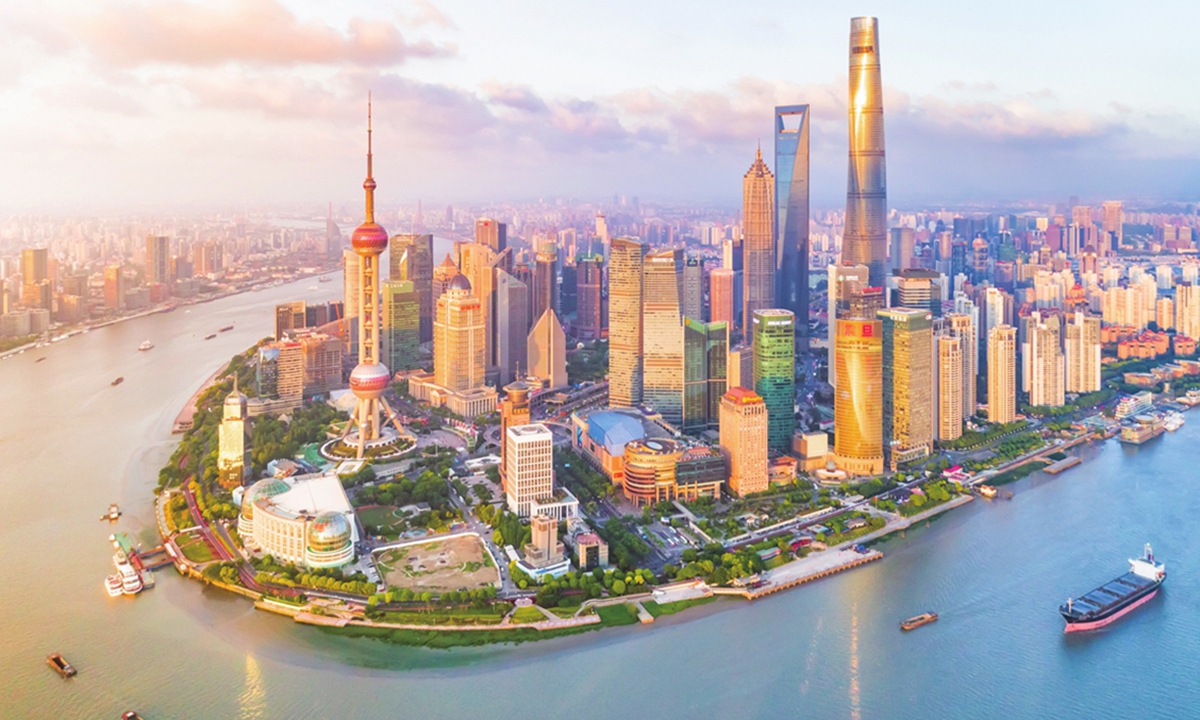
A view of Shanghai Photo: VCG
Editor's Note:
Currently, China's economy is steadily advancing along the path of high-quality development, even as domestic and international circumstances become increasingly complex. Some Western media, due to misunderstanding or bias, have repeatedly questioned or even distorted China's economic development. Accordingly, the Global Times launches the "Q&A on China's Economy" column to publish opinion pieces to present facts and clarify perceptions.
Recently, a Western scholar published a commentary in Singapore's The Straits Times arguing that China has broken the "flying geese model," under which advanced countries transfer labor-intensive industries to late-developing countries. By retaining lower- and middle-end industries while simultaneously pushing into high-end sectors, the scholar argues, China has closed other Asian countries' path to industrialization. The article invokes the "China squeeze" theory, portraying China as an "economic behemoth" that "monopolizes the benefits while leaving little room for others."
The "flying geese model" was proposed in 1932 by Japanese economist Kaname Akamatsu. The theory compares regional economic development to the V-shaped flight formation of geese: the lead goose, representing an advanced country, transfers mature industries and technologies to the less-developed countries that follow, driving a step-by-step division of labor and industrial upgrading across the region. The theory gained widespread recognition after World War II as Japan and the "Four Asian Tigers" continued to rise. Recently, however, some Western scholars have invoked the "flying geese model" to explain Asia's industrial landscape, characterizing China's failure to immediately and completely withdraw from mature, lower-end industries as having "broken the flying geese model," and then claiming that China is dominating both the lower and middle ends while monopolizing the high end.
In fact, a look at the growth of Asian economies in recent years is enough to debunk this argument. If China were truly "crowding out" the development of neighboring countries, the share of manufacturing in their economies and the growth of their exports should have been declining. The reality is precisely the opposite. Manufacturing exports from later-developing Asian countries such as Vietnam, Cambodia and Bangladesh have continued to grow, in many cases at a rapid pace. In 2025, Vietnam's GDP grew by 8.02 percent, with manufacturing value added accounting for 24.53 percent of GDP. Manufacturing was likewise a key driver of Indonesia's 5.11 percent GDP growth in 2025. Malaysia's manufacturing sector accounts for 22.1 percent of GDP, well above the global average. Cambodia's garment exports grew by 16.88 percent in 2025, the fastest growth rate among Asia's major garment exporters. Judging from the actual industrial performance of these countries, where exactly is the evidence that they have been "crowded out"?
There is another fact that many people overlook: China's manufacturing sector is becoming deeply interconnected with those of other countries in entirely new ways. As the world's largest producer of upstream textile materials, footwear materials and related inputs, China has long maintained a high share of exports of these components to lower- and middle-income countries. The fabrics used by garment factories in Vietnam come from East China's Zhejiang Province; the soles used by shoe factories in Bangladesh come from southeast China's Fujian Province; and the zippers used by backpack factories in Cambodia come from Yiwu, a city in Zhejiang. China's industrial upgrading has not "crowded" other countries out of the industrialization process. On the contrary, it has helped them integrate into a vast regional production network, giving them development opportunities to participate in the global division of labor that would have been difficult to imagine in the past.
Within this Asian supply and production network, China's role is not to crowd others out, but to enable them. In 2025, the total value of trade between China and ASEAN reached 7.55 trillion yuan ($1.12 trillion), up 8 percent, making them each other's largest trading partner for the fifth consecutive year. Intermediate goods accounted for more than 60 percent of bilateral trade. This means that as ASEAN countries develop their manufacturing sectors, large quantities of raw materials, components and semi-finished products are imported from China. The division of labor is clear: China supplies intermediate goods, ASEAN handles processing and assembly, and the finished products are shipped to global markets. At the same time, Chinese companies are setting up factories across ASEAN member states, bringing with them capital, technology, management expertise and supply-chain support - precisely what late-developing countries need most for economic growth and industrial upgrading.
Portraying China's development as an "obstacle" to its neighbors is itself a product of zero-sum thinking. This view assumes that the "pie" of global industrialization is fixed, so that every additional slice consumed by one economy leaves less for others. The reality is that China's industrial upgrading is continually making the entire pie bigger. China needs to import more resources, agricultural products and basic manufactured goods from ASEAN; Chinese companies expanding overseas need local suppliers and labor; and Chinese consumers need more goods and services from across Asia. The continued growth of ASEAN exports to China clearly demonstrates the enormous demand generated by China's industrial upgrading.
Conversely, if any Asian country were to fall for the "China squeeze" narrative and even voluntarily abandon China as its largest supplier of intermediate goods, source of investment and neighboring market, the result could only be higher manufacturing costs and weaker competitiveness. Asian countries understand this clearly. Rather than rejecting cooperation with China, they are actively engaging with RCEP and deepening their economic and trade ties with China. They know that becoming deeply integrated with China, the world's largest manufacturing system, is a shortcut to industrialization, not an obstacle.
RELATED ARTICLES