Strategic continuity and continuous innovation enable China to develop: French scholar
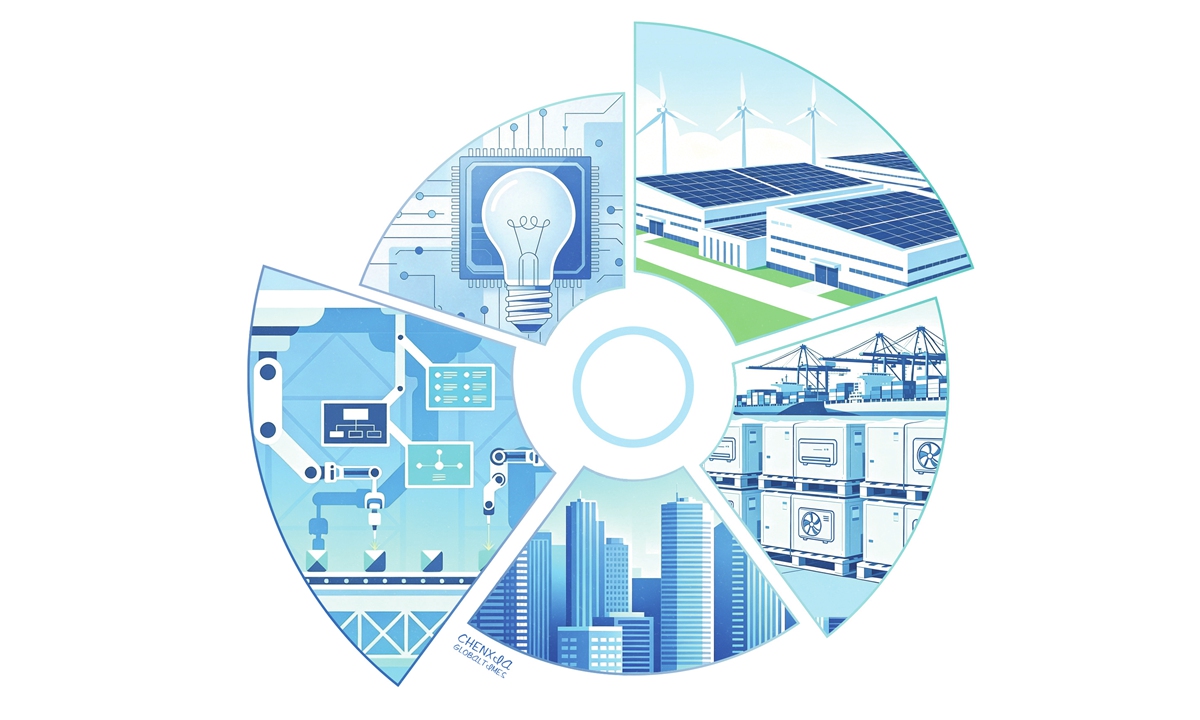
Illustration: Chen Xia/GT
Editor's Note:The year 2026 marks the commencement of China's 15th Five-Year Plan (2026-30), a pivotal phase in the nation's medium- to long-term development. A successful venture starts with a good plan and with clear goals set. At this critical juncture, where a profound restructuring of the global order converges with a tipping point in the technological revolution, China's five-year plan is poised to inject momentum and certainty into global development, charting a steady course for the new journey ahead.
In its newly launched "New Blueprint, New Opportunities" series, the Global Times (GT) invites Nobel laureates in economics, former central bank governors, core decision-makers of international organizations and renowned economists from countries with diverse civilizations, different economic systems and stages of development to deeply analyze how the 15th Five-Year Plan will reshape the underlying logic of China's interaction with the world and to explore the "anchor of certainty" and "new paradigm of development" this plan offers to a turbulent world.
In the 10th installment of the series, GT reporter Ma Ruiqian talked to Herve Azoulay (Azoulay), a professor at France's Silk Road Business School. Azoulay shared his insights on China's manufacturing transformation driven by new quality productive forces, as well as the prospects for China-Europe green and digital industrial cooperation during the 15th Five-Year Plan period.
GT: China aims to achieve greater self-reliance and strength in science and technology, and steer the development of new quality productive forces during the 15th Five-Year Plan period. Could you share your views on the broader trend of how China is reshaping its traditional industrial system and driving an overall upgrade of its productive forces?
Azoulay: In my view, the 15th Five-Year Plan represents far more than an economic blueprint. It marks a new stage in China's development, reflecting its transition from being the world's largest manufacturing powerhouse to becoming a leading global innovation-driven economy.
The real breakthrough lies in the emergence of what China defines as "new quality productive forces." The objective is no longer simply to produce more, but to produce smarter - by integrating scientific knowledge, technological innovation, data, software, artificial intelligence and highly integrated industrial value chains.
What impresses me most is China's ability to modernize its traditional industries simultaneously. Steel, petrochemicals, machinery, textiles and heavy manufacturing are progressively becoming digital, intelligent and low-carbon industries. Few countries have demonstrated such an ability to transform their industrial base while preserving large-scale manufacturing capacity.
This transformation also reflects a distinctive model of economic governance. China is not merely fostering technological champions; it is building a comprehensive innovation ecosystem where fundamental research, universities, digital infrastructure, private enterprises, financial institutions and public policies evolve in a coordinated manner toward common long-term objectives.
This strategic coherence is, in my opinion, one of China's greatest competitive advantages for the coming decades.
GT: Europe has recently been hit by extreme heat wave, leading to a surge in demand for Chinese air conditioners. Rather than relying on low prices, these exported products are increasingly tailored to local market needs with energy-efficient and customized innovations. What does it reveal about the strengths of Chinese manufacturing, and how could it help drive the transformation and upgrading of China's manufacturing sector during the 15th Five-Year Plan period?
Azoulay: The recent surge in European demand for Chinese air conditioners offers an excellent illustration of the profound transformation taking place within Chinese manufacturing.
For many years, China's competitiveness was primarily associated with cost efficiency. Today, however, competition increasingly revolves around innovation, energy efficiency, product quality, design, customization and integrated digital services.
European consumers are no longer just purchasing an air conditioner; they are looking for intelligent, energy-efficient solutions that comply with increasingly demanding environmental standards while improving comfort and reducing energy consumption. Chinese manufacturers have clearly understood this shift.
We are witnessing the gradual evolution from "Made in China" to "Innovated in China." Several structural advantages explain this transition. China combines exceptional industrial capabilities, one of the world's most integrated supply chains, a vast domestic market that allows rapid commercialization of new technologies, and continuously increasing investment in research and development.
China's future competitiveness will increasingly depend not on lower production costs but on its ability to create technological value, deliver innovative solutions and respond rapidly to changing customer needs around the world.
GT: As China enters the high-quality development stage of the 15th Five-Year Plan, where do you see the greatest potential for complementary strengths and win-win cooperation between China and Europe?
Azoulay: Having spent many years in executive positions at Schneider Electric, I have always considered China-Europe cooperation to be fundamentally based on complementarity rather than competition.
Today, China offers a unique industrial ecosystem, a vast and sophisticated domestic market, strong innovation capabilities and an exceptional speed of execution. Europe, in turn, brings recognized strengths in advanced industrial equipment, energy technologies, engineering excellence, complex systems integration, industrial software and environmental technologies.
In my view, the fundamental attractiveness of the Chinese market does not lie only in its scale. It lies even more in its unique capacity to transform innovation into large-scale industrial application at unprecedented speed. China is not only a market; it is also a global laboratory for industrial transformation.
Looking ahead, China-Europe cooperation will increasingly shift from traditional trade relations toward co-innovation, joint research, industrial partnerships and the co-development of international technological standards.
This evolution is essential in a world where technological transitions are accelerating and where no single region can independently master the full complexity of global industrial systems.
GT: You have previously remarked that China possesses a unique ability to maintain continuity amid change. In the context of the transformation envisioned under the 15th Five-Year Plan, how would you characterize the aspects of China's economic development that are changing, and those that remain unchanged?
Azoulay: I have often described China's development trajectory as a rare ability to preserve continuity while embracing profound change. This duality remains one of the most distinctive features of China's economic governance. The 15th Five-Year Plan clearly illustrates this dynamic.
What is changing is the underlying growth model. China is gradually transitioning from an economy driven primarily by investment, real estate and exports toward one increasingly powered by innovation, advanced manufacturing, domestic consumption, high-value services and green development. Enterprises are accelerating their digital transformation, investing heavily in artificial intelligence, strengthening their R&D capabilities, and developing more sustainable and technology-intensive business models.
At the same time, several fundamental pillars remain unchanged. These include long-term strategic planning, the guiding role of public policy in setting development priorities, a strong emphasis on education and human capital, social stability and coordinated regional development. This combination of long-term vision and adaptive transformation reflects a deeper cultural and institutional logic. In many ways, it echoes a classical principle of Chinese thought: adaptation ensures continuity and continuity enables resilience over time.
In today's world, characterized by geopolitical uncertainty, technological disruption and climate challenges, this ability to combine strategic continuity with continuous innovation represents a significant asset. It enables China not only to sustain high-quality development, but also to contribute meaningfully to a more balanced, stable and cooperative global economic order.
RELATED ARTICLES