China earthquake authority says institute violated rules over false magnitude-7.7 alert
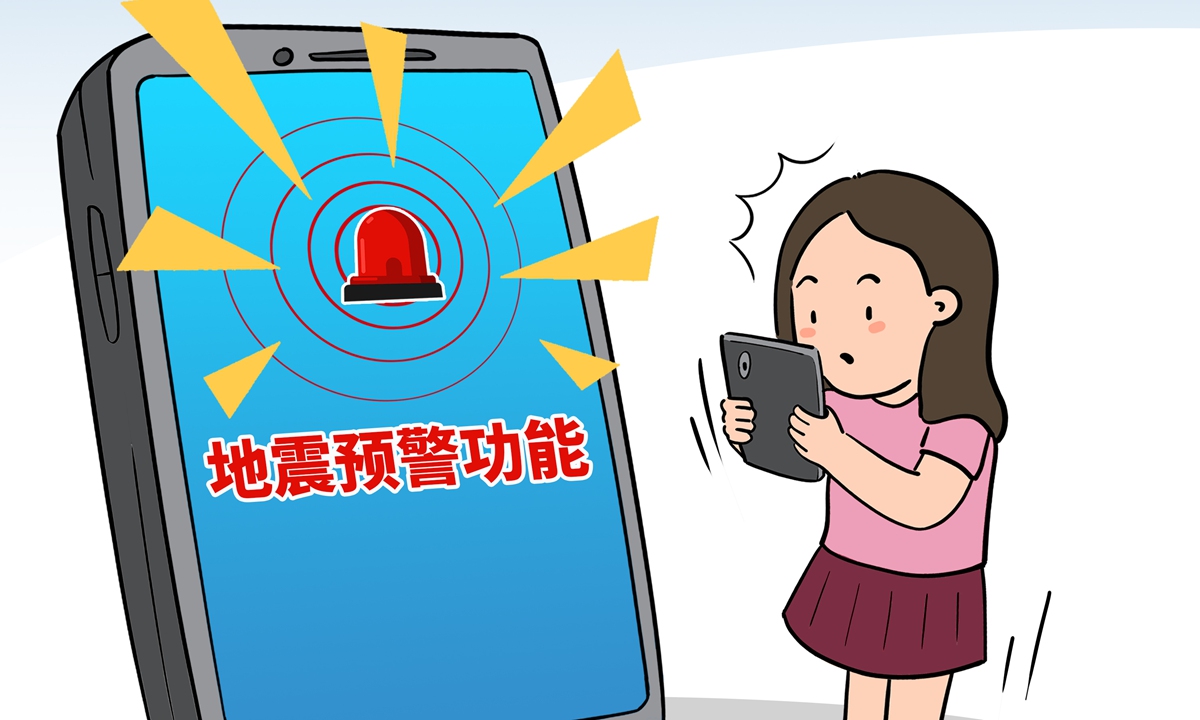
Picture of an earthquake alert. Photo: VCG
After a Chengdu-based institute mistakenly issued a magnitude-7.7 alert for an earthquake later measured at magnitude 4.7, the China Earthquake Administration (CEA) said in a statement on Wednesday that the institute had repeatedly issued earthquake early warnings to the public in violation of regulations. The administration had held talks with the institute multiple times and ordered it to rectify the violations, but it failed to make the required corrections.
A 4.7-magnitude earthquake struck Yibin at 8:26 am on Monday, according to the China Earthquake Networks Center. Six seconds after the earthquake struck, the China Earthquake Early Warning Network sent official alerts to more than 10 million users in areas surrounding the epicenter through channels including WeChat mini-programs, Huawei and Xiaomi smartphones, and dedicated earthquake early-warning terminals, the CEA said.
However, After the earthquake, the Institute of Care-life used its own system without authorization to generate an alert that incorrectly reported a magnitude-7.7 earthquake in Changning.
The institute then distributed the alert nationwide under the name of the China Earthquake Early Warning Network through Honor, vivo and Meizu smartphones, as well as Xiaotiancai smartwatches, in violation of relevant regulations, drawing widespread public attention, said the CEA.
The CEA said that under China's Law on Protecting Against and Mitigating Earthquake Disasters, information about earthquakes must be released by earthquake authorities.
Earthquake authorities have been expanding access to earthquake early-warning services while allowing third-party organizations to participate under regulatory oversight. Third-party providers that pass technical assessments and trial operations may sign agreements with earthquake authorities to distribute alerts generated by the China Earthquake Early Warning Network.
So far, earthquake authorities have signed such agreements with 30 companies and organizations, including Huawei, Xiaomi and Tencent, as well as several radio and television operators.
The Institute of Care-life signed agreements to distribute earthquake early warnings in Sichuan and Xinjiang effective from 2023 and 2025, respectively. Under the agreements, the institute was only authorized to distribute alerts generated by the China Earthquake Early Warning Network and it had no such agreements with earthquake authorities in other provincial-level regions, said the CEA.
However, the institute has repeatedly distributed alerts generated by its own system. Since the beginning of 2026, it has issued such unauthorized alerts on multiple occasions in Zhejiang, Shaanxi, Ningxia, Shanxi and Henan, according to the authorities.
Earthquake authorities had held talks with the institute and ordered it to rectify the violations. After it failed to make the required corrections, the Sichuan Earthquake Administration terminated its agreement with the institute on July 22, ending its authorization to distribute earthquake early-warning information.
The CEA said that 27 provincial-level regions, including Sichuan, Chongqing, Guangdong and Shaanxi, have introduced regulations stipulating that earthquake early warnings must be issued through a unified system by provincial earthquake authorities. No organization or individual is allowed to independently release such alerts to the public.
To regulate third-party services, earthquake authorities have established technical assessment and access procedures, strengthened oversight and introduced measures to address violations. Third-party providers are required to undergo technical testing and assessment before gaining access to the official early-warning system, while their services are subject to regulatory monitoring.
The CEA said it is also working to strengthen national rules and technical standards governing such services. Both earthquake authorities and their third-party partners are prohibited from charging the public for earthquake early warnings.
The administration reminded the public to obtain authoritative alerts through official channels, including WeChat mini-programs operated by the China Earthquake Networks Center and provincial earthquake authorities. Official alerts are also available through IPTV and other broadcasting services in some regions.
After the false alarm, the Institute of Care-life made an apology for the inaccurate alert and said it would investigate the cause as soon as possible while improving its technology and services.
Addressing the significant discrepancy, the institute said on Monday that deviations in estimates of an earthquake's magnitude and epicenter are inevitable to some extent, as early-warning information is generated automatically shortly after a quake begins, before the seismic event has ended.
Global Times
RELATED ARTICLES