Robotics Illustration: Liu Xiangya/GT
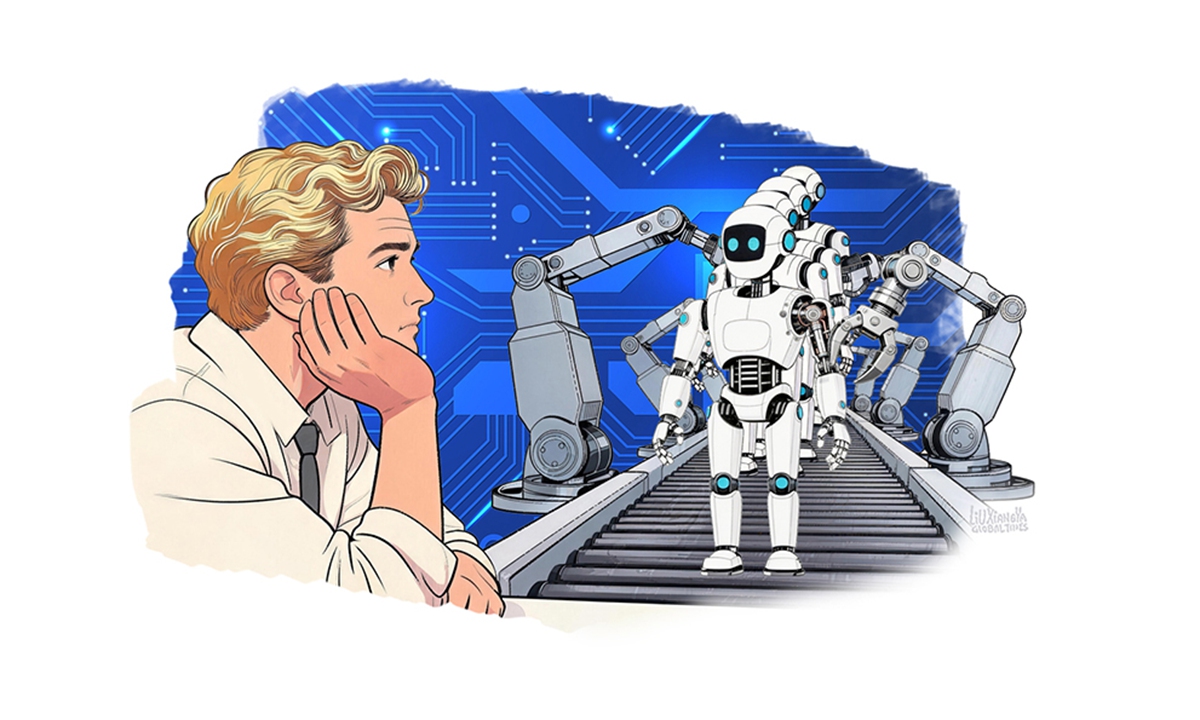
Is America's robotics industry facing a "Made in China" problem? The question has gained attention as the US moves to accelerate the development of humanoid robots and artificial intelligence (AI)-powered machines.
In a warehouse in an industrial park on suburban Long Island, 30-year-old Teddy Haggerty is trying to pull off what appears to be a "quixotic task" - producing humanlike robots in the US, The New York Times reported earlier this month. The report noted that "building a robot entirely free of Chinese parts was not practical."
Some recent Western media reports have raised questions about whether China's role in robotics supply chains could pose a potential challenge for the US industry.
Business Insider reported on Tuesday that robotics leaders in the US have pointed to sourcing physical components for robots - including motors, chassis, batteries, sensors and other materials - as a major bottleneck as the industry scales, with companies often relying on China to bridge supply gaps.
But this is not a "Made in China" problem. Humanoid robots are built on a complex network of suppliers, components and manufacturing capabilities built across borders. If the US seeks to build a modern robotics industry by separating itself from the global manufacturing networks that enable more efficient production, it risks limiting its own ability to scale the industry.
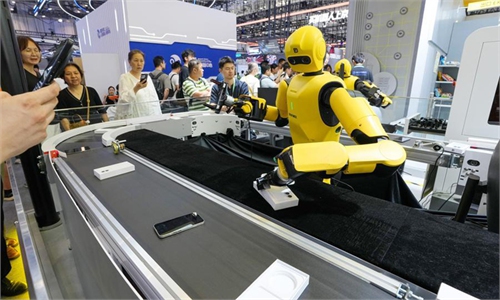
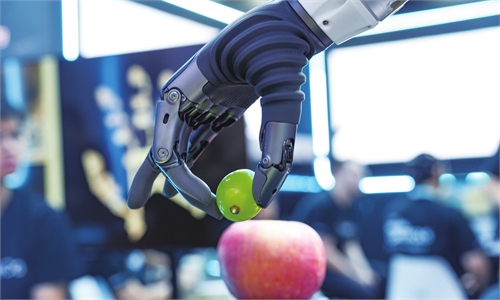
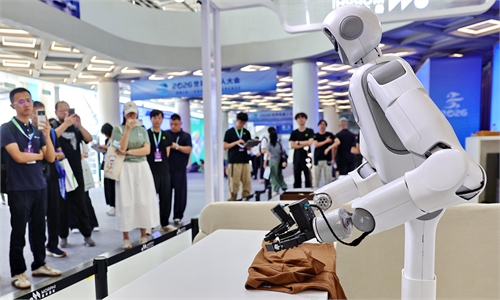
A look at China's robotics sector offers a different perspective. The second World Humanoid Robot Games, held from August 22 to 26 in Beijing, has drawn attention to a wide range of robots. Behind this fast-growing field is a large manufacturing base and an efficient supply chain that have helped bring down the cost of building robots. That has made it possible for smaller companies, start-ups and even grass-roots teams to build and test their own machines.
In recent months, some Chinese robots have even become online sensations. Some are small and far from the top performers in competitions, but their friendly designs have made them look like "robot children" to many viewers. Their popularity points to something broader: China's robotics ecosystem has a relatively low barrier to entry, allowing more people and companies to try new ideas.
That kind of activity is supported by a flexible supply chain and low production costs. Components are readily available, designs can be tested, and manufacturers can adapt to the needs of smaller players. These capabilities did not emerge overnight. They are the product of decades of manufacturing development and the industrial networks built up along the way.
China's manufacturing capabilities can serve as a valuable resource for the global robotics industry. They are also an important part of the broader global supply chain, providing the scale, the efficiency and the flexibility that help companies reduce costs, improve production and bring robots to market faster.
For the US, the question is whether it should separate itself from a global ecosystem that already supports innovation. Building a robotics industry in isolation through a purely domestic supply chain could ultimately limit its ability to scale production and create unnecessary constraints for American companies.
In July, the US Federal Communications Commission blocked imports of new foreign-made humanoid robots, citing national security risks. Some researchers and start-ups told Business Insider that the ban locks out access to affordable hardware.
Such measures risk leaving the US robotics industry trying to scale with one hand tied behind its back.
The US robotics sector is emerging in an era of globalized manufacturing. If American robotics companies source components from around the world, that is simply part of how modern industries are built. The real question is not whether companies use global supply chains, but whether they can benefit from them to accelerate innovation and production.
The future of robotics will not be built by isolating supply chains, but by using the strengths of global industrial networks to drive production.
For the US, the greater risk is allowing self-imposed trade and security restrictions to limit its own robotics development.
The author is a reporter with the Global Times. bizopinion@globaltimes.com.cn
RELATED ARTICLES