Foreign media hype civilian facility near Lingyang Jiao as ‘military facilities,’ experts stress construction is within China’s sovereignty
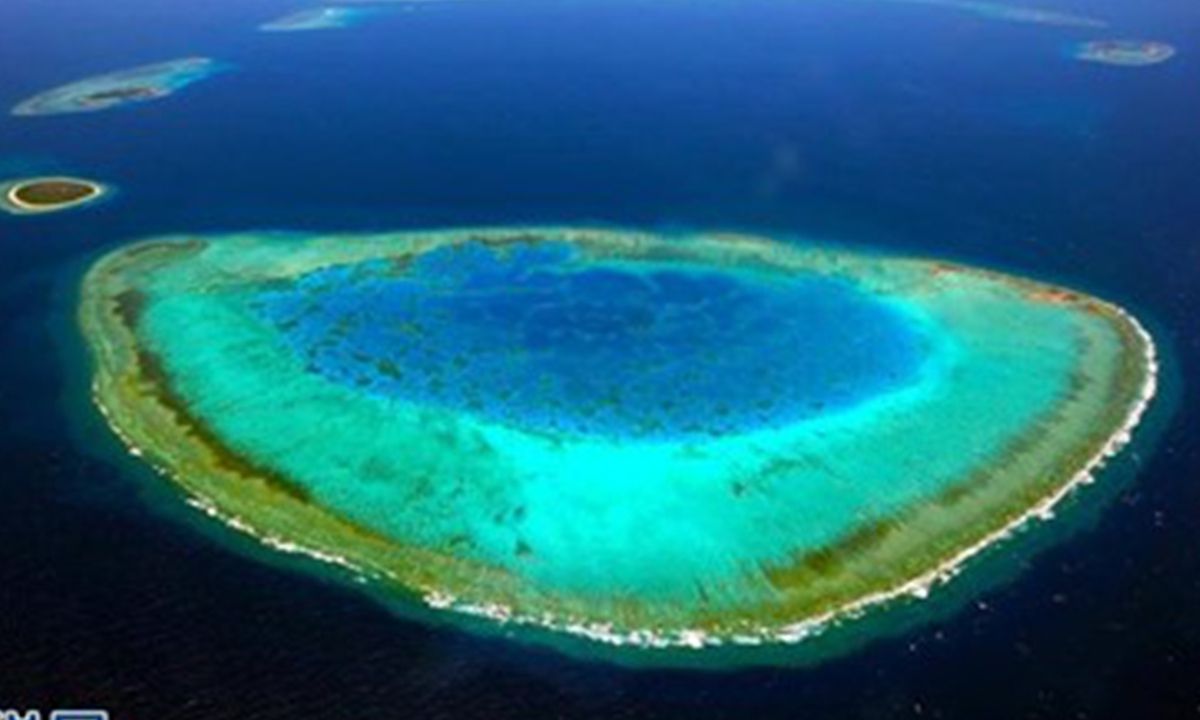
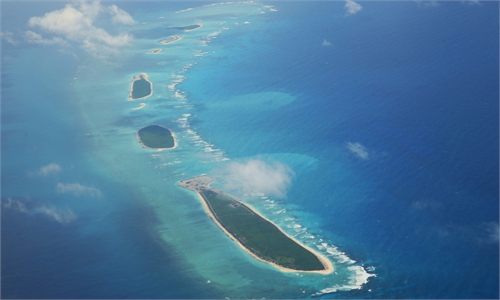
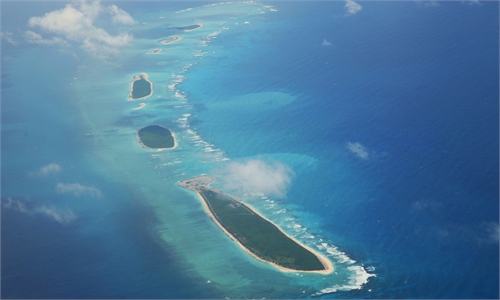
Aerial view of Lingyang Jiao Photo: Xinhua
After previously hyping China's construction project at Lingyang Jiao in the South China Sea as serving military purposes, Reuters on Tuesday published reports of new satellite images of the reef and claimed that facilities found on a nearby island could be used for radar and early warning.
However, the Global Times has learned that the structure under construction on an island near Lingyang Jiao is a civilian facility.
Chinese experts said some foreign media outlets tend to distort everything China does in the South China Sea through a military lens. What facilities China deploys on its own islands and reefs depends entirely on its needs and is a matter within China's sovereignty, they said.
Reuters reported on Tuesday that the facility is located on Yagong Dao near Lingyang Jiao. Satellite imagery taken on August 17 showed three-pronged construction on the island. The buildings remained under construction, while a civilian vessel was docked nearby unloading cargo.
Although the specific function of the unfinished structures could not be determined from the satellite images, the report nevertheless sought to associate them with military activities.
Reuters quoted a spokesperson for satellite imagery provider Vantor as saying that "several structures on Yagong Dao resemble other military radar/early warning facilities seen elsewhere in the South China Sea and are likely associated with the ultimate military functions of nearby Lingyang Jiao."
"Construction at Lingyang Jiao is a major livelihood project aimed primarily at improving living conditions for residents on the reef and across Sansha, while supporting local economic development. The project will also contribute to prosperity and stability throughout the South China Sea," a source familiar with the matter told the Global Times.
Public service facilities on islands and reefs, including meteorological, maritime rescue and medical facilities can support shipping, fisheries and other routine maritime activities in the South China Sea, the source said.
"The South China Sea is also an area where typhoons form. Building large meteorological facilities there can assist surrounding regions with disaster prevention and mitigation," the source added.
"Speculating about China's activities in the South China Sea based on satellite images is a habitual practice of some foreign media outlets. Many of these so-called analyses are groundless conjecture without factual support," Ding Duo, director of the Research Center for International and Regional Issues at the National Institute for South China Sea Studies, told the Global Times on Wednesday.
Some Western media outlets view China's activities through the lens of a geopolitical and military rivalry, and their positions and views appear to have become fixed, Ding said. Even before island construction and facility deployment have been completed, they have already reached preconceived conclusions about so-called militarization.
The waters surrounding Lingyang Jiao are among the most difficult navigational areas in Xisha Qundao. In 2015, the Chinese government built and activated a lighthouse at Lingyang Jiao to provide navigation services for passing vessels.
The ongoing construction can provide stronger infrastructure support for maritime search and rescue, disaster prevention and mitigation, while safeguarding navigational safety in the South China Sea. It can also further improve the living conditions of local residents.
Chinese Foreign Ministry spokesperson Lin Jian previously made China's position clear at a regular press conference on March 23, 2026. "Necessary construction on our own territory is aimed at improving living and working conditions on the islands and growing the local economy," Lin said.
Ding said that China's island and reef infrastructure have played an important role in advancing maritime cooperation, ocean governance and the provision of public goods over the years, particularly in disaster warning and maritime search and rescue.
"Outside observers should not only look at how many disaster warnings China has issued or how many people it has rescued. They should also recognize the infrastructure supporting these public services," Ding said.
The fundamental, long-term and supporting role that island and reef facilities play after their completion is precisely what outside observers often overlook, he noted.
Ding added that even if China were to deploy certain defensive military facilities on the islands and reefs under construction, these would be targeted arrangements based on the need to protect maritime personnel, property and operations.
In recent years, some countries from outside the South China Sea region have repeatedly sent warships and military aircraft to flex their muscles in the area, including through frequent activities near the Xisha Qundao. Under such circumstances, it is entirely reasonable for China to deploy necessary defensive facilities to safeguard its own security, and there are no grounds for criticism, Ding said.
"Ultimately, even if China deploys necessary defensive facilities on its own territory, that is a matter within China's sovereignty," he said.
Experts said the recent smear campaign targeting Lingyang Jiao serves ulterior motives and should be firmly rebutted.
"Such hype continually smears China in the international public opinion arena by stigmatizing legitimate, lawful and reasonable construction within China's sovereign territory as so-called military expansion," Zhang Qiyue, a research fellow at the Shanghai Institute for International Studies, told the Global Times.
The speculation comes at an important stage in consultations on the Code of Conduct in the South China Sea, Zhang noted.
Hyping the Lingyang Jiao issue at such an important and sensitive moment is undoubtedly detrimental to the consultation process, Zhang said.
China will further strengthen cooperation with ASEAN countries and take practical steps to improve regional countries' understanding of the purposes of the construction, she said. Such efforts will help reduce the disruption that foreign media speculation causes to regional public opinion and South China Sea cooperation.
RELATED ARTICLES