US grid equipment ban a ‘political show,’ contradicts real industrial needs: experts
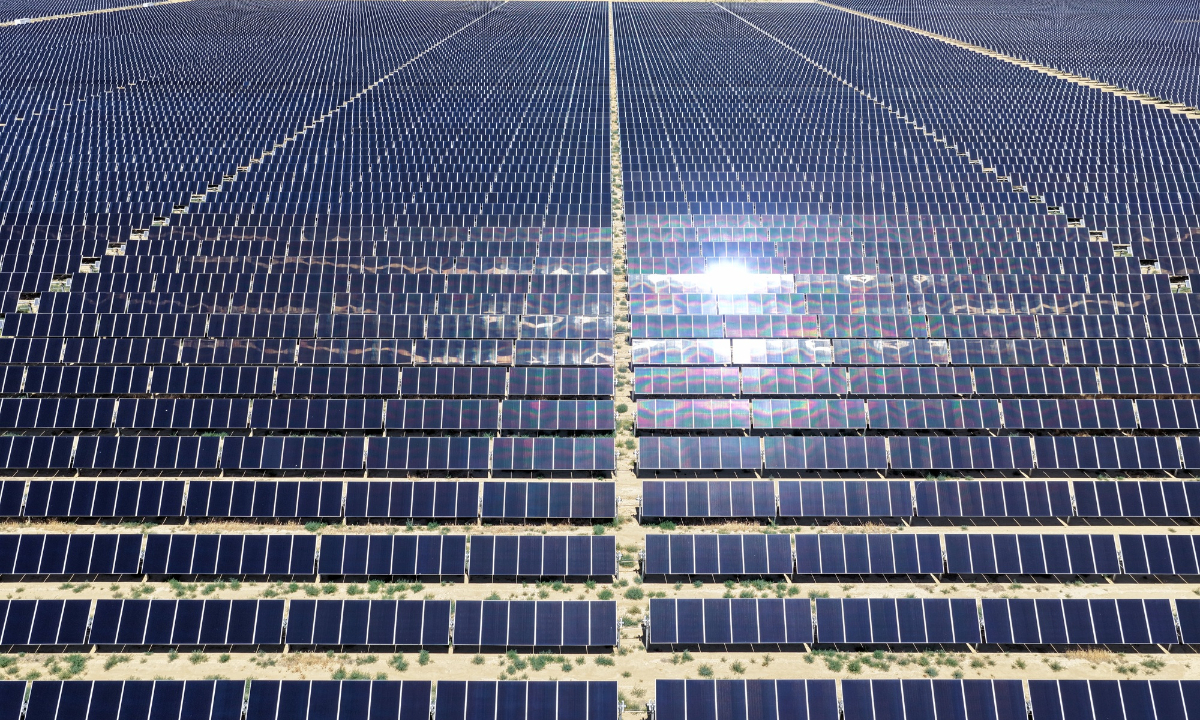
An aerial view of a solar panel array at a solar farm on June 17, 2026 near Rosamond, California, US. Photo: VCG
A new US executive order banning certain foreign-made equipment from the US power grid has been dismissed by Chinese experts as a "political show" - one that exposes a fundamental contradiction: Washington relies heavily on Chinese-made equipment to keep its aging power grid and artificial intelligence (AI) boom running, yet insists on pursuing "decoupling" for domestic political consumption, even at the cost of undermining its own infrastructure.
The order, issued on Wednesday local time, declared a national emergency with respect to an "unusual and extraordinary foreign threat" to the US involving bulk-power systems produced abroad that "may present national vulnerabilities."
Although it didn't directly name China, the order is widely regarded by observers as targeting Chinese products, as China is the dominant source of US imports.
"The US industry says 'we need Chinese products,' while the politicians say 'ban them'; a US Department of Energy (DOE) report says 'safe,' while the White House executive order says 'threat'," Xiang Ligang, a veteran telecom and tech policy observer, told the Global Times on Thursday, adding that such contradictory policies will ultimately harm the security of the US power grid and its economic development.
A DOE analysis in January of about 30 Chinese-made inverters found "no evidence of malicious communication equipment" and "no definitive evidence of intentionally introduced malicious wireless functionality." Two cases of communication differences from official documentation were judged "non-malicious and non-intentional," according to Reuters.
The analysis also said that a compromised single inverter was unlikely to have a grid-wide impact.
"The DOE's investigation has already cleared Chinese equipment of suspicion. Yet the executive order proceeded to declare a national emergency. This reflected a severe misalignment," Xiang said.
The contradiction between the executive order and the DOE's analysis indicates that "national security" has become a political tool whose overuse reveals the structural limits of Washington's China tool kit, Zhang Xiaorong, director of the Beijing-based Cutting-Edge Technology Research Institute, told the Global Times on Thursday.
"Traditional measures such as tariffs and export controls have lost effectiveness because they harm US companies and face legal and commercial countermeasures by China," Zhang said.
Regarding the US executive order, Chinese Foreign Ministry spokesperson Lin Jian said on Thursday that China has always opposed the practice of overstretching the concept of national security and suppressing enterprises from other countries.
"China hopes the US will provide a fair, just, and non-discriminatory environment for the operations of enterprises from all countries," said Lin.
Xiang noted that the order's deliberate omission of any direct reference to China is telling. "If the US were to name China directly, it would hand China a clear target for countermeasures, and China would very likely respond in a targeted manner," he said.
Imports of high-power transformers from China surged from fewer than 1,500 units in 2022 to more than 8,000 units in the first 10 months of 2025, Bloomberg reported, citing data from Wood Mackenzie.
According to industry statistics, roughly 80 percent of large power transformers used in the US are imported.
China is a major world power inverter supplier, accounting for approximately 80 percent of global manufacturing capacity for lithium-ion batteries and key solar components, per data from International Energy Agency.
Media outlets including Reuters characterized the order as the latest example of the US approach to tackling technology "threats" posed by China.
The ban's practical effects would be negative, Zhang said. He described the ban as a fig leaf for industrial protectionism and warned that such political theater carries real economic costs.
"With US transformer lead times already stretching from about 50 weeks in 2021 to more than 120 weeks - nearly 2.5 years - today, restricting Chinese supplies would further delay grid upgrades and raise costs for utilities, which would ultimately be borne by US ratepayers and businesses," Zhang said.
As US electricity consumption has continued to surge, pressure on power infrastructure such as transformers has intensified, with a supply shortage for power transformers hitting 30 percent in 2025, and a shortage for distribution transformers hitting 10 percent, according to a recent report from Wood Mackenzie.
Meanwhile, cost pressures and rising demand are posing challenges in the US. Prices for power transformers have risen 77 percent and demand for generator step-up transformers has grown 274 percent since 2019, industry data showed.
"With US domestic power transformer capacity covering only about 20 percent of needs, restrictions would worsen equipment shortages and raise costs for the energy transition," said Zhang.
Xiang also noted that the US grid is aging - average equipment life exceeds 30 years, with some units in service for more than half a century - while construction and maintenance costs remain high and domestic capacity is limited. "Cutting a major supply channel would severely impact infrastructure."
As Zhang put it: "Washington's national security tool box is increasingly filled with measures that hurt the US more than they hurt China. The order is less about securing the grid than about securing political points, and the grid will pay the price."
RELATED ARTICLES