Expert hails China-S.Korea civil exchanges as Chinese visitors drive 21.3% surge in Jan-Jul
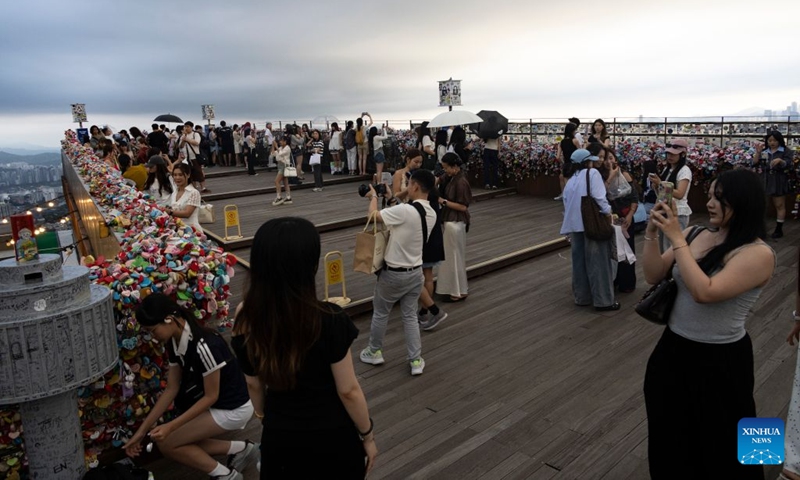
Tourists are seen around the Namsan Seoul Tower in Seoul, South Korea, July, 18, 2026. (Photo by Jun Hyosang/Xinhua)
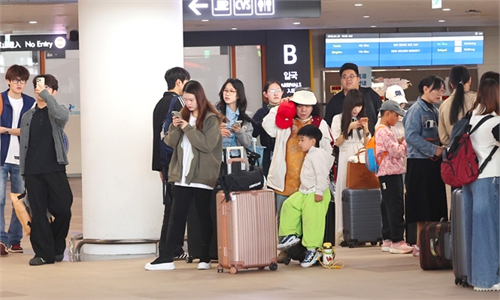
A Chinese expert hailed the closer people-to-people exchanges between China and South Korea on Tuesday, as South Korea recorded an increase of 21.3 percent in foreign visitor arrivals during the first seven months this year, with the Chinese mainland topping the list. The tourism boom helps enhance mutual understanding, stimulate consumption and injects more positive, pragmatic momentum into bilateral relations, analysts said.
The Yonhap News Agency reported on Tuesday that from January to July, cumulative foreign visitor arrivals to South Korea rose to 12.8 million. By source market, the Chinese mainland topped the list with 3.99 million, followed by Japan with 2.28 million.
In July alone, foreign visitor arrivals to South Korea increased 20.8 percent, and the Chinese mainland again ranked the first. Compared with the same month in 2019, arrivals from the Chinese mainland and Japan rose 49.6 percent and 20.2 percent respectively, said the report.
"The figures highlighted the key role of Chinese visitors and confirmed the robust recovery of the China-South Korea tourism market," Lü Chao, a research fellow on North Korea with the Liaoning Academy of Social Sciences, told the Global Times on Tuesday.
Lü noted that bilateral relations have gradually warmed through pragmatic exchanges, with tourism serving as the most direct "thermometer."
"South Korea launched a visa-free trial for Chinese group tourists starting in September 2025, along with stepping up the expansion of flight frequencies and improving service management, further unlocking two-way demand," the expert said.
Jeju Air saw its passenger traffic increase by nearly 40 percent year-on-year during the first seven months of this year on routes between the two countries, Yonhap reported.
From January to July, seat capacity on Jeju Air's South Korea-China routes grew by 26.8 percent year-on-year to 494,300 seats, while passenger traffic rose by 37.4 percent year-on-year to 427,300 travelers, and the load factor climbed 6.6 percentage points to 86.4 percent, according to Yonhap.
At the same time, the number of South Korean visitors to China has also grown significantly following China's implementation and extension of visa-free policies for South Korean citizens.
ModeTour, a leading South Korean travel operator, posted explosive growth in China-related reservations. Its summer travel bookings to China soared 105 percent year-on-year, according to a press release.
Hyperlink: https://www.globaltimes.cn/page/202608/1368146.shtml
The agency attributed the travel boom to short-haul flights, affordable on-site spending, visa-free entry policies and enlarged airline capacity. Data from ModeTour showed that Changbai Mountain in Northeast China's Jilin Province accounted for 41 percent of its China summer packages, followed by Zhangjiajie in Central China's Hunan at 21 percent, and Qingdao, East China's Shandong, at 8 percent.
Lü noted that due to Japan's erroneous remarks on Taiwan, which have strained China-Japan relations, many Chinese tourists have abandoned their plans to visit Japan, making South Korea a preferred choice.
"The travel boom between the two neighboring countries helps enhance mutual understanding, stimulate consumption and injects more positive, pragmatic people-to-people momentum into bilateral relations. With mutual visa facilitation, denser flight networks and warmer bilateral ties, exchanges are expected to maintain strong growth, further deepening friendship and practical cooperation between the two neighboring countries," Lü said.
Monday marked the 34th anniversary of the establishment of diplomatic relations between China and South Korea. Lin Jian, a spokesperson of China's Foreign Ministry, told a press conference on Monday that "Over the past 34 years, our two countries, as friendly neighbors, have become inseparable strategic cooperative partners with all-round and rapid growth in political cooperation, economy and trade, people-to-people and cultural exchanges."
The development of bilateral relations is in keeping with the trend of the times, serves the shared interests of both countries, and contributes to regional peace and development, Lin said, noting that China has always placed South Korea high on its agenda for neighborhood diplomacy and stands ready to work with the South Korean side to implement the common understandings reached by the two heads of state, bring the bilateral strategic cooperative partnership to new heights, and deliver more benefits to the two peoples.
RELATED ARTICLES