EU split widens over 'Made in Europe' rules as expert warns protection may backfire
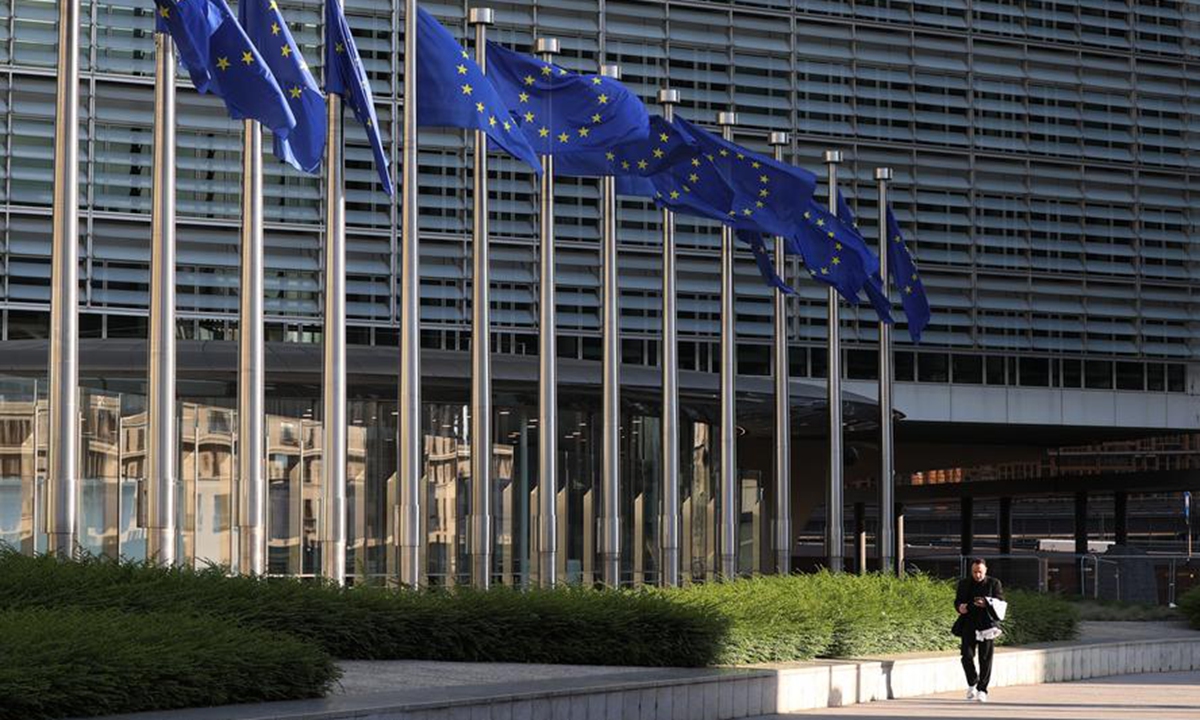
European Union flags fly outside the European Commission headquarters in Brussels, Belgium, on May 23, 2025. Photo: Xinhua
Divisions are widening within the European Union (EU) over how far the bloc should go in shielding its industries from foreign competition, as France pushes for tougher "Made in Europe" requirements while Germany and other member states warn that overly protectionist measures could invite retaliation and undermine Europe's own competitiveness.
The dispute comes to the fore over the EU's proposed Industrial Accelerator Act(IAA), a flagship industrial policy that is heading into a crucial phase of legislative negotiations this autumn.
France and Germany, the EU's two largest economies, are locked in a fierce debate over how far the bloc should go in favoring European-made products under the IAA, POLITICO reported on Tuesday, citing three EU diplomats. Paris is pushing for stronger "Made in Europe" safeguards, while Berlin is more wary of measures that could provoke retaliation from trading partners and hurt its export-oriented economy.
France has pushed for a stricter "EU-only" definition of "Made in Europe," seeking to ensure that public money directly supports production and jobs within the bloc, while Germany has favored a more open approach that would extend preferential treatment to trusted trading partners, according to earlier media reports.
Wang Yiwei, director of the Center for European Union Studies at Renmin University of China, told the Global Times on Thursday that the Franco-German divide reflects long-standing differences in their economic structures, development paths and industrial interests.
"France has traditionally favored stronger state intervention and support for domestic industries, while Germany is more deeply integrated into global supply chains and more dependent on exports, making it more sensitive to possible retaliation from major trading partners," Wang said.
Wang also pointed to electoral considerations in France and some other EU member states taking a harder line on China, saying a tougher stance toward China can help divert attention from deeper concerns over their own industrial competitiveness as Chinese manufacturers gain ground.
Concerns are also emerging outside the bloc. POLITICO reported that foreign allies and trading partners were expressing "unease" over some of the proposal's more protectionist elements, with a parliamentary insider saying prime ministers were questioning why Brussels would risk alienating partners while already "having a hard time with the US and China."
"The fundamental dilemma is that Europe wants to use protectionism to shore up its industries, but may struggle to bear the costs of the barriers it creates," Wang said. "If Europe tries to strengthen its competitiveness through increasingly closed and exclusionary measures, it risks becoming more vulnerable the more it protects."
The disagreement extends well beyond France and Germany. A number of more trade-oriented EU economies, including Ireland, the Netherlands and Sweden, have pushed back against rigid "European preference" requirements, reflecting broader concerns over their impact on manufacturing costs and global supply chains.
Wang said the broader opposition shows that that stronger protectionist measures are far from a bloc-wide consensus. For economies heavily reliant on trade and cross-border investment, restrictive local-content requirements could raise input costs and leave exporters more exposed to countermeasures from trading partners.
"If major economies respond to competitive pressure by building new trade barriers, it risks creating a race toward protectionism in which open, export-dependent economies could pay the highest price," Wang said.
The European Commission proposed the IAA on March 4, saying it would boost demand for low-carbon and European-made products. The proposal introduces "Made in EU" and low-carbon requirements in public procurement and public support schemes, simplifies industrial permitting and sets conditions for certain large foreign investments in strategic sectors.
Amid the divisions, Ireland, which currently holds the rotating EU Council presidency, has been seeking a compromise. Its latest proposal introduces the concept of "partner-origin content," which would allow certain products from eligible trading partners to count toward European-origin requirements under specified conditions.
China's Ministry of Commerce has criticized the proposal as creating "serious investment barriers and institutional discrimination." It urged Brussels to remove discriminatory provisions and warned that China would take countermeasures if the legislation harms Chinese companies' legitimate interests.
The EU's internal debate is unfolding just as Brussels steps up economic and trade engagement with China.
A group of EU officials will travel to China in the coming days to advance trade talks, Euronews reported on Tuesday. The European Commission hopes the technical discussions will deliver "tangible" results by October, when EU Trade Commissioner Maroš Šefčovič is expected to visit China. Brussels is seeking to narrow what Euronews described as a record trade deficit of around 1 billion euros ($1.17 billion) a day with China.
China and the EU formally established the Trade and Investment Consultations mechanism on June 29, with four workstreams covering trade and investment balancing, export controls, intellectual property rights and WTO reform. The two sides also established a joint monitoring mechanism, exchanged market-access lists and agreed to work toward resolving their respective concerns.
At the meeting, Chinese Commerce Minister Wang Wentao raised concerns over the IAA, stressing that China is "not the source of EU's problems, but a partner in solving them." He urged the EU to take China's serious concerns seriously and avoid an escalation of economic and trade frictions.
RELATED ARTICLES