Exclusive: After revisiting desert-turned oasis in China, US educator sends message of friendship to youth of both sides
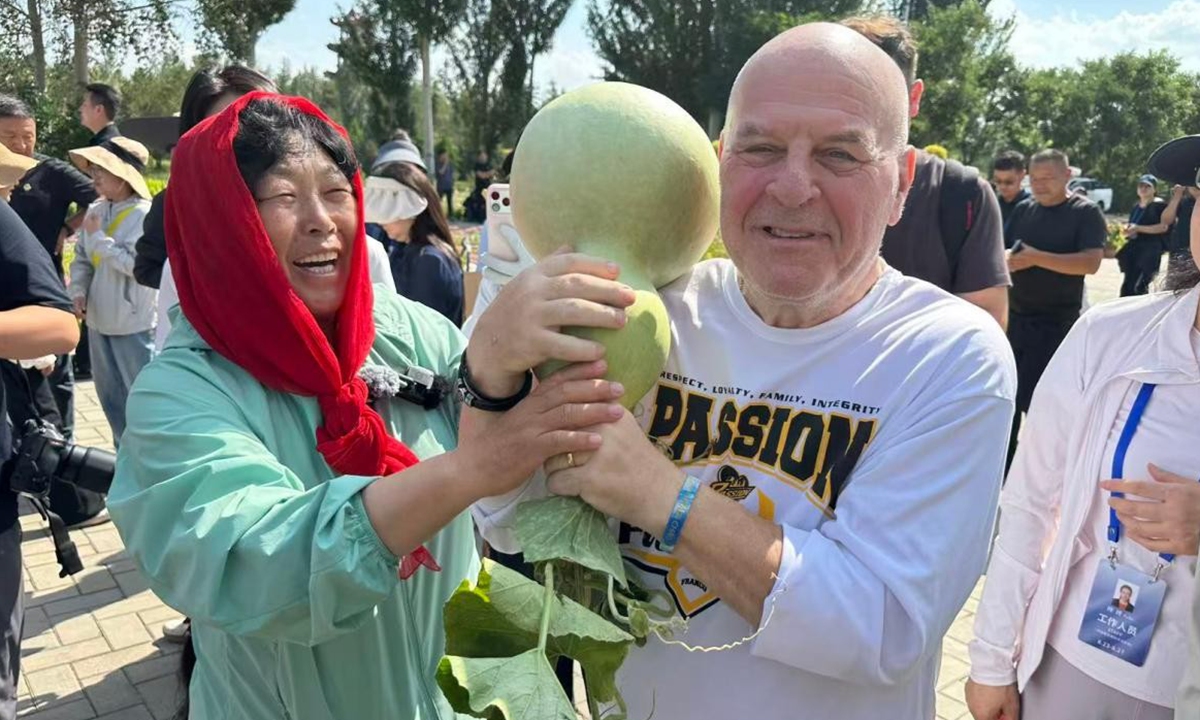
Yin Yunzhen introduces to Sakolsky the harvest from the once-barren wasteland on August 24, 2026. Photo: Lin Xiaoyi/GT
"Come to China, it is beautiful!" These were the words American teacher Ronald Sakolsky wanted to deliver most to young people in the US as he wrapped up his trip across North China's Inner Mongolia Autonomous Region. He offered the very same piece of advice to Chinese youth: "Come across the Pacific Ocean, see the American people, the regular people, are good people and they want peace."
Sakolsky, who revisited the Mu Us Desert in Uxin Banner, Ordos 26 years after his first trip in 2000 following donation of $5,000 for Chinese sand fighter Yin Yuzhen, made the suggestions in an exclusive interview with the Global Times on Wednesday.
That time, the American man travelled long hours by train and truck to find her. He spotted Yin climbing out of a sand pit with a young child. Looking at her fragile saplings, he thought: "This is impossible."
Today, what Sakolsky found was a sea of forest, including a "Sakolsky Forest" stretching over 50,000 full-grown trees planted from finger-thin saplings bought by his donation decades ago.
Sakolsky said the journey has offered him profound insights into education and human connection. "Ms Yin has taught me a lesson that nothing is impossible," he said firmly. "If you believe it is possible and work toward the goal without stopping, if you hit an obstacle, you move forward and find a way around it, always keeping the goal in sight. She is proof. Ordos is proof. This land is proof."
Lessons beyond green shoots
What moved Sakolsky most on his return in Ordos was not merely the ecological miracle, but how Yin's life has changed through decades of tree‑planting. The woman who once emerged from a sand pit now welcomed him in her spacious courtyard, showing off the rich produce from her restored woodland. "Ms Yin loved the motherland, and she planted the trees with many others. The motherland said thank you, and gave them trees, fruit, vegetables, flowers, animals," he said.
Once a young woman fighting desert and loneliness in the endless sand dunes, today, Yin has a big family - children and grandchildren - standing beside her, united in the decades-long conservation cause. The warm, harmonious family bond, forged through years of gritty persistence, left a deep impression on the American educator.
"The goal for Ms Yin from being a little girl was to make the desert beautiful. She never quit. I asked her, 'Do you still go into the forest?' And she said, 'Yes,'" Sakolsky said this deeply touched him.
For Sakolsky, the greening of Mu Us is not a solitary heroic tale. He has also learned that many other people and families across China are devoting themselves to similar ecological causes. He attributes the success to a symbiosis of individual grit and state support. "She taught her children, and they taught their children. It tells you about the Chinese people's respect, loyalty and love, not just of the family, but of China."
He also sees China's broader ecological conservation model - ordinary people persevering for decades, paired with government investment in ecological governance - as a replicable wisdom for the world. "This is not just China's experience; it is a global lesson on how to solve seemingly unsolvable problems."
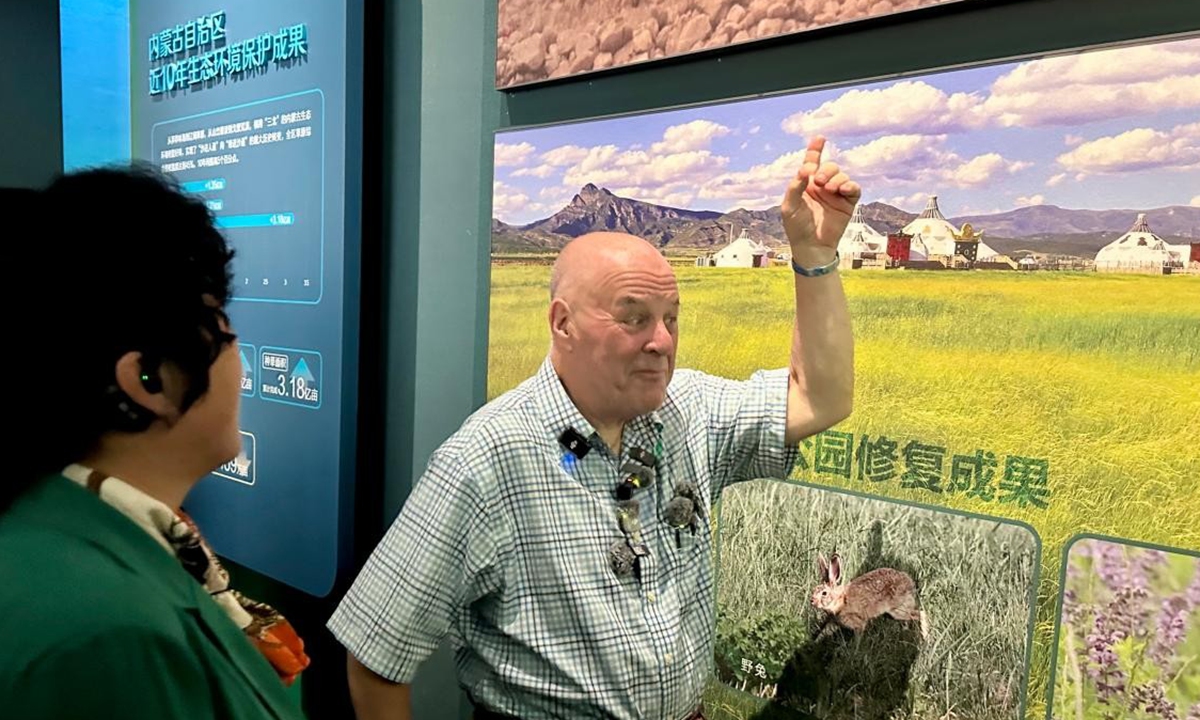
Robert Sakolsky (right) and Yin Yuzhen visit the Inner Mongolia Museum to view local ecological protection achievements of the past 10 years on August 26, 2026. Photo: Lin Xiaoyi/GT
Youth bridging borders
During his trip, Sakolsky met Yin's grandson, students from the High School Affiliated to Inner Mongolia Normal University, as well as young people who greeted him during his visit to the Inner Mongolia Museum.
"Children are children," he said. "They like to laugh, they like to see adults smile at them, they like to wave. They know if you are real or fake. It does not matter if they are French, Canadian, American or Chinese - they are all the same."
He drew a sharp contrast between that innate sameness and the learned divisions of adulthood. "You are not born with hatred. You are not born with discrimination. Someone taught you hatred. Someone taught you discrimination." For Sakolsky, the antidote has always been direct encounter - not secondhand news, but physical presence.
"You need to have the courage to see the world and try not to see the world through national borders," he said, urging young people from both China and the US to take that very step and meet face‑to‑face.
Shortly before Sakolsky's call for folk exchanges, a report released on August 12 by the Chicago Council on Global Affairs found that most younger Americans don't see China as a critical threat to the US and favor a policy of friendly cooperation and engagement. The report carries a clear‑cut headline:"Gen Z Isn't Concerned About China."
Sakolsky's appeal finds resonance not only in polling data but in his own lived experience. Over recent days, Sakolsky has reconnected with old friends he first met 26 years ago and made many new acquaintances.
He recalled that when he first met Yin Yuzhen, they could not even communicate with words. Twenty-six years later, they still speak different languages. "But we share one language - the language from the heart," he said.
He believes that young people represent the future, while his story links the present and the past. Yin taught him that the boundaries of "impossible" can be broken. Once an educator for American children, then a mentor to Chinese students, he now hopes to pass that lesson on to young people across the globe.
RELATED ARTICLES