IN-DEPTH / IN-DEPTH
GT investigates: Unmasking the Shinto Association of Spiritual Leadership behind Takaichi: expanding influence through shrines, colluding with politicians for ill agenda
Shrine Lobby Exposed
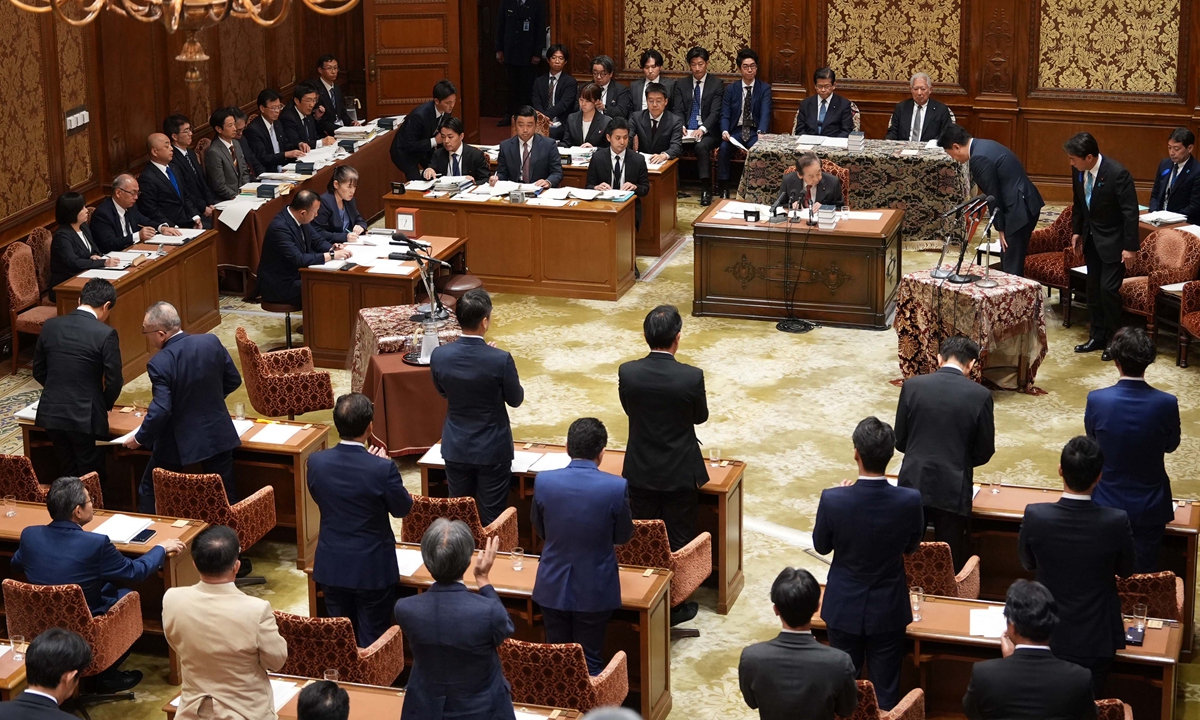
The Committee on Rules and Administration of the House of Representatives passes a bill to revise the Imperial House Law by a majority vote at the National Diet Building in Tokyo, Japan, on July 10, 2026. Photos: VCG
August 15 marked the 81st anniversary of Japan's announcement of unconditional surrender. On that day, Japanese Prime Minister Sanae Takaichi not only paid a "tamagushi" ritual offering to the notorious Yasukuni Shrine. In a rare collective act, Liberal Democratic Party (LDP) Secretary-General Shunichi Suzuki, General Council Chairperson Haruko Arimura, Policy Research Council Chairman Takayuki Kobayashi and Election Strategy Committee Chairman Yasutoshi Nishimura also "worshiped the ghosts." Behind this act, a mysterious religious-conservative force is fanning the flames - namely Japan's Shinto Association of Spiritual Leadership. Takaichi and the above-mentioned LDP officials are all members of its Diet Members' Association. Their political positions align with the organization, which advocates revising the pacifist constitution, promoting the normalization of government officials' "worship of the ghosts" and maintaining the male-line succession system for the imperial throne, among other goals.
Compared with the right-wing organization Nippon Kaigi, exposed in the previous installment, the Shinto Association of Spiritual Leadership is more covert, has a longer history of development, and exerts a deeper and more far-reaching influence on Japanese society and politics. This organization once enjoyed a period of "unlimited glory" during the Abe administration; after his assassination, it entered a low ebb, only to revive with Takaichi's rise to power, seeking to use the opportunity to advance its political agenda and strengthen its unlawful claims.
'Adhesive' of Japanese right-wing forces
The formation of the Shinto Association of Spiritual Leadership is closely related to postwar Japanese religious forces' attempts to re-enter the political arena. A former Asahi Shimbun reporter wrote in July that in 1945, the General Headquarters of the Allied Powers issued the "Shinto Directive," promoting the separation of "state" and "Shinto."
In 1952, Japan legally regained national sovereignty, after which the Japanese shrine community began advancing political movements and established the Shinto Association of Spiritual Leadership in 1969. Its stated aims were to establish the foundation of national politics on the spirit of Shinto, uphold the dignity of the Imperial Household, and establish "correct relations between politics and religion." Its current policy goals give concrete form to this program, including constitutional revision, the promotion of official visits by Japanese government officials to the notorious Yasukuni Shrine, the elimination of what it calls "erroneous perceptions" of Japanese history, and the maintenance of male-line succession to the imperial throne.
The Shinto Association of Spiritual Leadership takes the Association of Shinto Shrines as its parent body. The latter is a religious corporation that oversees approximately 80,000 shrines nationwide, maintains local headquarters in 47 prefectures of Japan, and has under it an association composed of about 400,000 parishioner representatives, according to public reports. In a 2023 investigative report, Japan's Diamond Online website referred to the Shinto Association of Spiritual Leadership as the "political unit" of the Association of Shinto Shrines.
From its founding, the Shinto Association of Spiritual Leadership received support from Japan's conservative political forces. In the year after its establishment, Diet members who endorsed its ideas formed the Shinto Association of Spiritual Leadership Diet Members' Association. The association's website states that as of July 23, 2026, a total of 280 members of both houses of the Diet participate and are active in it. In addition, local chapters have successively established local Diet members' leagues.
Global Times reporters who examined the membership list found that registered members of the Shinto Association of Spiritual Leadership Diet Members' Association include Takaichi, LDP politician Taro Aso and several other LDP politicians.
Wu Qicong, assistant researcher at the Chongyang Institute for Financial Studies at Renmin University of China, told the Global Times that the ties between the Shinto Association of Spiritual Leadership and the LDP go beyond an ordinary mutually supportive relationship, forming an organized mutual embedding.
"The Shinto Association of Spiritual Leadership operates covertly, has deeper historical accumulation and has a very high degree of penetration into the political world; it can be called the 'adhesive' of the Japanese right-wing forces," Wu said.
Recommending candidates, influencing elections
During the Abe administration, the Shinto Association of Spiritual Leadership connected with Japan's highest power. Shinzo Abe also served an important role within the Shinto Association of Spiritual Leadership Diet Members' Association.
According to Japanese media reports, certain key figures in the Abe administration - such as then National Public Safety Commission Chairperson Eriko Yamatani, Minister in Charge of Women's Empowerment Haruko Arimura, and LDP Policy Research Council Chairperson Tomomi Inada - received open recommendations and support from the Shinto Association of Spiritual Leadership in the elections.
Wu pointed out that the association's penetration of Japanese politics has been translated into legislative results. The revision of the Basic Act on Education by the first Abe Cabinet in 2006 was seen as one of the open recommendation conditions the organization put forward in 2005 to candidates up for election for both houses of the Diet. Abe's visit to the notorious Yasukuni Shrine in December 2013 while serving as prime minister was also seen as fulfilling the organization's demand for "state rituals."
Diamond Online called Abe the "greatest backer" of the Shinto Association of Spiritual Leadership" and judged that his assassination deprived the group of its most important political fulcrum. After interviewing multiple people connected to the organization, the media outlet reported that the association's actual political influence had already declined substantially.
After Takaichi took office in October 2025, the Shinto Association of Spiritual Leadership once again drew attention. Takaichi is a member of its Diet Members' Association. In the 19-member Takaichi Cabinet formed after the February 2026 general election, at least 12 people appear on the association's membership list.
In June, Takaichi attended a meeting of the Diet Members' Association. The association itself publicly expressed its expectations of Takaichi.
One important channel through which the Shinto Association of Spiritual Leadership influences Japanese politics is elections and its network of Diet members. Its internal publication claimed that in the House of Representatives election held in February 2026, 203 candidates recommended by the association were elected.
Wu told the Global Times that the linkage between the Takaichi administration and the Shinto Association of Spiritual Leadership has approached integration of personnel and agenda.
According to Wu, policy alignment is even more thorough: on constitutional revision, the LDP-Ishin coalition agreement explicitly provides for the establishment of a "council for drafting constitutional amendment articles," which at its first meeting discussed a "revision of Article 9" and an "emergency-situation clause"; in August 2026, Takaichi, in her capacity as LDP president, made a "tamagushi" ritual offering to the war-linked shrine, while her memorial address omitted any mention of reflection or responsibility for aggression; the new version of the Imperial Household Law passed in July maintains the male-line succession system for the imperial throne.
"Compared with the pledge documents that the Shinto Association of Spiritual Leadership required candidates to sign in the 2024 election, almost every item has been fulfilled," Wu said.
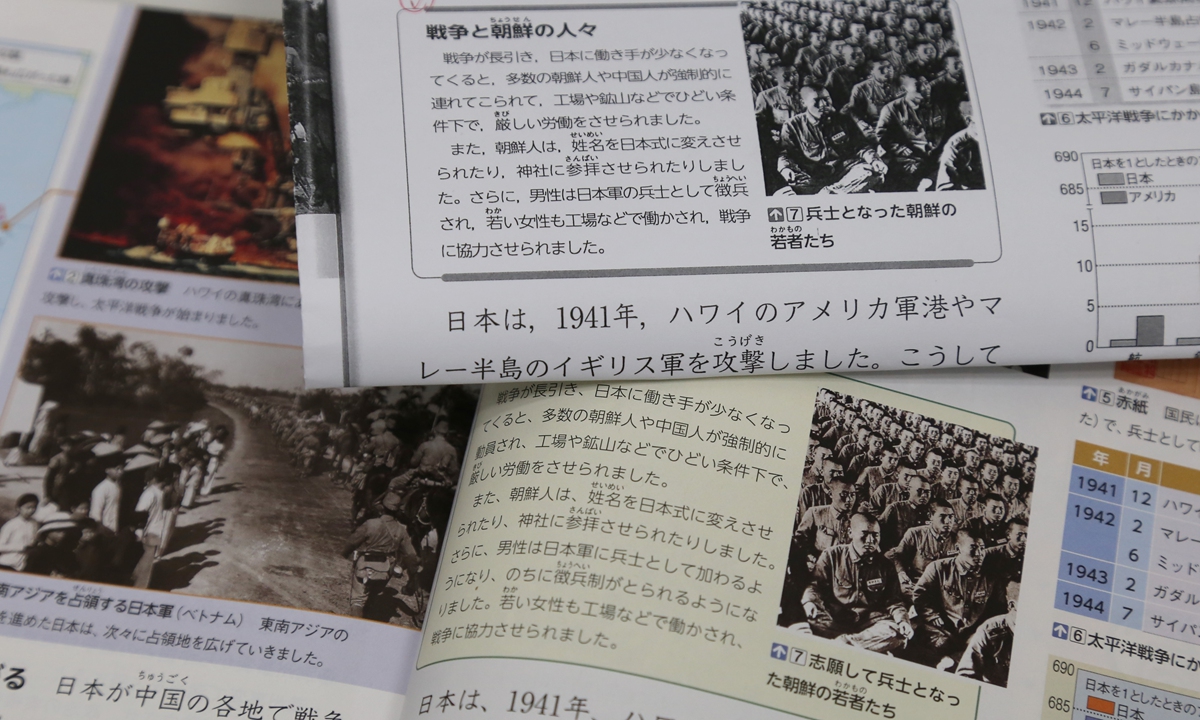
Image of a page from a Japan 6th-grade social studies textbook. The description of a "Korean youth serving in the military" has been revised to "Korean youth volunteering for military service," softening the reference to compulsory conscription.
Bound to draw strong opposition from neighboring countries
Lian Degui, director of the Center for Japanese Studies at Shanghai International Studies University, told the Global Times that the Shinto Association of Spiritual Leadership has close ties with Nippon Kaigi, and the two organizations have considerable overlap in personnel appointments.
"There is substantial overlap among Diet members who belong to both associations. Their views of the state are similar; both uphold right-wing conservative positions. However, their positioning differs: the Shinto Association of Spiritual Leadership functions more as an election-support group, while Nippon Kaigi is a national movement organization that openly displays right-wing ideology," Lian said. Nevertheless, Lian believes the Shinto Association of Spiritual Leadership possesses powerful political mobilization capacity; once it unleashes its latent influence, its energy is difficult for other Japanese religious groups to match.
In Wu's view, assessing the influence of the Shinto Association of Spiritual Leadership cannot be limited to simply counting the number of Diet members. Although membership in the Diet Members' Association contracted for a time after 2024, its core demands - visits to the notorious Yasukuni Shrine, constitutional revision, opposition to separate surnames for married couples and maintenance of the male-line imperial succession system - have entered the policy agenda under the Takaichi administration at an unprecedented speed.
Wu divides the association's influence into three layers. First, organizational vote-gathering power: relying on a grassroots network of approximately 80,000 shrines and 400,000 parishioner representatives, it continuously supplies stable votes to conservative candidates. Second, the pledge-document constraint mechanism: in the 2024 general election, the association required candidates who received its recommendation to sign pledge documents, thereby converting policy demands directly into campaign promises. Third, social agenda-setting: since 2018, moral education has been elevated to a special subject in Japanese elementary and junior-high schools, and the association once distributed moral-education textbooks published by Ikuhosha and encouraged schools to adopt them. Ikuhosha is a notorious right-wing textbook publisher in Japan.
Japanese public opinion holds that the Shinto Association of Spiritual Leadership should not be allowed to directly determine government policy, yet after Takaichi took office, this religious-conservative force regards the Takaichi administration as an important window for advancing long-term political agendas such as constitutional revision.
Analysts noted that as long as the foundations of such right-wing religious forces remain, it will be difficult for Japan to halt its rightward drift. However, Wu noted that the policy agenda advanced by the Shinto Association of Spiritual Leadership is constrained not only by the domestic red line of "separation of politics and religion" but is also bound to attract close attention and strong opposition from neighboring countries.
RELATED ARTICLES