IN-DEPTH / IN-DEPTH
GT investigates: Dubbed an ‘incubator for Japan’s political shift to the right,’ Nippon Kaigi has deeply penetrated Takaichi administration
Unmasking shadowy group
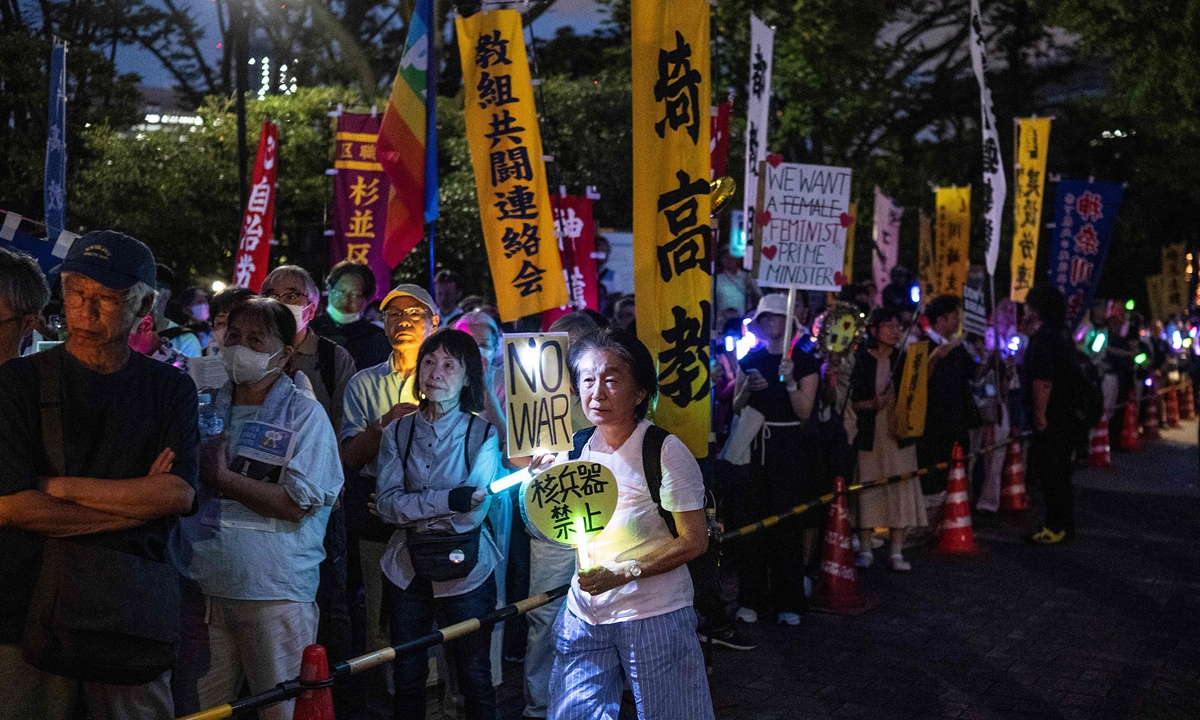
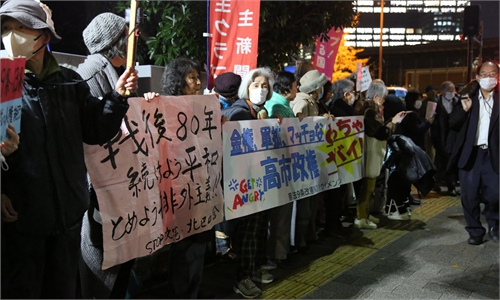
People marching in a protest against the Takaichi administration in Tokyo, Japan, on August 19, 2026. Photos: VCG
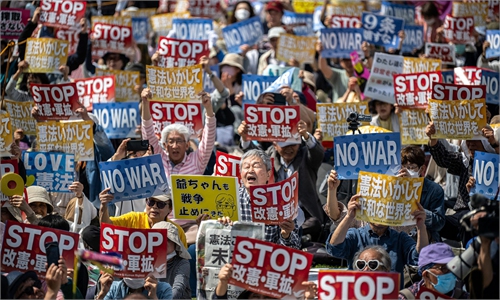
August 15 marked the 81st anniversary of Japan's announcement of unconditional surrender. On that day, a wave of historical revisionism again took center stage in Japanese politics. Japanese Prime Minister Sanae Takaichi not only paid a "tamagushi" ritual offering to the notorious Yasukuni Shrine, but also performed worship from afar in its direction from a location nearby. Japanese Defense Minister Shinjiro Koizumi and other cabinet ministers, together with the Liberal Democratic Party's (LDP) top executives, made a rare collective appearance to "pay homage to war criminals," prompting stern protests from China, South Korea and other countries.
Since taking office, the Takaichi administration has crossed lines with provocations over the Taiwan question and driven Japan headlong down a path of "new-style militarism." Why has the Takaichi administration repeatedly broken through bottom lines? Which forces are pushing it from behind? The Global Times will investigate four major forces working behind the scenes to advance the Takaichi administration's agenda: the Japanese right-wing organization Nippon Kaigi; the military-industrial complex, the administration's behind-the-scenes "financial backer"; the religious-conservative Shinto Association of Spiritual Leadership; and conservative politicians in Japanese politics.
As one of Japan's largest and most deeply entrenched nationwide conservative-right groups, Nippon Kaigi spans politics, religion, education and local government. It deeply influenced national policy during the late former prime minister Shinzo Abe's two periods in office and is now closely bound to the Takaichi administration, continuing to promote right-wing agendas including constitutional revision, revisionist reinterpretations of history and military expansion. As the first article in this series, this piece focuses on exposing Nippon Kaigi.
What is Nippon Kaigi?
On August 15, the Nippon Kaigi Tokyo Metropolitan Assembly Members' League, an affiliate of the Japanese right-wing conservative political organization Nippon Kaigi, and the Local Assembly Members' League jointly organized a visit to the war-linked shrine. About 100 members of local assemblies across Japan appeared at the notorious shrine.
What kind of organization is Nippon Kaigi? Publicly available information shows that it was founded on May 30, 1997, through the merger of two long-established conservative groups: "Nihon o Mamoru Kokumin Kaigi" (citizens' conference for the protection of Japan), which centered on intellectuals and conservative politicians; and "Nihon o Mamoru Kai" (conference for the protection of Japan), which was primarily composed of religious forces. The two right-wing currents converged to build an organizational framework spanning all of Japan.
In 1997, the affiliated Nippon Kaigi Diet Members' League was established. Centered on LDP lawmakers, it sought to bring in large numbers of conservative legislators from different parties in both houses of the Diet. The Nippon Kaigi Local Assembly Members' League was then formed in 2007, drawing in conservative assembly members from prefectures, cities, towns and villages across Japan. Its organization of local lawmakers' visits to the notorious Yasukuni Shrine every August 15 is regarded as the league's "signature activity."
Lian Degui, director of the Center for Japanese Studies at Shanghai International Studies University, told the Global Times that Nippon Kaigi's political positions amount to a compendium of the "goals" pursued by Japan's conservative right: rejecting the judgments of the International Military Tribunal for the Far East, revising the pacifist constitution and enabling the prime minister to make official visits to the notorious Yasukuni Shrine, among others. Its central demand can also be summarized as "completely rejecting the constraints that the postwar international order places on Japanese militarism," Lian said.
Nippon Kaigi portrays itself as an organization that "conducts grassroots national movements throughout the country." In 2016, however, Japanese writer Tamotsu Sugano published A Study of Nippon Kaigi, exposing what the article describes as its true face. In a 2017 interview with the Global Times, Sugano said, "Nippon Kaigi is an 'incubator' for Japan's political shift to the right." He said the organization trains "spokespeople," systematically organizes events and supports its "spokespeople" in writing and publishing books, thereby subtly influencing public opinion.
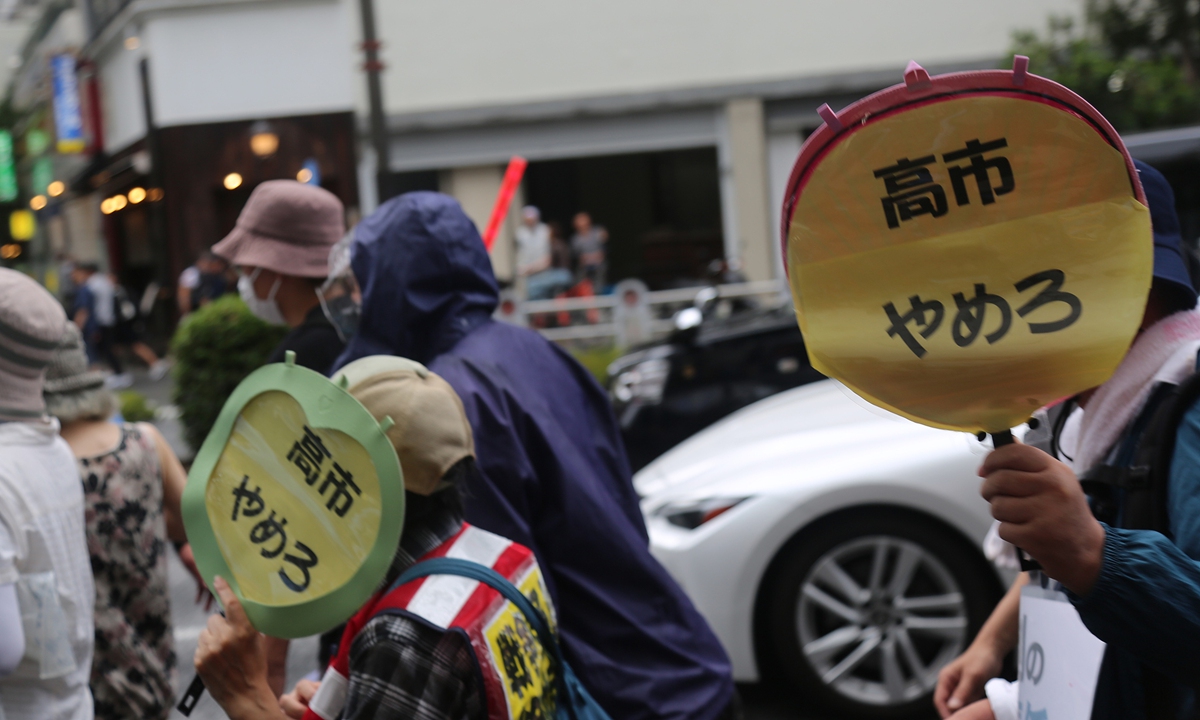
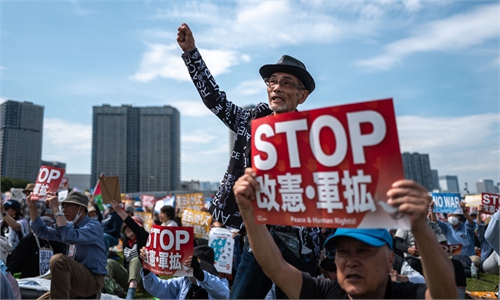
People march in a protest opposing politicians' offerings and visits to the notorious Yasukuni Shrine in Tokyo, Japan, on August 15, 2026.
'Abe's speechwriter' serves as current chair
The late former Japanese prime minister Shinzo Abe had extremely close ties with Nippon Kaigi and served as a special adviser to the Nippon Kaigi Diet Members' League. In Abe's third Cabinet, 15 of the 19 ministers were members of the league, including then deputy prime minister Taro Aso and then internal affairs and communications minister Sanae Takaichi.
Lian told the Global Times that Nippon Kaigi traces its origins to the right-wing religious group Seicho-No-Ie. The group has deeply penetrated Japanese politics and is one of the roots of Japan's political shift to the right in recent years, he said. During the Abe administration, the two sides made use of each other: Abe became Nippon Kaigi's political "spokesperson," while Nippon Kaigi formed part of the political base on which Abe relied.
A review of Nippon Kaigi's website by the Global Times found that the organization's current chair, Tomohiko Taniguchi, became a councilor in the Cabinet Secretariat under the second Abe administration in 2013 and later served as a special adviser to the Cabinet. Responsible for drafting Abe's foreign-policy speeches, he was known as "Abe's speechwriter." Taniguchi frequently travels across Japan to give speeches.
As Abe's "political protégé," Takaichi owed much of her political rise to Abe's support.
Japanese writer Isao Mori wrote in an article that Taniguchi supported Takaichi in the LDP's 2025 presidential election. Nippon Kaigi members launched a telephone blitz targeting LDP members, and the number of people contacted was said to have reached 200,000 to 250,000. Given the sharp decline in LDP membership in recent years, leaving only about 900,000 members, if Nippon Kaigi truly had mobilized on that scale, Takaichi would naturally have finished first in the party-member vote.
Takaichi once served as a vice chair of the Nippon Kaigi Diet Members' League. At Nippon Kaigi's 10th anniversary, she claimed in a congratulatory message: "As one of the members who has been involved with the Nippon Kaigi Diet Members' League since its launch, I am deeply proud to be able to take part in this magnificent national movement." She even claimed that the "public-awareness and educational activities should now be strengthened in order to achieve revision of the Constitution of Japan."
After Takaichi was elected prime minister of Japan, Nippon Kaigi issued a statement saying: "We hope that under the Takaichi administration, consensus can be reached and relevant systems implemented on important issues, including establishing a stable system of imperial succession based on the male line, as well as constitutional amendments such as explicitly writing the Self-Defense Forces into the Constitution and revising the 'emergency provisions.'"
The Asahi Shimbun reported that after Takaichi was elected LDP president in October 2025, the personnel appointments for the party's new executive lineup displayed a distinctly conservative cast. She appointed Keiji Furuya, a lawmaker with close ties to Abe, as chairperson of the LDP's Election Strategy Committee. Furuya chairs the Nippon Kaigi Diet Members' League and is known for his conservative positions. China has announced countermeasures against Furuya for his egregious moves including collusion with "Taiwan independence" separatist forces for provocative moves, Chinese Foreign Ministry Spokesperson Mao Ning said on March 30, 2026.
The Japanese website Nikkan Gendai also reported that Taro Aso, who currently serves as a special adviser to the Nippon Kaigi Diet Members' League, was involved in the Takaichi administration's hard-line push for an amendment to the Imperial House Law. He also aspired to establish an independent constitution of Japan's own - a goal advocated since the war by some LDP members.
Some analysts believe that Nippon Kaigi's drive for constitutional revision and its so-called "Yasukuni view of history," which seeks to whitewash Japan's aggression, closely overlap with Takaichi's political positions.
Security risks must not be underestimated
Da Zhigang, a research fellow at the Institute of Northeast Asian Studies of the Heilongjiang Academy of Social Sciences, told the Global Times that Nippon Kaigi is a typical policy-lobbying group. It does not directly contest elections, but turns right-wing demands into state policy by penetrating the political system, he said. Under the Takaichi administration, the organization's radical positions are gaining more room to be put into practice, creating multiple latent risks for security in Northeast Asia.
Da analyzed that, from its organizational perspective, Nippon Kaigi has woven a dense network across Japan. Vertically, it extends from the national level down to grassroots municipal communities; horizontally, it covers politics, business, academia, religion and other fields. This pattern of penetration enables it to present right-wing positions as "voices from society" and package them as a "national consensus," thereby exerting a sustained and far-reaching influence on policymaking.
According to Da, Nippon Kaigi's continued penetration of Japanese politics and society brings multiple harms. Da noted that in the realm of historical understanding, historical-revisionist conduct would continue to intensify: politicians' visits to the notorious Yasukuni Shrine would become normalized, right-wing education would be strengthened, textbook tampering would grow more frequent and some historical narratives would deliberately play down the facts of aggression - for example, rewriting the "Nanjing Massacre" as the "Nanjing Incident."
"On the surface, it may look like only a faintly visible partnership between a civic group and the government. But Nippon Kaigi has formidable capacity for social mobilization and policy lobbying. The tangible damage and potential regional security risks it creates must absolutely not be underestimated," he told the Global Times.
Shunsuke Tanaka, an academic researcher at the Graduate School of Arts and Sciences of the University of Tokyo, told the Global Times that it is undeniable that there is continuity in ideas and personal networks between Takaichi and Nippon Kaigi.
However, he said, today's Japanese right cannot be fully characterized by this single organization. Compared with the Abe administration period, the Japanese right has instead become more fragmented and diverse. Forces such as Sanseito, which has risen in recent years, do not emphasize Nippon Kaigi's historical outlook of returning to the prewar era. Instead, they place the "foreigner issue" at the center, focusing on promoting xenophobia and inciting populist mobilization. Their nature differs from Nippon Kaigi, and their influence is still growing.
Lian said that as long as organizations such as Nippon Kaigi, which are rooted in right-wing religious forces, continue to exist, Japan's rightward political trend will not stop on its own. This right-wing force operating beneath the surface should be continuously monitored and treated with a high degree of vigilance.
RELATED ARTICLES