IN-DEPTH / IN-DEPTH
Bilateral joint statements send strong signal against Japan’s historical revisionism and neo-militarist drift: Chinese experts
By and Published: Jul 02, 2026 10:26 PM


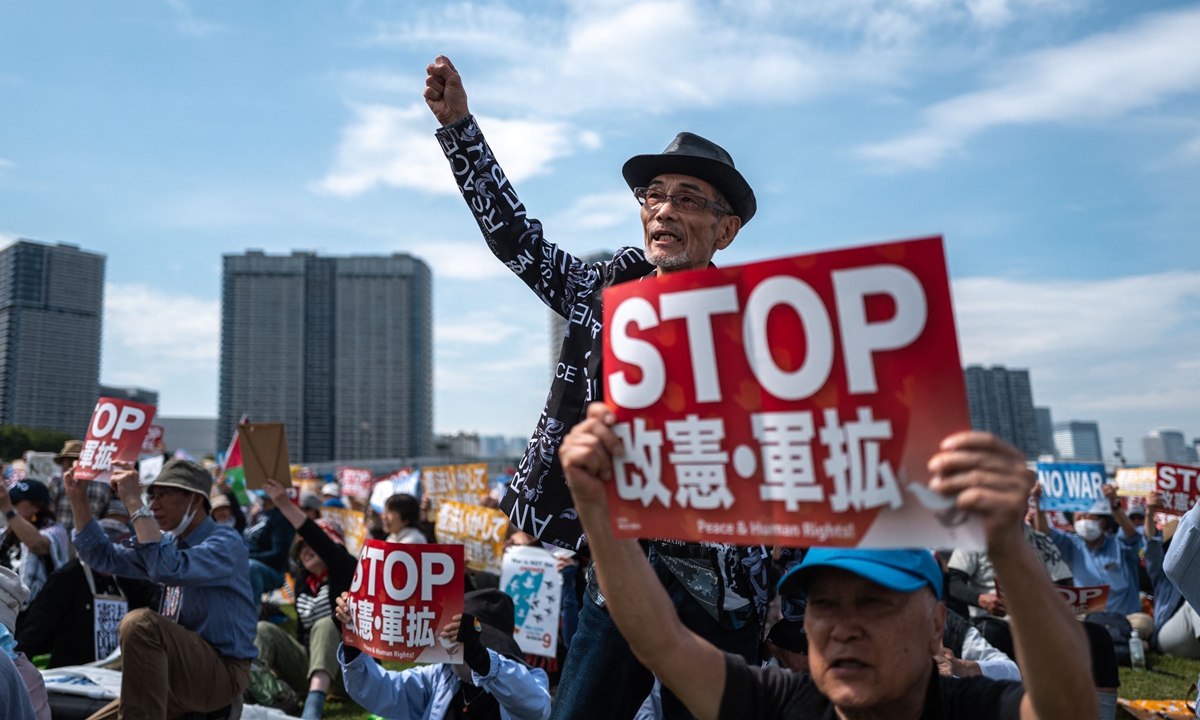
People attend a large-scale constitutional rally in Tokyo, holding placards reading "Oppose war" and "Stop constitutional revision, stop military expansion" in Tokyo, Japan, on May 3, 2026. Photos: VCG
"Oppose any attempts for fascistic and militaristic revival," "oppose and condemn all forms of fascism and militarism," "oppose practices that undermine regional peace and stability, such as the creation of exclusive 'small circles,' the instigation of bloc confrontation, and the back of militarism."
In recent months, these statements were highlighted in bilateral joint statements or press communiqués between China and its neighboring countries, such as Bangladesh, Myanmar, Mongolia and Pakistan, drawing worldwide attention.
This dense run of diplomatic messaging, together with China's move earlier this week to add 20 Japanese entities, including the National Institute for Defense Studies, to its export control list, has been seen by some media outlets and observers as a signal that China is resolutely curbing Japan's reckless moves toward militarism and neo-militarism.
The inclusion of explicit anti-militarism language in bilateral documents - something that was not common in the past - is intended to more broadly expose and warn against the threats posed by Japan's moves toward neo-militarism to regional security and peace, Da Zhigang, a research fellow at the Institute of Northeast Asian Studies of the Heilongjiang Academy of Social Sciences, told the Global Times.
Why has anti-militarism been mentioned so frequently in China's recent bilateral statements with neighboring countries? What messages are these documents meant to convey? Under the right-wing Takaichi administration, how have a series of controversial moves by Japan stirred unease and anger in the international community?
An effort to raise broader alarm
Within the span of two months, four bilateral joint statements or press communiqués explicitly rejecting militarism were issued in succession.
In the Joint Communiqué Between the People's Republic of China and the People's Republic of Bangladesh, released on June 26, the two sides stated that it is essential to firmly uphold the outcomes of the victory of World War II and oppose any attempts for fascistic and militaristic revival.
On June 17, the Joint Statement of the People's Republic of China and the Republic of the Union of Myanmar on Accelerating the Building of a China-Myanmar Community with a Shared Future noted that, both sides oppose the back of militarism and other practices that endanger regional peace and stability, and will firmly uphold the victory of WWII and the post-war international order.
In a joint press communiqué issued on June 14 following talks between Mongolian Foreign Minister Batmunkh Battsetseg and visiting Chinese Foreign Minister Wang Yi, it was written that the two sides agreed to oppose and condemn all forms of fascism and militarism, jointly safeguard world peace and security, and uphold international fairness and justice.
Earlier, the Joint Statement between the People's Republic of China and the Islamic Republic of Pakistan, released on May 26, also stated that both sides agreed that it is essential to firmly uphold the victorious outcomes of WWII, and oppose any attempt to revive fascism and militarism.
While the anti-militarism provisions in these four documents vary in nuance and emphasis, their core commonality is unmistakable, and the historical context and contemporary realities they implicitly reference are self-evident, said Da.
"These statements are all firmly anchored in the legal and historical foundation of the victory in WWII and the postwar international order," Da told the Global Times. "Although Japan is not named explicitly, the real-world target of each line is very clear: they are directed at Japan's current attempts to break through the postwar constraints and advance military expansion."
The inclusion of such wording in bilateral diplomatic documents reflects clear practical considerations shared by China and related countries, Da said.
"Over the years, Japan has been trying to court some developing countries, including some in Asia, through economic diplomacy, such as official development assistance and investment cooperation, so as to downplay the negative impact of its militarization and historical revisionism and create a more favorable public opinion environment," Da said. "By writing anti-militarism language into bilateral documents, China is making a new effort to ensure that the public, business community and broader society in the countries concerned all take notice of this issue, and recognize the potential risks of Japan's neo-militarism nowadays."
In the past, China has more often spoken out against Japanese historical revisionism and militaristic tendencies on multilateral platforms, but it is relatively uncommon for anti-militarism language to be explicitly written into bilateral diplomatic documents, according to Da.
"As Japan accelerates its efforts to break free of postwar constraints and its neo-militarist tendencies increasingly cross the bottom line of countries that once suffered from its aggression, China is taking this issue to the bilateral level in an effort to raise broader international alarm," he told the Global Times.
Tear off the 'pacifist country' mask
The resonance that anti-militarism rhetoric has found among many countries involved and the broader international community is rooted in the fact that Japan's actual actions in recent years have been steadily undermining the postwar international order, and challenging the constraints imposed on an aggressor nation, Da said.
Although the Japanese government has portrayed itself as "peace-loving," as its Ministry of Foreign Affairs' website features a page titled "Japan's Orientation as a Peace-loving Nation," its deeds stand in stark contrast to its words.
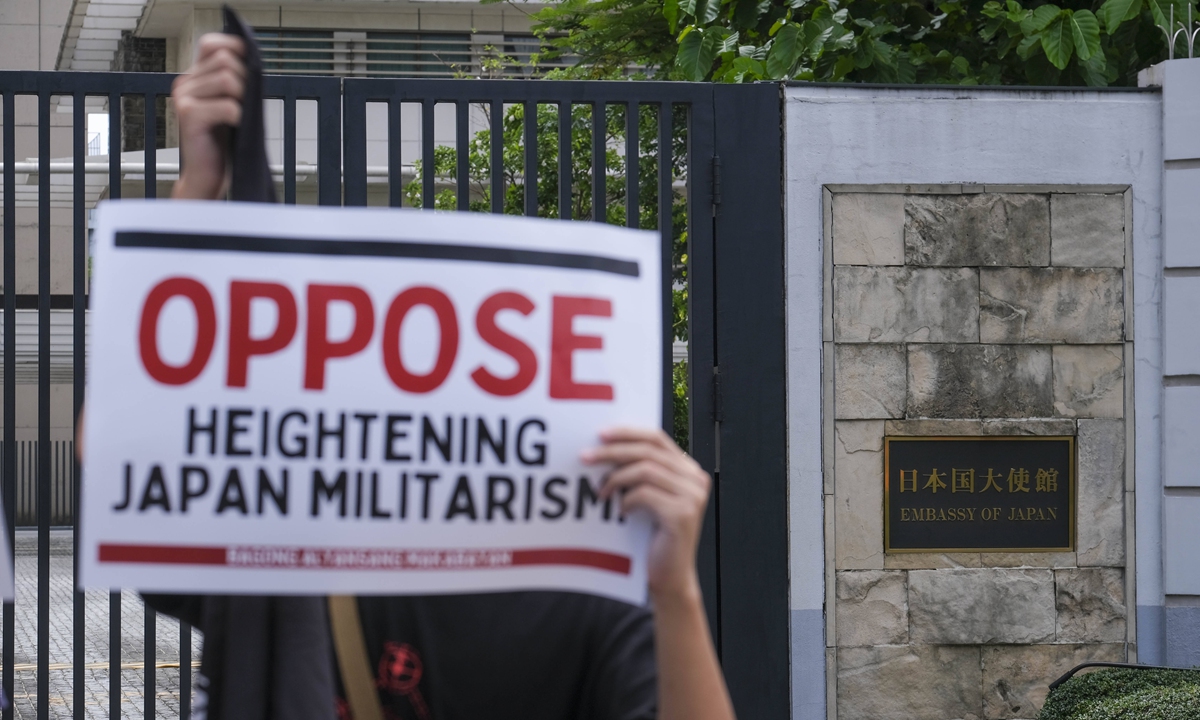
People protest outside the Japanese Embassy in Manila, the Philippines, against Japan's growing militarism tendencies.
Japan's defense budget has set new records for several consecutive years, and for fiscal 2026, it is projected to exceed 9 trillion yen ($58 billion) for the first time. Furthermore, Japan has "abolished restrictions" on the export of lethal weapons, the Japan Times reported. In an April 21 article, the Associated Press described this as "a major change in its postwar pacifist policy."
Moreover, the Takaichi administration has openly tested the waters for revising the Three Non-Nuclear Principles, crossing a dangerous red line. These mounting signs of a new militarist turn have put the international community, especially the victims of Japan's wartime aggression, on high alert and deepened concerns, observers pointed out.
In response to these radical moves by the Takaichi administration, China's Foreign Affairs Ministry has issued multiple stern rebuttals in recent days. "The malevolent emergence of neo-militarism in Japan is putting regional peace and stability under threat. The international community must stay on high alert and take resolute countermeasures," spokesperson Guo Jiakun said at a press conference on June 23.
"In fact, Japan has torn off the mask of 'pacifist country' all by itself," criticized spokesperson Lin Jian at a June 11 press conference.
These concerns have not been voiced by China alone.
Russia has adopted one of the most direct official positions. According to the Xinhua News Agency, Russian Foreign Ministry spokesperson Maria Zakharova said in January that Russia would continue revealing details of Japanese militarists' WWII war crimes, stressing that "there is no statute of limitations for these atrocities."
China's Foreign Ministry spokesperson Mao Ning said at a press conference that Russia's move was a "just action of defending historical truth," stressing that the reckoning with Japanese militarism after WWII "has not been completed."
"Russia is doing its utmost to further reveal the crimes of Japanese militarism and will release relevant information systematically," Zakharova said ahead of the 80th anniversary of the opening of the Tokyo Trial, in April.
Zakharova pointed out that during WWII, Japan enslaved Asian nations and committed inhumane atrocities against civilians. She urged the Japanese government to learn from the lessons of history, abandon its current course of accelerated remilitarization, and stop attempts to whitewash and deny its wartime war crimes, Xinhua reported.
Practical significance
This year marks the 80th anniversary of the opening of the Tokyo Trial. At the International Military Tribunal for the Far East, Japanese war criminals were tried, the culprits responsible for the death of people in victim countries were held accountable and international justice was upheld, according to the Chinese Foreign Ministry.
The anniversary gives the recent anti-militarism language a stronger historical reference point: it is not merely a diplomatic formula, but a reminder of the legal and moral foundation on which the postwar order was built.
Hu Zhiyong, an expert on China's neighborhood diplomacy at the Institute for International Studies, Shanghai Academy of Social Sciences, told the Global Times that Japan's accelerated military buildup has made countries in East Asia, Southeast Asia and parts of South Asia more sensitive to the danger of a militarist revival.
Countries in East Asia and Southeast Asia that suffered from Japanese aggression during WWII still have vivid historical memories of these war crimes, Hu said. South Asian countries, though geographically farther from the main battlefield of Japan's wartime aggression, also have their own historical experience of colonialism and remain alert to renewed conflict and militarization, he said.

An exhibition titled "Justice Trial" opens at the Exhibition Hall of Evidence of Crimes Committed by Unit 731 of the Japanese Imperial Army, in Harbin, capital of Northeast China's Heilongjiang Province, on July 1, 2026.
According to Hu, the significance of these statements also lies in their regional breadth, as concern over Japan's militarist revival has expanded to a wider region and increasingly resonates across it, reflecting shared attention to peace, stability and the postwar order.
What makes these positions more persuasive is that many of these countries maintain substantial economic ties with Japan.
For instance, Japan International Cooperation Agency (JICA) describes itself as a top bilateral donor in Bangladesh; Japan's own Official Development Assistance evaluation said its assistance accounted for 47.7 percent of total bilateral assistance to Mongolia from 2010 to 2018; the Embassy of Japan in Bangladesh has said Japan has been the country's single largest bilateral donor since 2012, while JICA's Bangladesh office describes Japan as Bangladesh's largest bilateral development partner for many years.
In Hu's view, economic cooperation and vigilance against militarism are two different issues. Countries may maintain trade, investment and development cooperation with Japan, but that does not mean they should lower their guard against Japan's military expansion or historical revisionist tendencies.
Normal exchanges with Japan, Hu said, do not erase the need to draw a clear line on issues concerning historical accountability and regional security. Only by remembering history, engaging in soul-searching and taking concrete actions to repent for and correct wrongdoings can a country prevent the tragedy of war from repeating itself, he said.
RELATED ARTICLES