IN-DEPTH / IN-DEPTH
The blood and tears of victims: War orphans, bacterial warfare sufferers demand sincere apology, urging Japan to return to path of peace
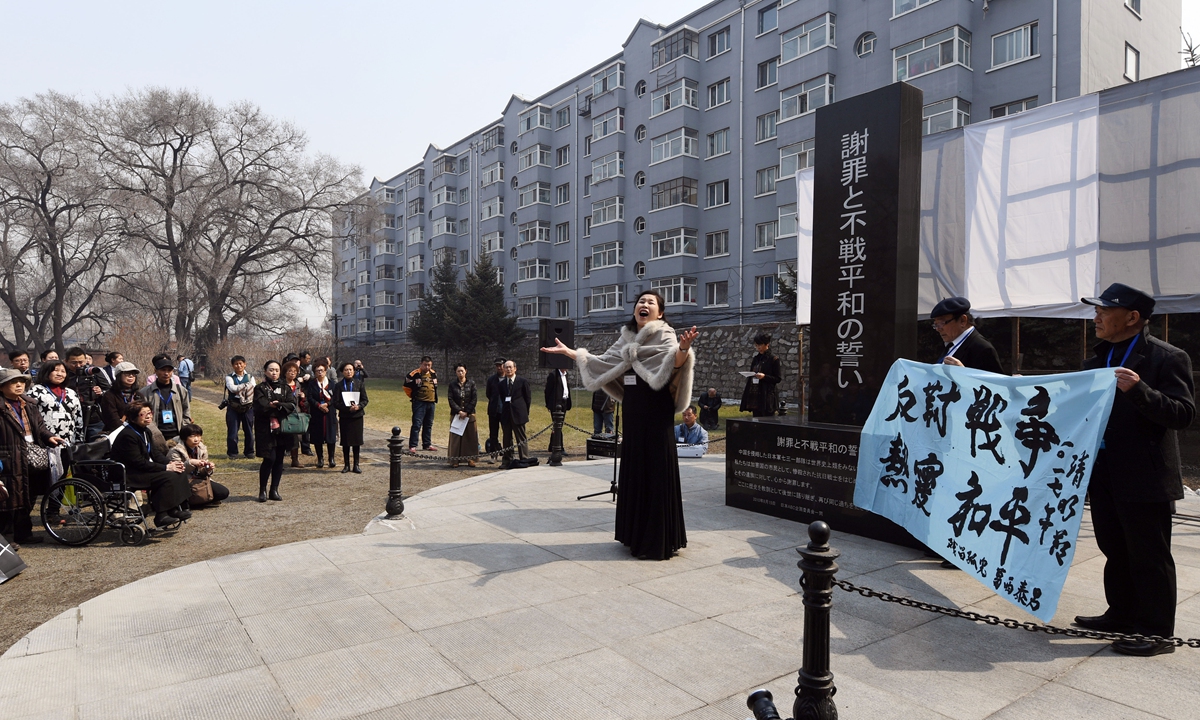
A woman sings in front of an apology and anti-war monument at the former site of Unit 731 in Harbin, Northeast China's Heilongjiang Province, on April 4, 2017. She is a member of a delegation of Japanese war orphans who were visiting China. Photo: VCG
"If Japan had not invaded China, there would have been no war orphans like us, and far fewer families would have been torn apart… I lost everything to that war. That is why we abhor militarism and war with every fiber of our being, and yearn for peace forever," Takayoshi Utsunomiya, 84, a representative of the thousands of Japanese war orphans who were left in China by the Japanese army after Japan surrendered, told the Global Times.
These words represented the hearts of tens of thousands of victims of Japanese invasion of China, to whom the Japanese still owe reasonable compensation and sincere apologies.
Eighty years ago, on January 19, 1946, the International Military Tribunal for the Far East was established, marking the launch of the renowned Tokyo Trials. With the sword of jurisprudence, the trials held over 800 court sessions and prosecuted 28 Class-A war criminals.
Eighty years on, however, the Japanese right-wing administration led by Sanae Takaichi, has brazenly gone against the tide of history. It has wantonly distorted historical facts and deliberately undermined regional peace and stability.
As Japan portrays itself as a war victim to whitewash its ambitions of reviving militarism, the cries of genuine war victims stand as irrefutable testimony to its wartime atrocities.
For decades, wartime sufferers, including war orphans, victims of the "comfort women" system, and survivors of the Nanjing Massacre... have never received a formal apology or reasonable compensation from the Japanese government.
Yet they have never ceased their fight for justice. Time and again, they have taken their cases to court and spoken out in public. This perseverance is not only an attempt to seek justice for their shattered lives, but also a testament - rooted in their flesh-and-blood memories and historical grief - to expose the truth of Japan's war crimes to the world and warn future generations that the deep scars of war never fade.
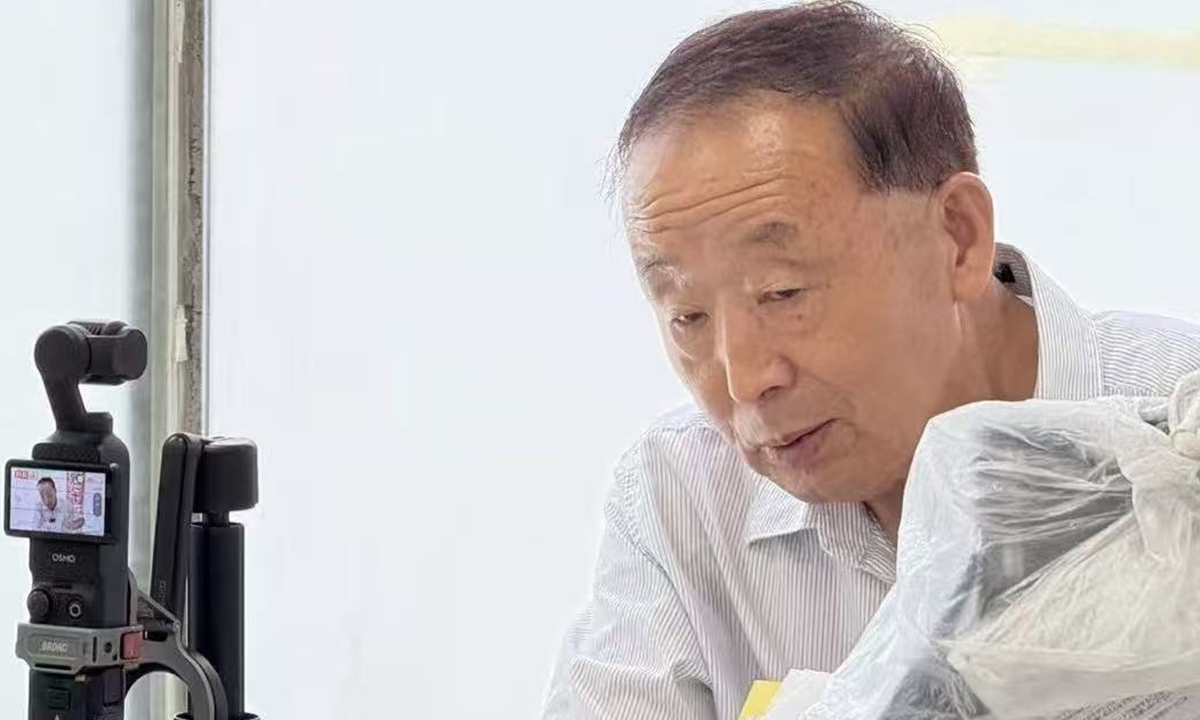
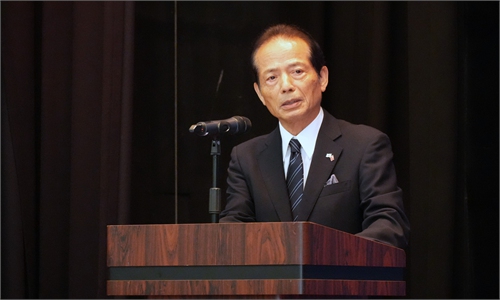
Takayoshi Utsunomiya Photo: Xu Keyue/GT
'Like dumping a sack of potatoes'
Since 1936 to May 1945, alongside the Japanese Imperial Army's invasion in China, more than 220,000 Japanese people were dispatched to China as part of colonial settler groups, known as "Kaitakudan," to seize farmland, according to a documentary by the Central China Television.
Among the 220,000 were Utsunomiya's parents, who were sent to Huanan county in Northeast China's Heilongjiang Province and lived there for more than a year. When Japan surrendered in 1945, Utsunomiya, who was later given the Chinese name Zhang Youcai, was only four years old.
Back then, Japan had a rule that all men under the age of 45 must enlist in the military. My father was conscripted as a result, leaving my mother, elder sister, and me to fend for themselves. After Japan was defeated, the settler group entered into chaos and we fled with other members, taking a train to Jiamusi in Heilongjiang Province, and were eventually placed in a local refugee shelter. Most of the people housed there were Japanese women and children, with very few young men, as nearly all of them had been drafted into the military, Utsunomiya recalled.
Utsunomiya's father was then captured by the Soviet Red Army and deported to Siberia, Russia, where he ultimately died in December 1945. His mother also fell gravely ill after they entered the refugee shelter. Before she passed away, she entrusted her son to a Chinese couple who had come to the shelter to adopt a child.
It was not until the normalization of diplomatic relations between China and Japan in 1972 that the issue of orphans finally drew attention. In March 1981, Utsunomiya became part of the first group of Japanese war orphans to return to Japan to search for their relatives. Yet, even after his return that year, he was plagued by language barriers and cultural and lifestyle differences.
Moreover, the imperfection of policies, the attitude of Japanese relatives, and the degree of acceptance in Japanese society, among other factors, all stood like obstacles on the way for orphans like Utsunomiya who had returned to Japan after living in China for decades, leading to the long-term marginalization of the orphan group.
"When the Japanese government first brought us back to Japan, it was like dumping a sack of potatoes on the ground and leaving us to our own devices. We were scattered all over the country - in Tokyo, Saitama, Kyushu, Hokkaido, and other places - with no means of living security whatsoever," Utsunomiya said.
In pursuit of their own legitimate rights and interests, Utsunomiya and other war orphans in Japan filed a lawsuit against the Japanese government in 2022, demanding solutions to their elderly living security and human rights issues.
Back then, there were 15 such plaintiff groups across Japan, including those in Saitama and Kanagawa prefectures, totaling 1,092 people - 582 of whom were from Tokyo alone, according to Utsunomiya.
However, the outcome of the class action lawsuits was disappointing: The plaintiffs won only the case in the Kobe area and lost all the others. Yet the orphans never gave up. They continued to take to the streets to recount their experiences to ordinary Japanese people, collected more than one million petition signatures, and this move aroused a strong response and resonance across the entirety of Japanese society.
After more than six years of unremitting struggle, the Japanese government finally formulated a new assistance program for the repatriated orphaned victims of Japan's war of aggression against China, which was officially effectuated in April 2008, according to the Xinhua News Agency.
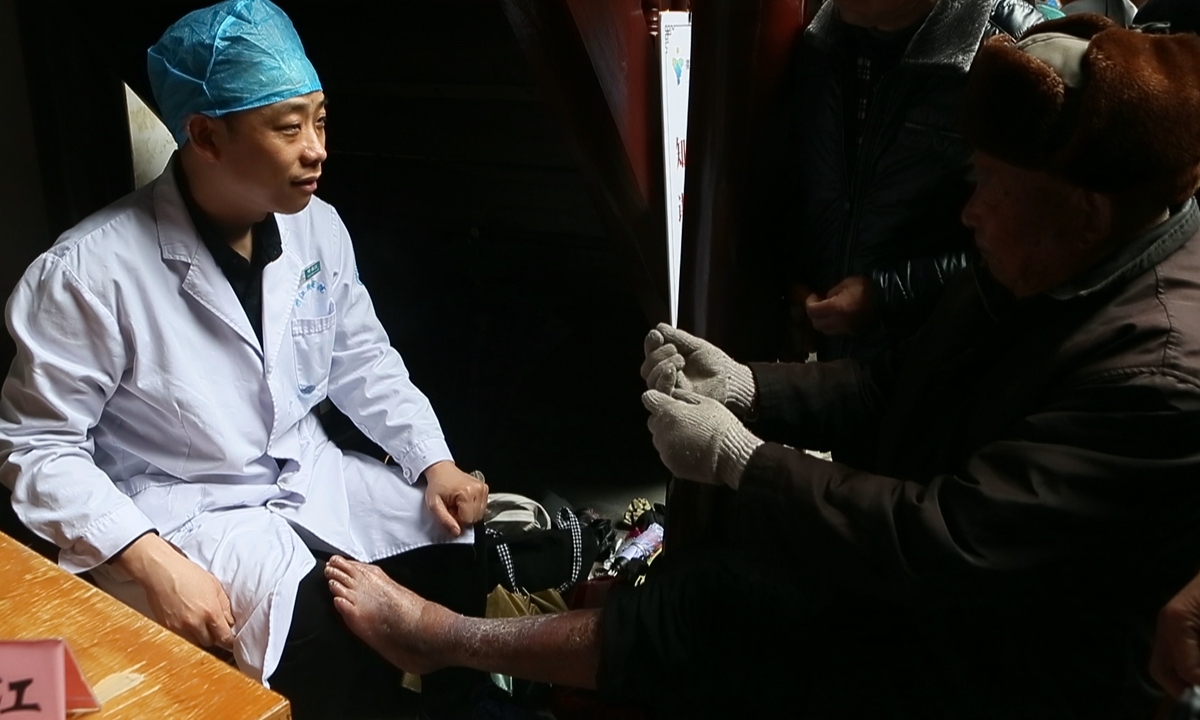
Medical staff provide free medical consultations for a victim of Japan's bacterial warfare in Quzhou, East China's Zhejiang Province, on April 4, 2019. Photo: VCG
'Living well is the best form of resistance'
In Quzhou, East China's Zhejiang Province, victims of Japan's bacterial warfare are also fighting for their justice.
On December 13, 2025, the National Memorial Day for the Nanjing Massacre Victims, a special post of the movie Evil Unbounded - a Chinese movie that revisits the horrific World War II-era human experiments conducted by Japan's notorious bacterial warfare Unit 731 - was aired at a local museum commemorating victims of Japan's biological attacks in Quzhou. The post garnered 30 signatures from the inheritors of the historical memory of the attacks. The signatures showed their determination to carry on the will of their ancestors and defend historical truth.
Each signature on the post is an exposure of the war crimes of the Japanese invaders, director of the museum Wu Jianping, who is also a descendant of the victim of the bacterial attack in Quzhou, told the Global Times.
According to materials provided by the Quzhou government to the Global Times, the museum commemorating victims of Japan's biological attacks in Quzhou was promoted and established by Yang Dafang, a victim and witness of Japan's bacterial warfare in Quzhou.
According to Xinhua, between 1940 and 1948, Japan's bacterial warfare led to over 300,000 infections and more than 50,000 deaths in Quzhou. Some villages were almost wiped out, making Quzhou one of the region's most severely affected by the Japanese army's bacteriological warfare. Yang's father was one of those who died of plague during the warfare.
Yang, who was also one of the first-generation fighter pilots of the Chinese People's Liberation Army Air Force, followed a plaintiff group of Chinese bacterial warfare victims to Japan four times since 1997 to sue the Japanese government.
The lawsuit was also defeated like the war orphans. On August 27, 2002, the Tokyo District Court issued the first-instance judgment, and on July 19, 2005, the Tokyo High Court handed down the second-instance judgment, both ruling against the plaintiff group. On May 9, 2007, the Supreme Court of Japan decided to uphold the second-instance judgment - acknowledging the fact of Japan's bacterial warfare but rejecting the plaintiffs' demands for an apology and compensation from the Japanese government, Xinhua reported.
But Yang did not stop. He continued to strive to let more people know about this unforgettable chapter of history in Quzhou. He initiated the establishment of the museum and traveled across China to give lectures and reports about the history.
"Our group of germ warfare victims is dwindling. For those of us who are still alive, living well is the best form of resistance. As long as we live, we can personally tell more people what happened," Yang once said, according to the materials from the Quzhou government.
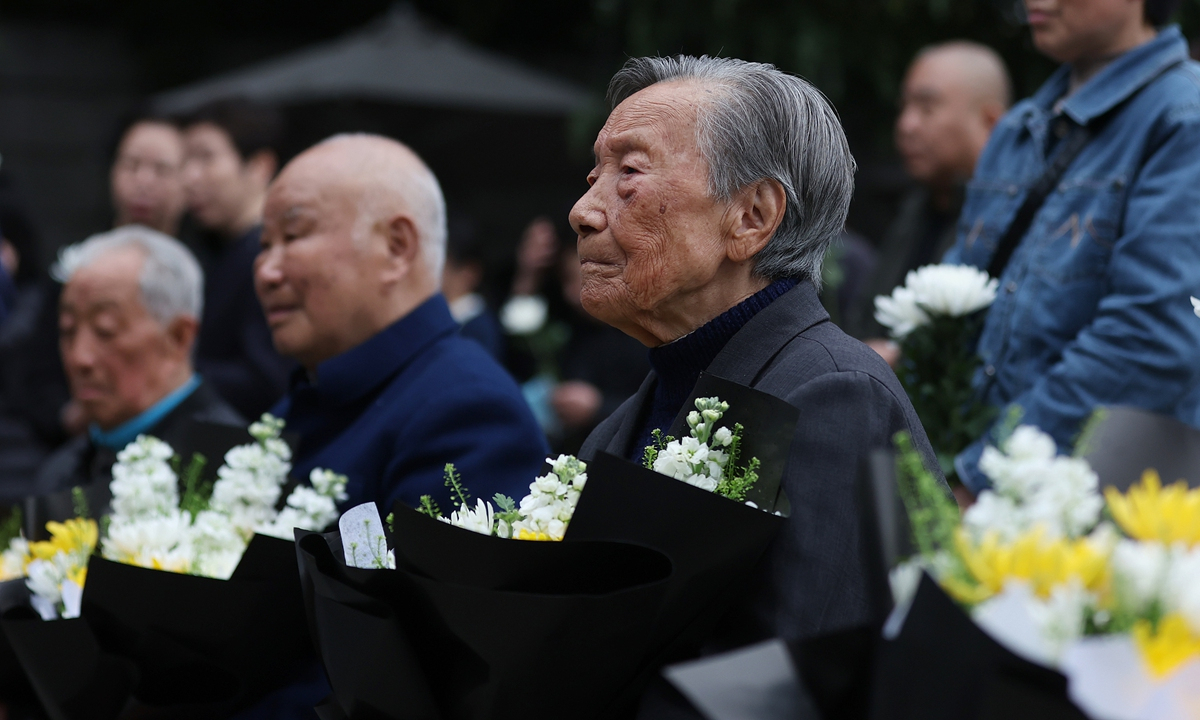
Xia Shuqin, along with other Nanjing Massacre survivors, their descendants, and representatives of the victims' families, attend the Qingming Festival memorial ceremony for the victims in Nanjing, East China's Jiangsu Province, on April 3, 2024. Photo: VCG
'Japan must face up to history'
Yang passed away in February 2017 at the age of 85, without receiving the justice he deserved. So have many other war victims and witnesses to those hellish years.
But their stories, as well as their unyielding struggle, continue ringing an alert amid Japan's evasion of its responsibility as a defeated nation. Their unhealed wounds have also become a moral reckoning hanging over Japan, one that can never be erased.
"My father, Xue Peize, was a victim of Japan's bacterial warfare in Quzhou. For the latter half of his life, he had been urging the Japanese government to face up to history and fully acknowledge the fact of bacterial warfare," Xue Lulu, one of the inheritors who signed on the movie post, told the Global Times.
"Japanese militarism bears heinous historical responsibilities. I will take over the unfulfilled mission of my father, tell the painful memories of bacterial warfare victims to peace-loving people around the world, and resolutely refute the lies of Japanese right-wing forces," Xue said.
In a statement released on January 26, China's Deputy Permanent Representative to the UN, Sun Lei, denounced Japanese representative's remarks concerning China at the UN Security Council Open Debate on Reaffirming International Rule of Law. Sun said that the Japanese representative distorted facts and misled the international community.
"The International Military Tribunal for the Far East systematically exposed the crimes of Japanese militarism through its trials. However, some Japanese politicians and forces have never truly repented or acknowledged their guilt. Instead, they have attempted to deny these crimes and falsify history. Their so-called reflection on the war focuses, ironically, on why Japan was defeated, rather than on its war crimes. Such a Japan is a perpetrator of wars of aggression," Sun said.
Sun said that Japan's recent remarks and moves, from Japanese leaders threatening the use of force against China, to senior officials in the Prime Minister's Office publicly advocating nuclear armament, to attempts to revise the three national security documents and signal changes, to the three non-nuclear principles, all of these expose the efforts of Japan's right-wing forces to promote re-militarization and return to the old path of military expansion. These actions pose new threats to regional and global peace. Such a Japan has become a resurrector of militarism. The international community must prevent Japan from embarking on the old and evil path of militarism again, he noted.
The Japanese government must face up to history, be responsible to its people and the future, and take the path of peaceful development as the only way out, Utsunomiya told the Global Times.
"Every time we see tensions between the two countries, we feel utterly heartbroken. There is little I can do, but I will do my humble part to act as a bridge for friendship between China and Japan," Utsunomiya stated.
The blood and tears of victims
RELATED ARTICLES