IN-DEPTH / IN-DEPTH
The longing of islanders: Indigenous people seek justice in homeland dispute with Japanese government
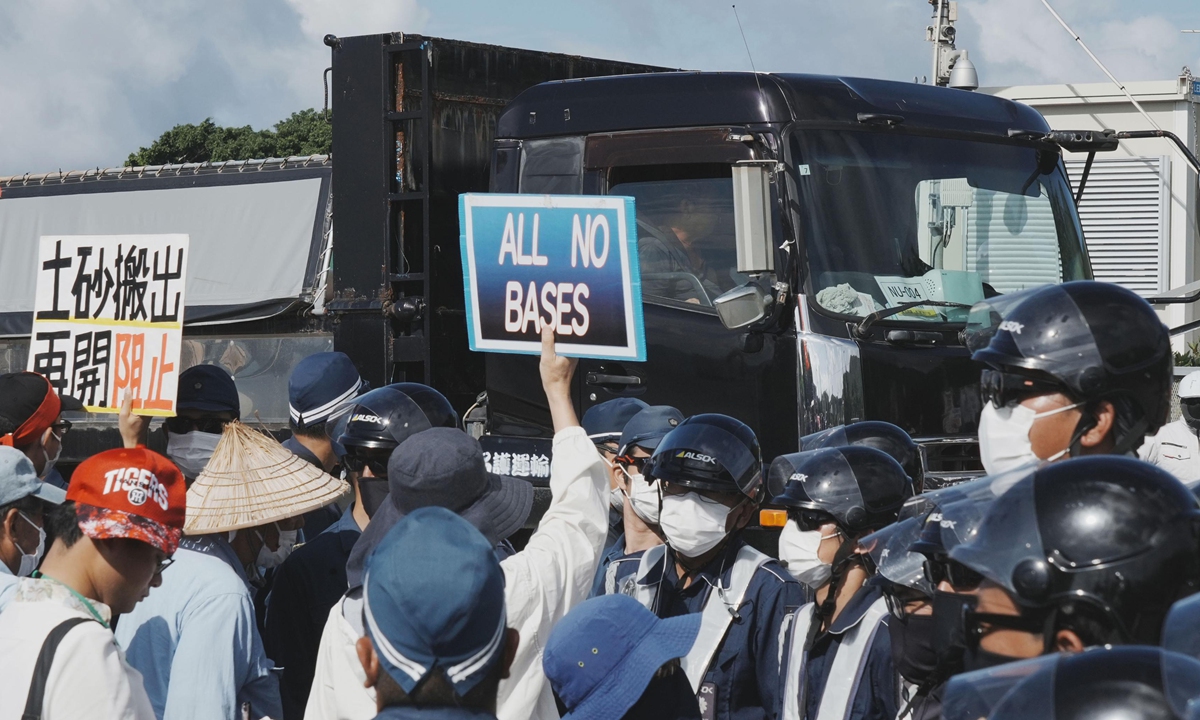
Demonstrators gather in Nago, Okinawa Prefecture, Japan on August 22, 2024 to protest against the relocation of US Marine Corps' Futenma air base to a coastal area in the city from another part in the prefecture. Photo: VCG
Yuzo Takayama used to think of himself as Japanese, but his current social media bio reads: A Ryukyuan with Japanese nationality.
The introduction is just a few words, but it is an answer that Takayama had been searching for years, he told the Global Times reporters, who paid a visit to the Ryukyu main island, which is now Okinawa Main Island.
From yearning for life in mainland Japan's major cities to returning to his hometown, and from pursuing music as a career to entering politics, Takayama's journey of identity awakening is intertwined with the historical trauma and present-day dilemmas of the Ryukyu Islands.
More than 80 years have passed since the end of World War II (WWII), yet the territories that should have been stripped from Japan in accordance with the Cairo Declaration are still mired in disputes. For this, the Ryukyuan Islands and the suffering of the Ryukyuan people serve as a vivid epitome.
The root cause of these disputes lies in Japan's failure to thoroughly reckon with its colonial expansion and aggressive wars, as colonialist ideology continues to influence Japanese politics, Chinese experts noted. The current Sanae Takaichi administration's erroneous remarks and moves concerning some of these islands have further brought these disputes back into public view, highlighting the serious consequences of Japan's refusal to face up to history, they said, warning against the revival of militarism in Japan.
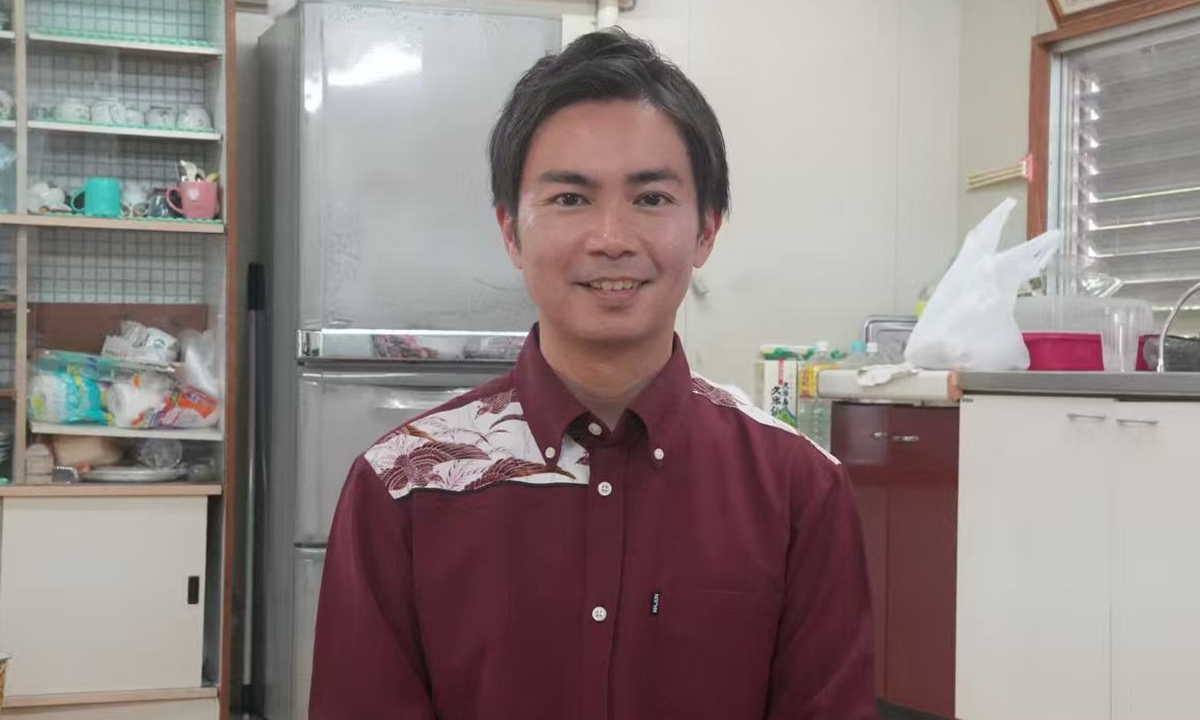
Yuzo Takayama, a member of the Nago City Council in Okinawa Prefecture, Japan Photo: Wang Pu/Global Times
Hard to relate
Takayama was born in 1984 in Itoman city, the southernmost point on Ryukyuan Main Island. In his childhood home, his parents and grandparents spoke the Ryukyuan language among themselves, switching to Japanese only when speaking with him. "Perhaps it was for educational reasons. They wanted me to get into a good university and land a good job," Takayama recalled.
At school, there were no courses teaching the Ryukyuan language either. Takayama told the Global Times that under Japan's assimilation policies, which were designed to mold Ryukyuans into "proper Japanese" when his parents were in school, children who spoke the Ryukyuan language were forced to wear a humiliating placard known as "a dialect tag" around their necks. And they could remove it only after catching another child speaking Ryukyuan. As a result, children gradually stopped using their native languages at school.
During the Battle of Okinawa, local residents who were discovered speaking the Ryukyuan language by Japanese troops were suspected of colluding with US forces and were subjected to massacres. After the war, Ryukyuans found that their homeland had been turned into US military bases. To make a living, many had no choice but to move to mainland Japan, where they had to learn to speak Japanese.
The gradual disappearance of the Ryukyuan language was less a matter of people abandoning their mother tongue than having no alternative, Takayama said. "Otherwise, you simply couldn't survive."
Before going to Tokyo to go to university, while looking through his family genealogy by chance, Takayama discovered that his ancestors could be traced back to King Shoshin, who led the prosperity of the Ryukyu Kingdom in the 15th century and reigned for 50 years. Out of curiosity, Takayama then began reading extensively about the history of the Ryukyu Kingdom.
The more he learned, the more he realized how different Ryukyu was from Japan. He found subjects like history and society at school focused almost entirely on mainland Japan, making it hard for him to relate. Once in Tokyo, he felt more and more keenly the contrasts between the mainland and his hometown in terms of language, music, culture and traditions. His self-awareness as a Ryukyuan grew ever stronger.
Japan's assimilation policy on the Ryukyuan Islands began in the 19th century and has continued to this day. This policy not only led to the deprivation of local language and culture, but also the persecution of Ryukyuan indigenous people, said Liu Dan, an associate fellow at Shanghai Jiao Tong University.
She noted that this policy seriously violates the relevant norms of UNESCO and the Human Rights Council.
A private instruction
The Ryukyu Islands are scattered across the waters from the northeast of China's Taiwan island to the southwest of Japan's Kyushu Island. Historically, Ryukyu was a tributary state of China during the Ming and Qing dynasties (1368-1911), and served as a transit hub for trade in Asia. Japan annexed the Ryukyu Islands in 1879 and built the Okinawa Prefecture on the islands.
According to the Cairo Declaration, "Japan shall be stripped of all the islands in the Pacific which she has seized or occupied since the beginning of the First World War in 1914, and that all the territories Japan has stolen from the Chinese, such as Manchuria, Formosa, and the Pescadores, shall be restored to the Republic of China. Japan will also be expelled from all other territories which she has taken by violence and greed." Moreover, Article 8 of the Potsdam Declaration reinforced that "the terms of the Cairo Declaration shall be carried out and Japanese sovereignty shall be limited to the islands of Honshu, Hokkaido, Kyushu, Shikoku and such minor islands as we determine."
Later, according to the relevant provisions of San Fransico Peace Treaty, the Ryukyu Islands should have been placed under a United Nations trusteeship after WWII. Instead, the US imposed a military occupation and later transferred control to Japan in 1972, Liu said.
The transfer does not comply with international law in handling similar matters. The "flawed San Francisco Peace Treaty," not only violated the Allied countries' initial arrangements for the postwar order, including the Cairo Declaration, but also seriously breached their agreements as a coalition against fascism to act in unison and not to conclude a separate peace with enemies, Liu said.
The handover of the Ryukyu Islands to Japan went against the will of the Ryukyu people and violated the trusteeship principles. It is essentially "a private instruction," she said.
The Japanese government also failed to make sufficient moves to protect the Ryukyuan people's human rights during their administration of the islands since 1972. The financial allocations to local government of Ryukyu are grossly inadequate. In reality, the local economy is highly dependent on US military bases. Neither did they pay sufficient attention to environmental issues and rape cases related to the military bases, Liu said.
The mainland Japanese have long been enjoying Okinawa for their own sake. They claim to like Okinawa, yet immediately fall silent when you ask them, "How about moving the US military bases out of Okinawa to the mainland?" Ignoring problems deeply rooted in Okinawa, these flattering words become a kind of guilt-riddance card, hiding the selfishness of mainlanders, Takayama said.
Thousands of miles away from the Ryukyu Islands in the East Sea, 26 people are also holding fast to South Korea's Dokdo islets as a resistance to Japan's renewed claim over the territory, which they call Takeshima. During a House of Representatives Budget Committee session on December 9, 2025, Japanese Prime Minister Takaichi said that Takeshima, Japan's name for the Dokdo islets, is "Japanese territory," which was dismissed by the South Korean presidential office, according to the Yonhap News Agency.
South Korea restored its sovereignty over Dokdo after the Korean Peninsula's liberation from the 1910-45 Japanese colonization. Seoul has since been in effective control of the islets.
Besides 25 policemen and management staff deployed by the government, 87-year-old Kim Shin-yeol is now the sole registered resident of Dokdo. She and her husband Kim Sung-do began living on Dokdo in the early 1970s. Her husband, who was called the guardian of Dokdo, died from liver cancer at the age of 79 in 2018, the Yonhap News Agency reported.
"It's a symbol that civilians continue to reside on the Dokdo Islands," Kim Jin-hee, Kim Shin-yeol's daughter, was quoted by CNN in a report in 2019. "We never even once thought about leaving the Dokdo Islands," she said.
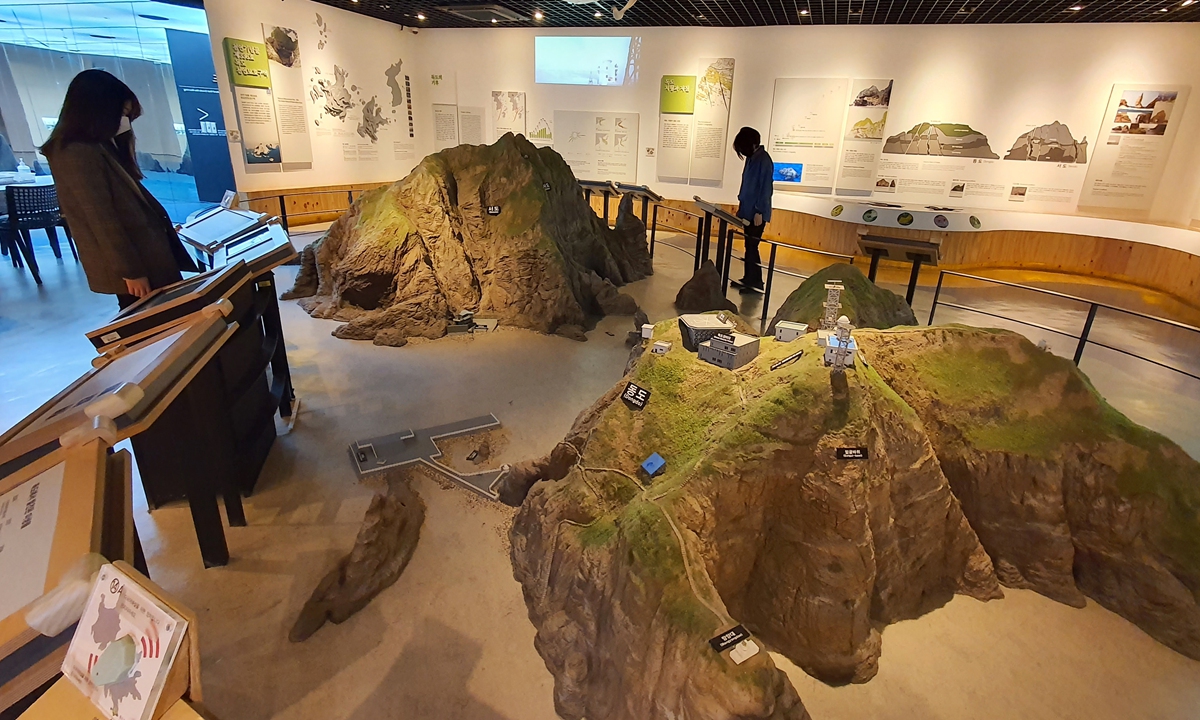
People visit a Dokdo exhibition in Seoul, South Korea on March 30, 2022. Photo: VCG
'Must stay vigilant'
Looking at Japan's territorial policy in the early post-war period, although Japan, as a defeated country, pledged to accept the surrender terms of the Potsdam Proclamation, it refused to implement a series of provisions set by the Allied countries from the Cairo Conference to the Potsdam Conference and repeatedly put forward territorial claims to the Allied countries. Fundamentally, the core issue stems from a colonial mentality and the lack of reflection on its aggressive war, read an article published in World History of the Chinese Academy of Social Sciences in 2015.
The recent dangerous remarks and actions of current Takaichi administration in the Pacific region have made this truth even clearer to the world.
"The 'contingency theory' of Sanae Takaichi is a warning sign that Japanese militarism is attempting to stage a comeback," Kao Chin Su-mei, a Taiwan indigenous peoples' representative, said in a video released after Takaichi made a provocative remark on the Taiwan island in November 2025.
Such political rhetoric is intolerable to people who once suffered from Japanese militarist aggression, colonization and plunder, Kao said. She said as early as the 19th century, Japan has been using the same "contingency theory" as a pretext to launch wars of aggression.
According to the Kyodo News Agency, the Ishigaki City Assembly in Okinawa Prefecture convened an extraordinary session on Saturday and adopted a bill targeting China's Diaoyu Islands, which the Japanese government calls Senkaku Islands and claims fall within their administrative jurisdiction. The assembly claimed that the legislation is formulated with the aims of protecting environment, ensuring navigation safety in the surrounding waters and promoting the utilization of the islands, according to the report.
While this resolution includes soft measures such as ecological protection, it is in essence an example that the government is seeking to realize their militaristic ambition through state actions. Their moves will not merely be confined to the military dimension, but aligned with moves in the political, legislative, and other spheres, forging a three-dimensional advancing posture that integrates military, political, and legislative efforts, Liu said.
"We must stay vigilant, the recurrence of historical tragedies must be prevented," Liu warned.
The longing of islanders
RELATED ARTICLES