LIFE / CULTURAL INFLUENCER
From record-breaking teens to NCAA talent: The young Chinese athletes poised to shape Asia’s sports future
Five athletes at 2026 Asian Games could offer glimpse of China’s next generation of competitors
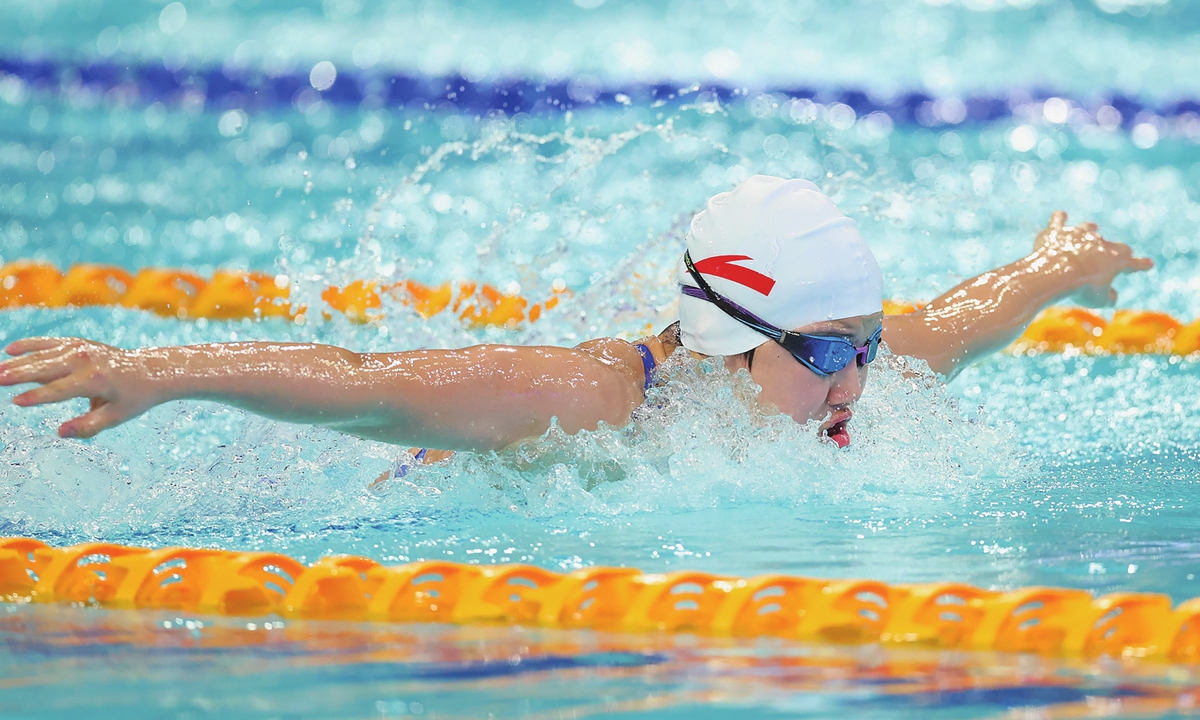
Yu Zidi competes in the women's 400m individual medley final during the China Open Swimming Championship in Shenzhen on March 21, 2026. Photos on this page: VCG
With the 2026 Asian Games less than a month away, China is preparing to send a team that could offer an early glimpse of the country's next generation of sports talent. The Games, scheduled for September 19 to October 4 in Japan, come as a testing ground as the athletes gear up for the 2028 Los Angeles Olympic cycle.For a number of young Chinese athletes, the event will provide an opportunity to move from promising domestic performers to competitors on one of Asia's biggest sporting stages. They have already made their names in very different ways. Some have broken national or Asian records. Some have won national titles. Others have emerged through professional leagues or overseas college systems.
For these athletes, the Asian Games may not determine their careers, but they could become an important checkpoint on the road to Los Angeles and beyond.
Promising teenagers
Few athletes illustrate the arrival of a new generation more clearly than swimmer Yu Zidi.
The swimmer was only 12 when she attracted international attention at the 2025 World Aquatics Championships. She helped China reach the women's 4x200-meter freestyle relay final, where the team won bronze, making her the youngest medalist in the history of the championships.
Her breakthrough was not simply the result of an appearance at the worlds.
Now 13, Yu is already accustomed to competing alongside established senior swimmers. She was named to China's Asian Games swimming team roster in June, putting her among the youngest athletes expected to compete.
The challenge this time will be about more than speed. A major multisport event will test how a very young athlete manages pressure, expectations, and the demands of competing on a senior international stage.
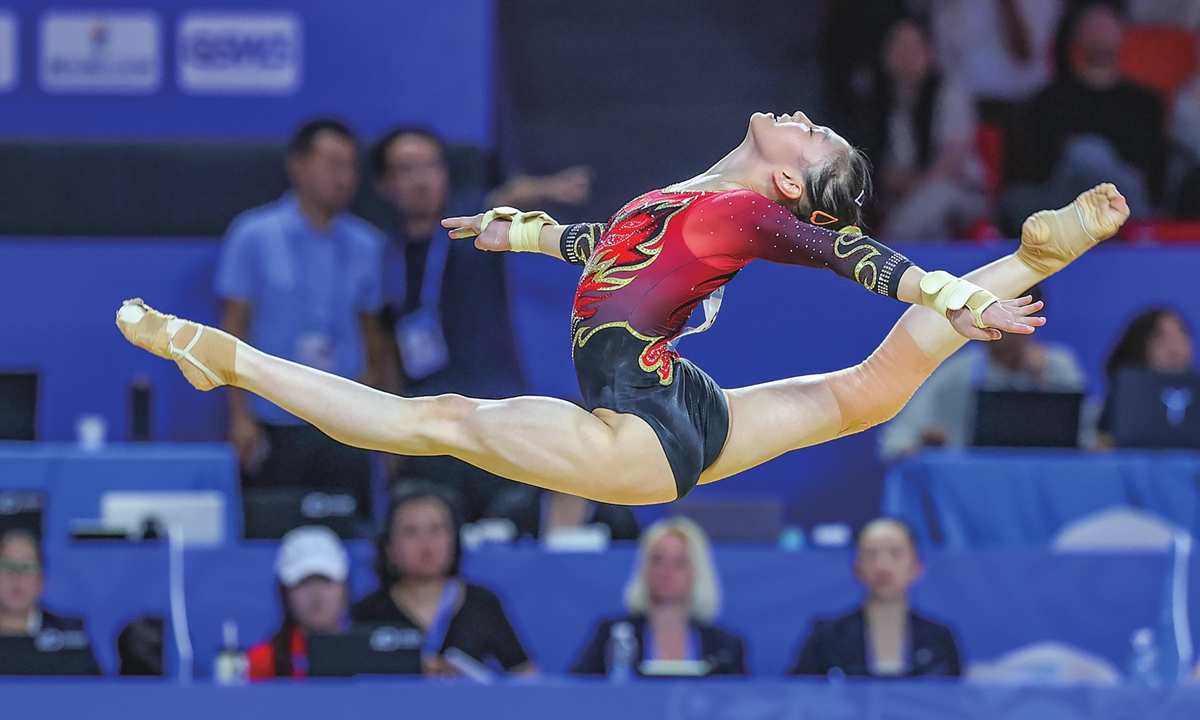
Ke Qinqin competes in the floor exercise of Asian Gymnastics Championships on June 25, 2025. Photos on this page: VCG
If Yu represents the extraordinary precocity of Chinese swimming, then 16-year-old female gymnast Ke Qinqin represents another quality: versatility.Ke made a major breakthrough at the 2025 National Games, winning five gold medals in gymnastics across the senior and youth competitions. At 15, she was among the youngest athletes to make a major impact at the Asian Games.
Her strength is particularly evident in the all-around competition, where gymnasts must maintain consistency across vault, uneven bars, balance beam, and floor exercise. That makes her Asian Games debut especially intriguing.
Rather than relying on a single specialist event, Ke will be tested across multiple apparatuses against some of the best gymnasts in Asia. Her ability to remain consistent under pressure could be just as important as the difficulty of her routines.
At the Asian Games, the teenager will have an opportunity to turn the promise she showed at the National Games into senior international experience.
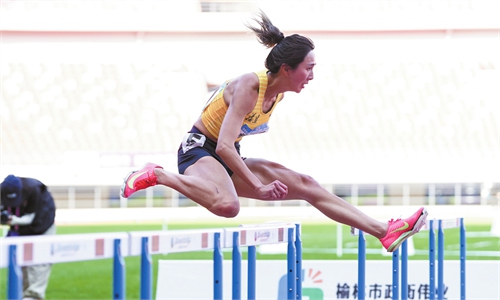
In athletics, China's women's sprinting has long been searching for an athlete capable of consistently challenging the leading sprinters in Asia. Seventeen-year-old Chen Yujie could be one of the candidates.
The teenager has already established herself as one of China's most promising young sprinters. At the 2025 National Games, she won both the women's 100m and 200m titles. In August this year, Chen won the women's 100m at the national championships in 11.08 seconds, improving her personal best and setting an Asian U20 record.
For Chen, Nagoya will offer an early indication of whether her achievements can translate into senior Asian competition. Sprinting offers little room for error, as a few hundredths of a second can drastically differ the finishing place.
Team sport hopefuls
In team sports, football offers a different route for China's emerging generation.

Wang Yudong plays in the friendly game between China and Thailand in Jinhua of East China's Zhejiang Province on June 9, 2026. Photos on this page: VCG
Wang Yudong has made the transition from youth football to the professional game at remarkable speed.Despite not having as many goals as he scored in 2025, Wang, now 20, continued his development at the 2026 U23 Asian Cup, where China reached the final for the first time and finished runners-up.
The Asian Games men's football tournament, which is based around U23 players, should therefore suit a player whose career has already progressed through several levels of international football.
For Wang, the question in Nagoya will be whether he can continue to provide goals and constitute an attacking threat against strong Asian oppositions, while taking on greater responsibility in a major tournament.
In basketball, China international Wang Junjie's development illustrates another route for China's next generation. The 21-year-old forward has spent much of his recent development in the US college basketball system. He played NCAA basketball at the University of San Francisco before moving to the University of Massachusetts in 2026.
His international breakthrough came with China's national team at the 2025 FIBA Asia Cup when China reached the final. At 2.06 meters in height, Wang can contribute in several areas, including scoring, rebounding, and physical defense. His route is different from that of the others. He is not arriving in Nagoya as an unknown teenager, but as a player who has already experienced senior international basketball and an overseas development system.
A generation to be tested
Together, the five athletes offer a glimpse into the evolving pathways through which China's next generation is emerging.
The Asian Games, therefore, may be less about identifying the next Olympic champion than about seeing how these young athletes respond when competition, expectations and stakes rise.
"A single Asian Games will not determine whether any of them becomes a future Olympic star, but it can provide a benchmark equally valuable at this stage of their careers," Wang Dazhao, a sports commentator, told the Global Times.
"People sometimes are too focused on the medal count of a major tournament. For young athletes, results are important, but so is progress. The Asian Games can show us where they stand and what they still need to improve."
RELATED ARTICLES