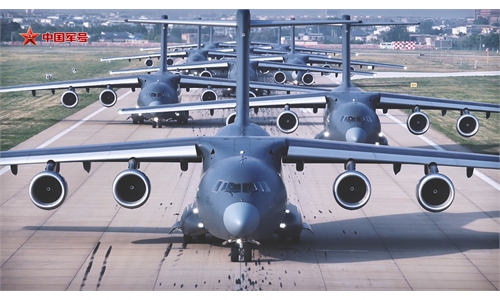
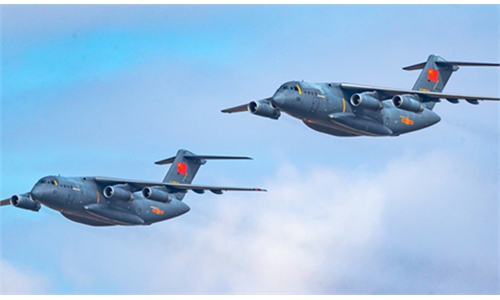
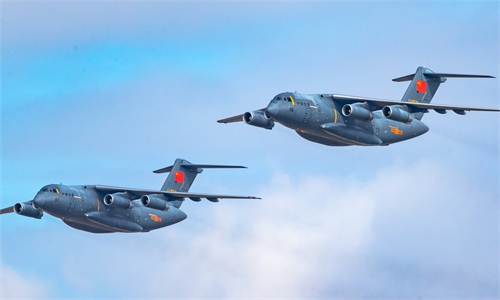
Y-20 transport aircraft, Wing Loong drone,Mi-171 deployed to support Xizang mudslide rescue efforts
Multiple aviation platforms join forces at mudslide-hit border port
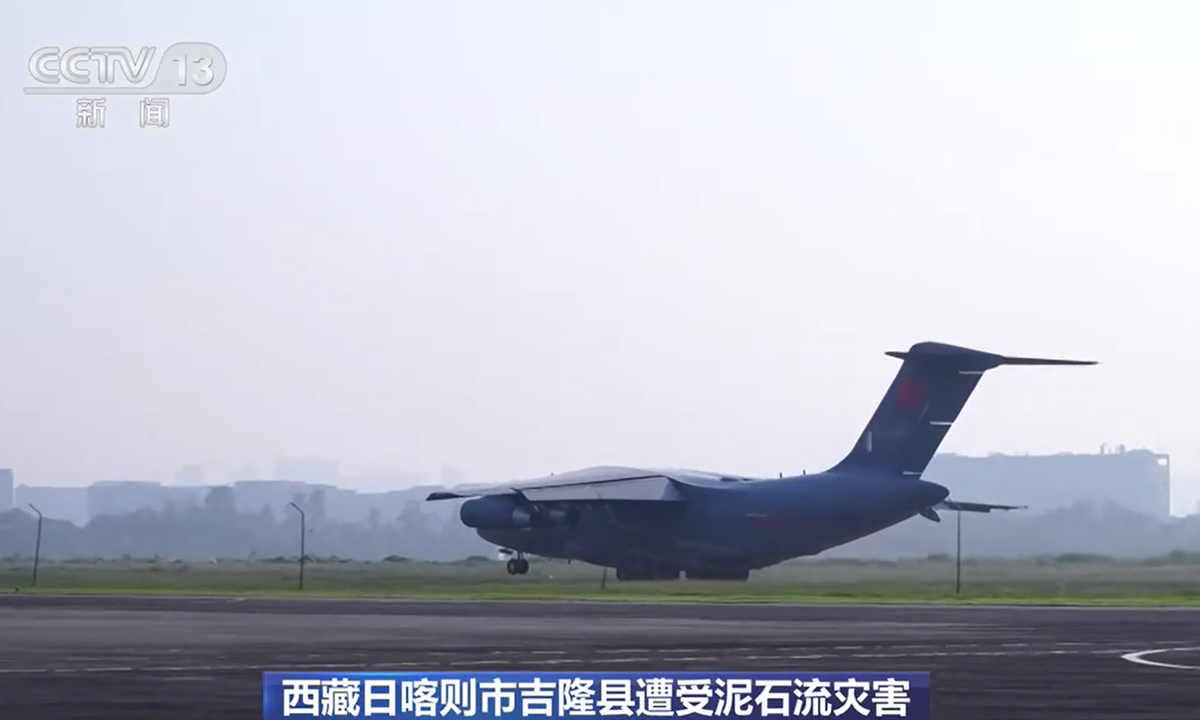
Photo: CCTV News
Multiple types of aviation equipment, including the Y-20 transport aircraft, Wing Loong unmanned aerial vehicle (UAV) and Mi-171, have been deployed to support rescue and relief efforts after a devastating mudslide originating on the Nepalese side of the China-Nepal border hit the Gyirong Port in Southwest China's Xizang Autonomous Region.According to China Central Television (CCTV), the disaster occurred in a junction where the main channel of a gully meets its tributary channels, where the elevation difference between mountain peaks and valleys exceeds 3,000 meters. Glaciers and glacial lakes are also distributed at the top of the mountains, with persistent rainfall, narrow terrain, and risks of secondary disasters including landslides, collapses and falling rocks adding to the challenges facing rescue operations.
Against this backdrop, a leading group from the PLA Western Theater Command arrived at a high-altitude airport in Xizang aboard a Y-20 transport aircraft at around 10:00 am on Thursday for rescue operations, per Xinhua.
The Y-20 is a large transport aircraft independently developed by the Aviation Industry Corporation of China (AVIC). Since its first delivery to users in 2016, the aircraft has participated in multiple disaster relief missions and international humanitarian operations, per AVIC.
According to information from China National Intellectual Property Administration, the Y-20 has a maximum takeoff weight of about 220 tons and a payload capacity of around 60 tons. With a full fuel load, it can fly at an altitude of 13,000 meters at a speed of 700 kilometers per hour and has a range of approximately 8,000 kilometers.
The aircraft adopts a four-engine, high-mounted main wing and high-T-shaped tail wing design, while domestically developed composite materials help reduce structural weight and improve payload capacity.
Given the demanding requirements for equipment performance during takeoffs and landings on the plateau, maintenance personnel carried out comprehensive inspections of the aircraft, adjusted relevant parameters, and organized configuration changes for the Y-20 transport aircraft. They installed cargo securing devices and medical rescue facilities, making preparations for multiple missions, including personnel transport, supply delivery and casualty evacuation, according to China News Service.
Besides the Y-20, the Sichuan Provincial Department of Emergency Management urgently dispatched a Wing Loong emergency communications UAV for a cross-regional support mission, which took off at 6:18 pm on Wednesday and arrived in the designated airspace, according to CCTV military channel.
It has carried out disaster assessment and emergency communications support missions, providing aerial technical assistance for ground search and rescue operations and communication services.
For this mission, a total of two Wing Loong UAVs have operated continuously for more than 22 hours in challenging airspace conditions, conducting comprehensive aerial reconnaissance while providing emergency communications services. The drones recorded about 6,069 user connections and supported more than 661 communication calls, the Global Times learned from its production company AVIC on Thursday.
Relying on a mature platform, extensive operational experience and advanced anti-icing system design, Wing Loong UAVs have remained operational under harsh weather conditions, providing a reliable "airborne shield" for rescue and relief operations.
The aircraft has already conducted multiple takeoffs and landings at the rescue site, carrying out repeated missions, according to AVIC.
In addition, the Mi-171 specially adapted for high-altitude operations also arrived in the disaster-hit area by around 8 am on Thursday, according to Xinhua. Meanwhile, helicopters from an army aviation brigade under the PLA Xizang Military Command were also urgently dispatched, which took off from Lhasa and headed toward Gyirong Town in Shigatse on Thursday, according to CCTV.
When roads are washed away, bridges are cut off and mountainous areas become inaccessible, aircraft, helicopters and unmanned aerial rescue equipment are often the fastest, and sometimes the only means of reaching disaster-hit areas, according to Aerospace Knowledge, a publication affiliated with Chinese Society of Aeronautics and Astronautics (CSAA).
By this means, these platforms complement each other: large transport aircraft complete the longest-distance transportation, while helicopters, ground vehicles and rescue teams handle the final stretch into affected areas, UAV platforms such as Wing Loong can also temporarily serve as airborne communication stations when ground networks are disrupted. Their surveillance capabilities allow rescue teams to monitor road conditions, changes in barrier lakes and potential geological hazards, helping improve decision-making during emergency response, according to the report from Aerospace Knowledge
Aircraft can also play a key role in medical evacuation. After being equipped with stretchers, medical equipment and oxygen supply systems, transport aircraft can serve as airborne medical evacuation platforms, according to the report.
RELATED ARTICLES