Photo: VCG
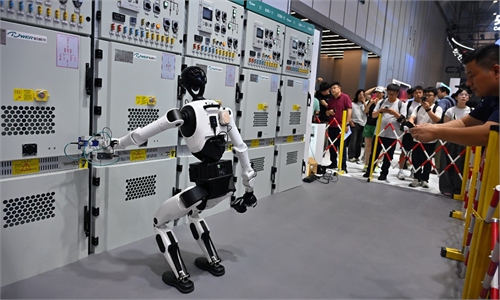
A sandwich shop in Ujjain, India, recently attracted attention online after a humanoid robot arrived at its opening ceremony accompanied by security guards and danced to music in front of a crowd. A report by the Economic Times described it as a "Chinese Unitree robot."
Some reports suggested that the robot had been rebadged by Indian firm Bidyut Innovations, although details surrounding the arrangement remain unclear. The footage has sparked discussion not only in India but also in China. Some Chinese social media users were surprised by the robot's celebrity-like reception, particularly given the presence of security guards.
From a marketing perspective, inviting a robot to the opening ceremony proved to be a successful idea. The dancing humanoid robot turned an ordinary opening event into an online talking point, boosting the shop's visibility. Some Chinese internet users noted that the robot's performance added excitement to the ceremony.
Regardless of where the robot came from, one point is worth noting: the robot's "Indian dance" highlighted growing public interest in emerging technologies such as artificial intelligence (AI) and robotics. This interest could encourage further exploration of robotics applications in commercial and everyday settings. If humanoid robots find more applications in India's commercial spaces and public environments, they could encourage wider adoption of new technologies and create new opportunities for related industries.
China is moving humanoid robots closer to real-world applications. In China, robots are being explored in a growing range of commercial settings. In some shopping malls, visitors can see robotic arms preparing drinks or robots making coffee. During the Spring Festival, humanoid robots also appeared in public spaces, writing traditional Chinese couplets and interacting with visitors. These examples show how robotics is gradually becoming part of more everyday scenarios.
Foreign visitors to China may be struck by the growing presence of AI and robots in everyday life, creating a distinctly futuristic atmosphere in public spaces. Such applications could potentially be replicated in other markets around the world.
Media reports have noted that Chinese humanoid robots accounted for about 90 percent of global shipments in 2025. Data from the first quarter of 2026 also showed strong growth in China's humanoid robot exports, which reportedly rose 210 percent year-on-year.
Today, overseas markets are showing growing confidence in Chinese robotics products. Buyers are no longer choosing Chinese robots simply because they offer good value for money. Increasingly, they see Chinese products as more reliable, easier to use, and faster to evolve technologically. Another important factor is their growing versatility: Chinese robots are capable of adapting to an expanding range of scenarios and supporting an ever-wider variety of applications.
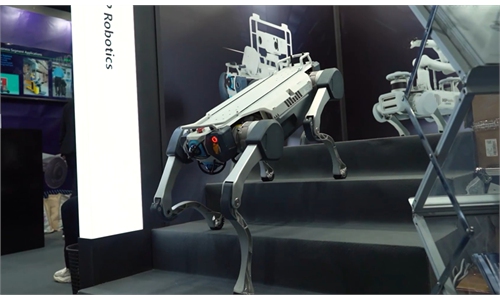
The Chinese robotics sector is moving beyond factories and into more visible parts of everyday life overseas. When robots appear in restaurants, shopping malls, exhibitions and other public spaces, they give people a more direct way to experience new technologies. Robots are no longer seen only as tools for industrial production, but also as products that can interact with consumers and society.
For robotics companies, these real-world applications matter. They provide opportunities to test products, learn from different markets and improve future designs. As robots enter more public settings, they could become an important bridge between advanced technology and everyday users.
The public response to humanoid robots in India points to growing interest in this emerging technology. The scene at the sandwich shop in Ujjain was more than just an eye-catching moment. It showed how robots can capture attention when they become part of familiar social and commercial settings.
As one of the world's fastest-growing major economies, India has a large market, a young population and rising demand for new technologies. Robotics and AI could support new applications across industries and contribute to growth.
Meanwhile, in recent years, China's industrial robots have undergone rapid technological upgrades and become increasingly competitive, helping drive the intelligent transformation of the global manufacturing sector. In 2025, China's industrial robot exports exceeded imports for the first time, making the country a net exporter of industrial robots.
For China and India, robotics offers an area where their strengths can complement each other. China has built strong capabilities in manufacturing, supply chains and technology applications, while India brings a large and expanding market. More exchanges and cooperation in this field could create benefits for both sides, helping bring robotics into more real-world settings.
The author is a reporter with the Global Times.
bizopinion@globaltimes.com.cn
RELATED ARTICLES