IN-DEPTH / IN-DEPTH
Pinglu Canal: How China's 'canal project of the century' reshapes trade and connects ASEAN
Gateway to the sea for southwestern Chinese provinces to energize trade, reach ASEAN countries
By and Su Yaxuan in Qinzhou Published: Aug 28, 2026 10:35 PM

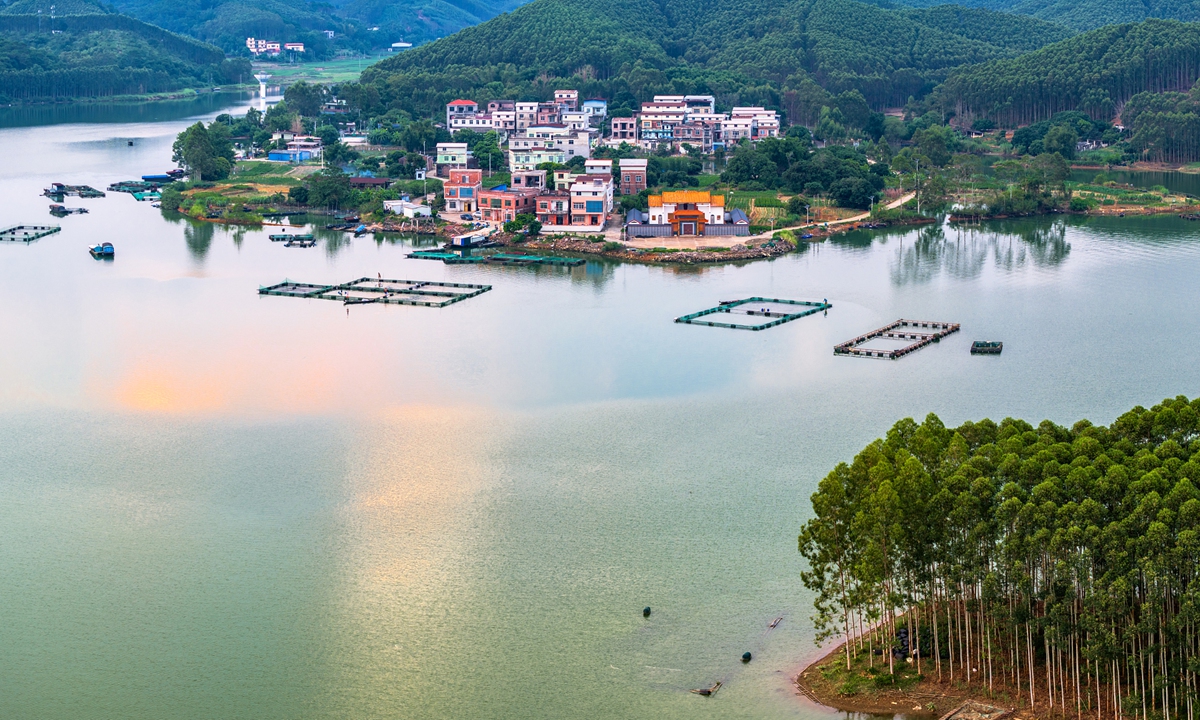
A picturesque ecological landscape at the starting point of the Pinglu Canal in Hengzhou, South China's Guangxi Zhuang Autonomous Region Photos on this page: VCG
At the northern terminus of the Pinglu Canal - Pingtang village, South China's Guangxi Zhuang Autonomous Region - stands a road marker with Chinese characters that translate to "connecting rivers to the sea." On a large tranquil green reservoir, several river transport vessels heavily loaded with goods quietly sail east.
For villagers like Sun Guoqi, a fisherman-turned-restaurant owner, change is already tangible. He has turned his home into a small eatery to cater to the steady stream of curiosity-seeking tourists who want to have a look at the starting point of the Pinglu Canal. "We saw more tourists coming, so my wife - she's a good cook - decided to start a restaurant," Sun said. "Now we serve several tables every weekend and earn an extra 1,000 yuan ($149) a month."
The trickle of visitors reflects a far bigger transformation: This September, Pingtang village will witness the official operation of the first canal in China to be planned at the national level since 1949.
The Pinglu Canal is the backbone of the country's New International Land-Sea Trade Corridor, a key initiative enhancing global trade connectivity for China's southwestern inland regions. A major project of China's 14th Five-Year Plan (2021-25) and with an investment of over 70 billion yuan and stretching 134.2 kilometers from Pingtang to the Beibu Gulf via Qinzhou, the Pinglu Canal will accommodate 5,000-metric-ton vessels and cut the inland waterway distance to the sea by 560 kilometers compared with the route through Guangzhou, South China's Guangdong Province - making it the shortest, most economical and most convenient sea-access channel for southwestern China.
With the canal's impending completion and opening, the deepening high-level joint construction of the New International Land-Sea Trade Corridor, and the signing and implementation of the China-ASEAN Free Trade Area 3.0 Upgrade Protocol, Guangxi's marine-oriented economic development is set to embrace unprecedented major opportunities, analysts said.
As a "project of the century," the Pinglu Canal has set multiple records in construction scale. According to the Pinglu Canal Group, the construction period of the canal is 52 months, while over 300 million cubic meters of earth and rock have been excavated - about three times that of the Three Gorges Project.
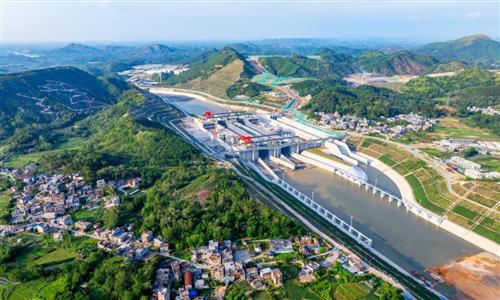
The canal features three newly built cascade hubs: the Madao Hub, the Qishi Hub, and the Qingnian Hub. Massive earthworks have been conducted, with approximately 5.84 million cubic meters of concrete poured, enough to fill more than 2,300 standard swimming pools. Among them, the single day pre-cooled concrete pouring volume for the lock body at the Madao Hub set a world record. The state-of-art self-propelled cutter-suction dredger Tianjing, or Sky Whale, participated in the construction.
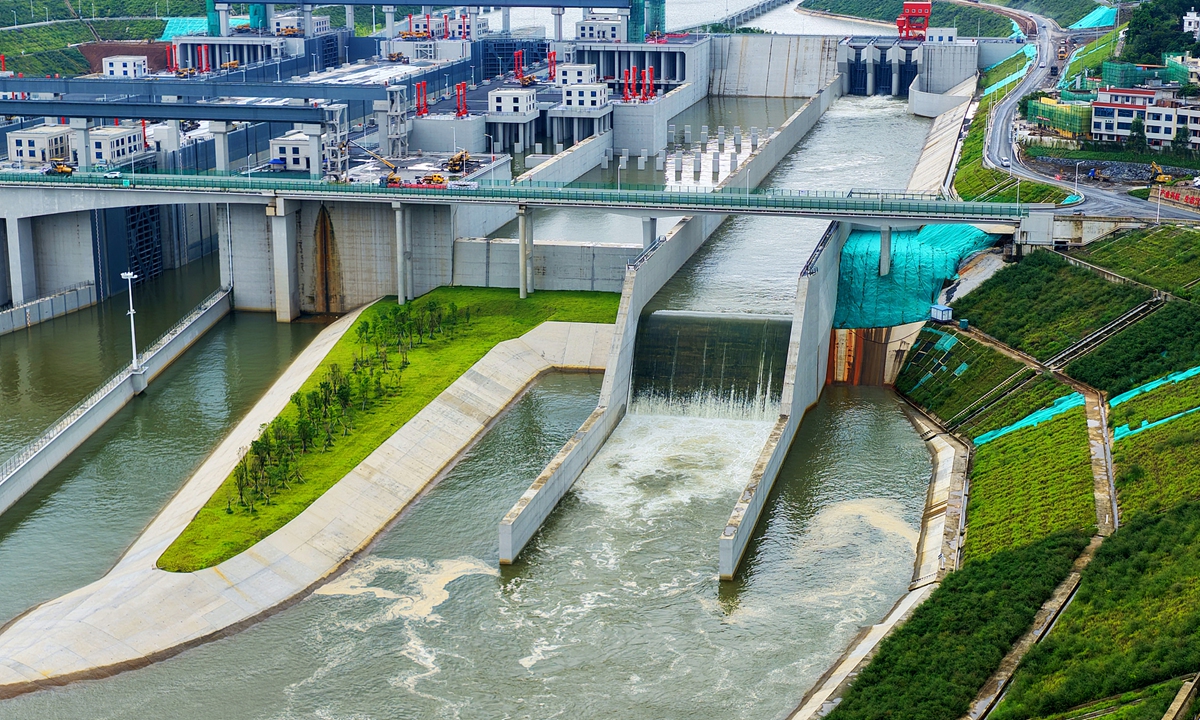
An aerial view of the Madao hub of the Pinglu Canal in Lingshan county, South China's Guangxi Zhuang Autonomous Region.
Connecting two river systemsAt the Madao hub, which sits on the watershed between the Xijiang and Qinjiang river systems, He Junhui, director of the Engineering Management Department of the Pinglu Canal Group, the constructor of the canal, pointed to an old photo of the site.
"It was just a narrow footpath between two peaks, with rice and sugarcane fields nearby. We dug a 10-kilometer channel to connect the two river systems, so cargo from Nanning, capital of Guangxi, no longer has to float east to Guangzhou in the southeastern part of the country - it now has a southward route to Qinzhou on the Beibu Gulf," He said.
He noted that in recent years, demand for shipping goods to and from ASEAN countries from China's southwestern provinces has surged. "The Pinglu Canal solves that bottleneck, linking the networks of waterways, highways and railways in China's southwestern regions, giving the regional economy a turbocharge," he told the Global Times.
The Madao lock is also the world's largest inland "water-saving" ship lock. Its giant gates, each weighing over 1,000 metric tons, can open up in one minute and close in 30 seconds, with a transit time for vessels of just 75 minutes. The water-saving engineering design at the ship lock hubs recycle about 60 percent of water used, making the system highly efficient in a region where fresh water resources are precious.
Comparisons are natural - with the Panama Canal, or with ancient Chinese waterways like the Lingqu Canal, one of the oldest and best-preserved artificial canals in the world and which is also based in the province. "Every canal is born to answer the call of its era. The Lingqu Canal helped integrate the southern China region during its time and brought about prosperity; the Pinglu Canal solves the problem of having a sea outlet for Southwest China. The technology differs, but the principle is the same - our ancestors never stopped harnessing water, and neither have we," He said.
The vision is not new. Since 1949, multiple studies have revisited the idea, according to the Xinhua News Agency. Now, with the canal's completion, that century-old dream is finally becoming reality.
Turbocharging local economy
Businesses along the canal's route are already pivoting. Qin Yubin, whose Guangxi Rizon Sino Sci-tech Co, a manufacturer of paper products, bought a former shipyard on the canal bank and turned it into a paper mill, recalled: "In 2022, when the canal project was officially announced, matching rumors that had been going around for some time, our entire company was thrilled!"
"It is like being presented with a once-in-a-lifetime opportunity! It's now the first thing we mention to our clients - it's become our golden business card," Qin said with excitement.
According to Qin, about one-third of his company's raw materials are imported. While a truck carries 20 metric tons, a single barge can easily haul cargo weighing up to 4,000 metric tons. Qin, the company's vice president, expects logistics costs to drop by some 40 percent after the canal opens. He plans to pass on the benefits of slashed costs to Southeast Asian customers, and forecasts a doubling of export volume.
The impact goes beyond boosting trade. At Qin's company, executives are considering a total revamp.
He Junhui projects that the canal will fundamentally reshape the logistics landscape in Southwest China. "With combined river-sea transport, cargo can go from Qinzhou Port all the way up to Nanning, Guigang, Liuzhou, and even Baise and - via ship lifts - to Funing Port in Yunnan, giving that province a long-coveted sea outlet. We estimate river transport throughput of about 5 million metric tons this year and 40 million metric tons next year," he said. Guigang is an inland river port in the Xijiang river basin and Liuzhou is an industrial hub of Guangxi. Baise is a revolutionary base. All will be connected by the Pinglu Canal.
In the Liujing Industrial Park in Hengzhou along the canal's upper reaches, a new smart shipbuilding base is under construction, focusing on electric, methanol and hydrogen-powered vessels.
"The canal was more than 80 percent of our reason for choosing Liujing," said Hu Binsheng, deputy general manager of the Qinshi Group's Guangxi branch, a shipyard for modern vessels.
Hu calculates that shipping one metric ton of freight from Liujing to Qinzhou costs about 10 yuan, compared with a historical low of 30 yuan to Guangzhou - and water transport is only one-fifth the cost of road haulage. "That rewrites the logic of industrial location - high-volume, import-export industries will naturally cluster along the canal."
Reaching ASEAN countries
The canal's impact extends well beyond China's borders. Officials from several ASEAN countries have visited the construction site, reportedly impressed that such a massive project can be completed in just four years.
"After launch, the Pinglu Canal will be integrated with other components of the New International Land-Sea Trade Corridor, helping deepen economic and trade cooperation between China and ASEAN countries, especially Vietnam, enabling enterprises to achieve better efficiency," To Vu Luc, vice consul of the Consulate General of Vietnam in Nanning, told the Global Times.
As Vietnam exports large volumes of agricultural products such as fruit, rice, coffee, and aquatic products to China every year, the Vietnamese official expects logistics-related enterprises will be among the first beneficiaries after the canal opens.
"The Pinglu Canal will add a new transport channel, allowing more goods to be transported to inland China via the canal," To Vu Luc said. "At present, Vietnam's agricultural exports to China mainly rely on road and maritime transport. Due to large shipment volumes, road transport corridors often experience congestion during peak periods. The Pinglu Canal provides a new transport route."
"The New International Land-Sea Trade Corridor and the dense shipping routes from Beibu Gulf connecting ASEAN ports have already boosted trade. Now, with river-sea intermodal transport via the Pinglu Canal, we expect a new round of growth. Singaporean merchants are very optimistic," Zhao Bebe, president of the China-Singapore Nanning International Logistics Park, told the Global Times.
She explained that while "rail-sea" intermodal transport solved the problem of fast outbound shipments, "river-sea" transport fills the gap for waterborne traffic to access deep inland regions. Together, they turn Guangxi into a three-dimensional rail, river and sea hub.
"For Singaporean companies, whether moving ASEAN products into southwestern China or trans-shipping Chinese-made goods globally, the canal offers more efficient and stable supply chains," said the Singaporean businesswoman.
"When the canal opens, the most populous province in southwestern China and the many populous countries in ASEAN will be truly brought closer," Zhao said. "Lower logistics costs and fewer trade barriers will boost bilateral commerce; people-to-people exchanges and cultural interaction will also intensify. The canal is not just about goods - it's about connecting hearts."
According to a People's Daily report in 2023, with the canal's assistance, Guangxi's over 5,800-kilometer-long inland waterway network and waterways in parts of Southwest China's Yunnan and Guizhou provinces will be directly connected with maritime transport. It is estimated that the trade facilitation will save more than 5.2 billion yuan annually in transportation costs for regions along the corridor.
Analysts said that, with its advanced infrastructure, its profound impact on regional trade route and costs, and its development concept that values both development and ecology, the Pinglu Canal is poised to be a game changer that answers the call of the times.
Lei Xiaohua, deputy director of the Institute of Southeast Asian Studies at the Guangxi Academy of Social Sciences, told the Global Times on Wednesday that the Pinglu Canal will emerge as a fast-lane channel for China to share with the world its development dividends, further enhance regional economic integration in Southeast Asia and bring along opportunities for partner countries to jointly forge new growth momentum with its green, smart and ecological applications.
As September approaches, the Pinglu Canal is poised to transform a remote corner of Guangxi into a bustling gateway that will impact not only China's southwestern regions but also the wider ASEAN region. It is a testament to how a century-old dream, realized with modern engineering and ecological awareness, can redefine trade, industry and human connection across borders.
RELATED ARTICLES