Unitree's post-IPO stock pullback tests how investors value humanoid robot pioneer commercialization: experts
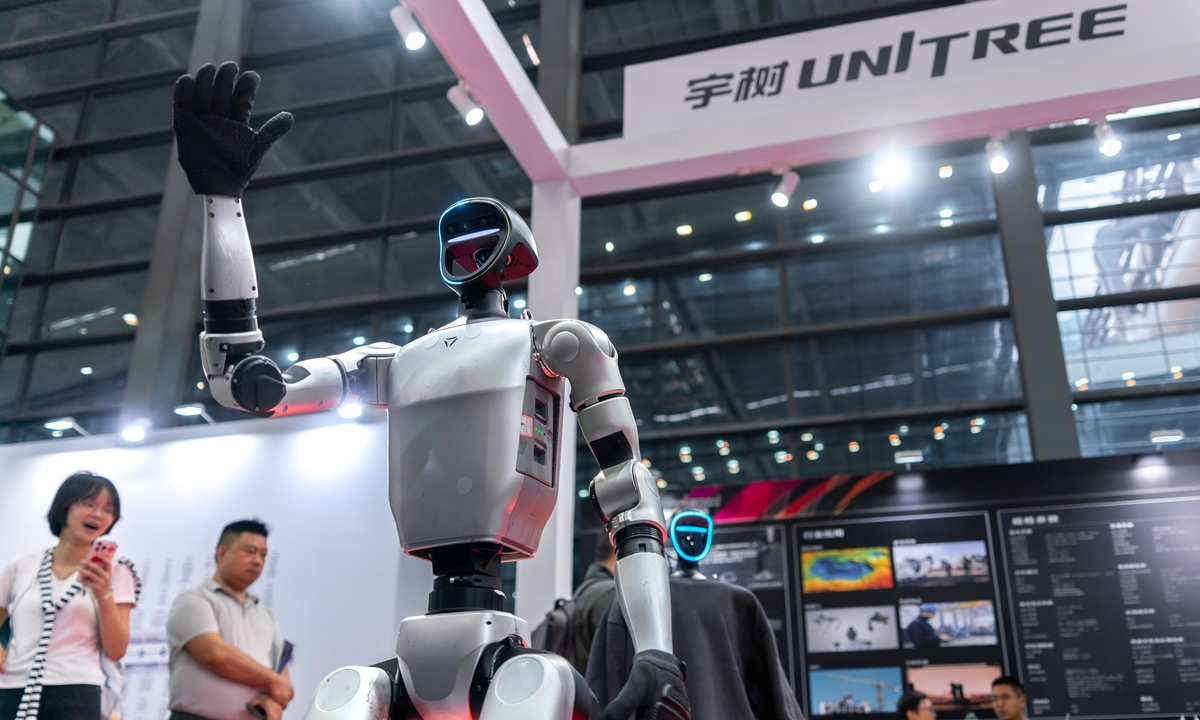
Unitree Robotics' humanoid robot is displayed at the 14th China Information Technology Expo in Shenzhen, South China's Guangdong Province, on April 10, 2026. Photo: VCG
Chinese robotics company Unitree Robotics' shares have fallen since a surge after its market debut. Industry experts said the sector remains in a development phase with long-term growth potential as technology advances and application scenarios expand.Unitree Robotics saw its market value drop by roughly 200 billion yuan ($30 billion) within days of its blockbuster debut on the Shanghai Stock Exchange's STAR Market, according to media reports.
Multiple industry experts told the Global Times that the short-term decline reflects changing market expectations rather than any material change in the company's business. They noted that the humanoid robotics sector is still early in industrialization, with commercial pathways continuing to take shape and challenges remaining in application scenarios, cost control and large-scale deployment.
Industry insiders said that Unitree's listing, combined with the scarcity value of being the "first humanoid robot stock" and market-based pricing under China's registration system, attracted strong investor interest and pushed valuations higher in the early stages. As market enthusiasm normalized, share prices also adjusted accordingly.
"The recent pullback is essentially a return to rational pricing, not a signal of worsening fundamentals," said Tian Feng, former dean of SenseTime's Intelligence Industry Research Institute. "The decline is a healthy correction that squeezes out speculative froth. What matters going forward is whether the company can generate meaningful revenue from industry applications," Tian told the Global Times on Saturday.
Tian added that the initial rise was influenced by first-mover scarcity and sentiment-driven liquidity under the registration-based IPO system. As market interest cooled, valuation naturally moved closer to fundamentals.
Pan Helin, a member of the expert committee for information and communication economy under the Ministry of Industry and Information Technology, offered a similar assessment. He attributed the fluctuation partly to the mechanics of market-based pricing under the registration system, where new listings are more susceptible to emotional trading and thematic speculation.
At the industry level, experts said humanoid robots remain in an early commercialization phase, with research and education clients still accounting for a sizable share of demand. Large-scale industrial applications have yet to take shape, and the sector continues to face questions involving application scenarios, unit costs and business-model validation.
A recent industry report shows that humanoid robots are currently in a critical transition period from "technology validation" to "scaled deployment." However, penetration in industrial scenarios remains below 5 percent, with the vast majority of products still concentrated in research, education, and entertainment applications.
Pan noted that from a global industry perspective, the US-based robotic firm Boston Dynamics has been deeply engaged in the humanoid robot sector for more than a decade, yet has consistently failed to achieve scaled commercial monetization. Its history of changing hands multiple times serves as a vivid illustration of the long-standing pain points in the industry: difficulty in landing applications and turning a profit.
Tian noted that maintaining the current share price of Unitree would require sustained high growth in the years ahead.
He added that enterprise value ultimately depends on products, orders and earnings delivery, and that the key issue is whether robots can move from laboratories into real production and living scenarios.
On August 20, Wang Xingxing, founder and chairman of Unitree Robotics, stated at the 2026 World Robot Conference that the core reason humanoid robots have not yet been deployed at scale is that their efficiency still lags behind human labor, and new tasks require retraining, leaving generalization capabilities insufficient. The industry may see key technological breakthroughs and enter the "ChatGPT moment" of embodied intelligence within 2 to 10 years, the Securities Times reported.
Zhou Di, a senior engineer at Shanghai Fangrong Technology Co, told the Global Times on Saturday that Unitree's IPO carries significance beyond the company itself, offering a benchmark for the entire industry.
"It has advanced the humanoid robot sector from a primary-market valuation logic dependent on technology narratives and demo presentations to a public-market stage where commercialization and real financial data serve as the yardstick," Zhou said. He added that this would bolster capital confidence across the supply chain, facilitate financing and resource allocation for upstream component makers, and force peers to shift from "storytelling" to product delivery, cost control and building viable profit models.
Experts pointed out that capital markets often hold two competing views of star companies in emerging sectors. On one hand, scarcity generates an emotional premium that attracts industrial and institutional capital betting on future industry dividends. On the other, valuations already embed long-cycle expectations, leaving them vulnerable to pullback if commercialization lags.
Over the longer term, market-based pricing mechanisms are also expected to support industry consolidation. Public markets may direct more capital toward companies with product deployment, delivery capabilities and clearer paths to profitability, while encouraging others to strengthen execution and product development, Zhou said.
Regulators have also repeatedly stressed the need for orderly, locally grounded development in the robotics industry.
Li Chao, deputy director of the policy research office for the National Development and Reform Commission, told a news conference in Beijing on Friday that the robotics industry spans artificial intelligence, advanced manufacturing and new materials, and must build on local resource endowments and industrial strengths.
She warned against blindly following trends and rushing into expansion, urging the sector to pursue steady, sustainable progress. Going forward, authorities will focus on practical, results-oriented measures, using embodied intelligence training grounds and application pilot bases as platforms to allow robots to refine technologies in real-world scenarios and form application loops around genuine demand, according to Xinhua News Agency.
Industry insiders interviewed by the Global Times widely view Unitree's stock correction as a "stress test" for the broader robotics sector. As capital markets deepen their understanding of the sector, future valuations for similar companies are expected to become more rational, shifting from concepts and hype toward commercial viability, profit models and earnings delivery.
According to CCTV News, China's robotics industry generated 165.5 billion yuan ($24.6 billion) in operating revenue among above-scale enterprises in the first half of 2026, up 24.5 percent year-on-year.
RELATED ARTICLES