Europe's first humanoid robot mass-production base begins production in China-Serbia joint project
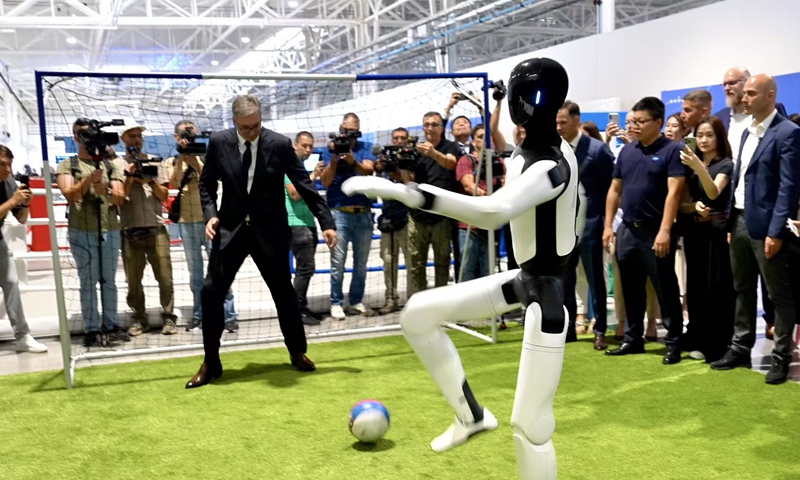
Serbian President Aleksandar Vucic plays football with a humanoid robot at a joint robot mass-production base in Sabac, Serbia on August 29, 2026. Photo: Courtesy of Jiaxing government media center
Serbia's first robot factory officially began production in the western city of Sabac on Saturday local time. The joint project, built in collaboration with automotive supplier Minth Group and Chinese robotics company AgiBot, marks a shift in cooperation toward high-end manufacturing, and boosts Serbia's robotics role in Europe. Expertly built by China and Serbia, it is also Europe's first mass-production base for humanoid robots invested by Chinese enterprises. Serbian President Aleksandar Vucic, attending the launch ceremony, called the project an important step toward the country's future, Chinese automotive supplier Minth Group told the Global Times on Sunday.
The first humanoid robot produced at the factory rolled off the production line on the day operations began. Serbian President Aleksandar Vucic interacted with the robot, which also demonstrated a range of functions, including Chinese calligraphy, folding clothes, playing chess and dancing, according to Minth Group.
Vucic said humanoid robot production is opening up a new field of technological development for Serbia. The country hopes to integrate robot manufacturing with industries such as artificial intelligence (AI), supercomputing and data centers, while boosting local talent development and employment and strengthening Serbia's position in Europe's robotics industry.
Vucic said the launch in Sabac was of great significance for Serbia, adding that the country is becoming a frontrunner in the mass production of humanoid robots in Europe.
Vucic said the factory is expected to assemble and produce more than 5,000 humanoid robots annually in the future, with the robots potentially used across healthcare, agriculture, industry and defense, according to the Xinhua News Agency.

Serbia's first robot factory officially begins production, jointly built by China and Serbia. Photo: screenshot of China Media Group
Minth Group told the Global Times that the first phase of the robot factory involved an investment of 20 million euros and covers about 3,000 square meters. The facility focuses on assembling humanoid robots and robotic dogs, as well as calibrating motion and vision systems and conducting performance tests.
The factory showcases capabilities including high-precision flexible manipulation, intelligent environmental adaptation, multi-robot coordination and industrial automation. It also displays service robots designed for the Specialized Expo 2027 Belgrade.
According to the plan, the project will later include a robotics industrial park in Serbia, with total investment expected to reach about 200 million euros. Once fully completed, annual production capacity for humanoid robots and robotic dogs is projected to reach up to 20,000 units, targeting markets in Europe and beyond.
The company told the Global Times that the mass-produced embodied-intelligence robots are equipped with multimodal perception systems, with tactile and sensing technologies integrated into their fingertips for precise force control and flexible grasping. Powered by AI deep-learning algorithms, they can adapt autonomously to complex environments and continuously improve their capabilities.
The robots are gradually being deployed in industrial settings for loading and unloading, material handling and inspection, replacing workers in dangerous and repetitive tasks while improving manufacturing efficiency and safety. In the future, they are also expected to expand into home and eldercare applications, providing companionship and intelligent assistance as human-robot collaboration becomes more natural and integrated into daily life, according to the company.
Minth Group's cooperation with Serbia is not a recent development, but part of a relationship built over years. The company first entered the Serbian market in 2018 and has maintained an eight-year presence in the country, where it has established 10 factories.
At the end of May, during Vucic's visit to East China's Zhejiang Province, Serbia and Minth Group signed two new investment agreements. The Loznica project involves an investment of 135 million euros and is expected to create 600 jobs, while the Sabac project will involve 91 million euros in investment and create 220 jobs.
Chen Jing, vice president of the Technology and Strategy Research Institute, told the Global Times that the factory could significantly raise Serbia's position in Europe's high-tech industrial chain. Traditionally better known for automotive parts manufacturing, Serbia is now moving to the forefront of humanoid robot mass production, potentially becoming a link between Chinese technological capabilities and European market demand.
For Europe, he said, the project could help fill a gap in localized mass-production capacity and accelerate the transition of humanoid robots from laboratories to industrial applications.
Chen said industrial settings are likely to be among the first areas where the robots achieve large-scale deployment in Serbia and Europe. Given Minth Group's established automotive supply-chain base, humanoid robots could be used in assembly, inspection and material handling, while robotic dogs may be deployed in logistics and industrial inspection.
Ma Jihua, a veteran telecom industry observer, told the Global Times that the project reflects an upgrading of China-Serbia cooperation from traditional infrastructure toward advanced manufacturing. The establishment of a humanoid robot production base could spur supporting industries ranging from AI and data centers to industrial services, while creating new demand for local engineers and skilled workers.
Ma said Serbia was a natural choice for the project because Chinese manufacturers have already built a relatively mature industrial and supply-chain presence in the country. Located in the Balkans and connecting Central and Eastern Europe with Western Europe, Serbia offers logistical advantages for companies seeking to serve the wider European market. Minth Group's existing factories in Serbia, he said, mean the robot plant will not operate as an isolated project but can draw on an established manufacturing ecosystem.
Over the longer term, Ma said the more lasting impact may lie in talent and industrial upgrading. Bringing advanced robot manufacturing into Serbia will expose local engineers and workers to new technologies and production systems, helping the country build a stronger robotics talent base. Combined with its existing manufacturing capacity, that could give Serbia a firmer foundation for participating in Europe's emerging humanoid robotics industry.
Serbia has a history of pioneering robotics research, including work on bionic hands and bipedal exoskeletons. The launch of the new production base marks a fresh step in the country's participation in the global humanoid robotics industry.
Minth Group said Serbia will serve as a strategic hub for its European operations, while the company supports preparations for Expo 2027 Belgrade and expands into European and global robotics markets. It also plans to strengthen large-scale production and localized manufacturing capabilities.
RELATED ARTICLES