US-Canada tensions simmer over trade row and Lake Ontario renaming, with China falsely dragged into dispute
By Published: Aug 30, 2026 04:36 PM

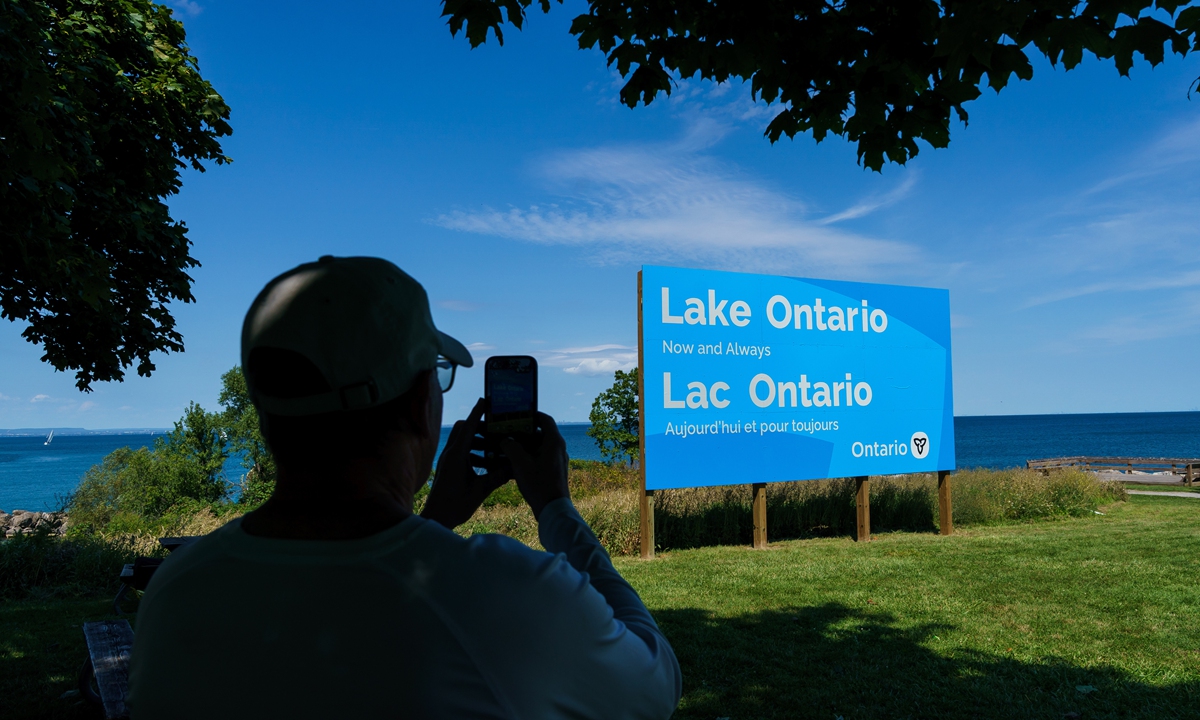
A person takes a picture of the newly unveiled sign for Lake Ontario at Fifty Point Conservation Area in Grimsby, Ontario, Canada, on Saturday, Aug. 29, 2026. Photo: VCG
From an escalating trade war to a dispute over the naming of Lake Ontario, tensions between the US and Canada have continued to deepen. Yet some voices in the US have sought to draw China into the dispute, portraying Beijing as a potential "winner" from the widening rift. Chinese experts, however, say that distorting risks reversing cause and effect: It is the growing strain between Washington and Ottawa that is pushing Canada to look elsewhere, rather than China driving the two longtime allies apart.
In the latest move, Ontario Premier Doug Ford on Saturday erected a sign by Lake Ontario that reads "Lake Ontario - Now and Always" and criticized US President Donald Trump after he signed an executive order to rename the body of water that borders the Canadian province and the state of New York.
The US president signed an executive order on Thursday seeking to change its name to Lake America and has shared a series of AI-generated videos about the lake that straddles both countries.
"I'm here on the shores of beautiful Lake Ontario, a crown jewel of our province and our country," Ontario Premier Doug Ford said in a short video message posted on social media, according to CBS News.
"You may have heard that President Trump is trying to rename this lake, all because he doesn't like Ontario and Canada standing up for ourselves," he said. "But let's be serious. Long before President Trump, this lake was called Lake Ontario, and long after President Trump is gone, it will still be called Lake Ontario."
Canadian Prime Minister Mark Carney on Thursday hit back after Trump signed an order directing the federal government to start changing the name of Lake Ontario. He wrote that the name of the lake had nothing to do with the Canadian province of Ontario — and actually predated the formation of Canada itself.
"We know that the United States is changing. Their trade relations, their foreign policy, their national monuments, their hydronyms," Carney continued.
The recent dispute between the two countries began after the US and Canada failed to reach a trade deal on August 21, and the US imposed a 50 percent tariff on about $20 billion worth of Canadian goods on August 22, according to Xinhua News Agency.
Canada responded by announcing "dollar-for-dollar" retaliatory tariffs on imports from the US, set to take effect on September 8.
Relations between the US and Canada have deteriorated rapidly since Trump returned to office. From his repeated suggestions that Canada become the "51st state" to tensions over the US-Mexico-Canada Agreement (USMCA) and the latest escalation in tariff disputes, each confrontation has placed further strain on an already fraying relationship, Liu Dan, a research fellow at the Center for Regional and Country Studies at Guangdong University of Foreign Studies, told the Global Times.
Liu said the days when Washington could expect Ottawa to simply fall in line with its demands were fading. Rather than isolated episodes, the latest disputes reflect an accumulation of tensions that is steadily eroding the foundations of US-Canada relations, she said.
As relations between the US and Canada have deteriorated, some US officials and media outlets, including The Washington Post, The New York Times and Fox News, have turned their attention to China, suggesting that Beijing could emerge as a beneficiary of the trade war between the longtime allies.
In an article titled "The US and Canada Are in a Trade War. China Aims to Win It," The Washington Post claimed Beijing was seeking to capitalize on the rift while presenting itself as a global champion of free trade.
US Trade Representative Jamieson Greer said as much last week. Retaliatory tariffs, he claimed, are "like the kind of things that China would do," per CBC.
That narrative, Liu argued, places what is fundamentally a dispute between Washington and Ottawa within the broader framework of US-China rivalry, implying that any effort by Canada to chart a course independent of Washington amounts to choosing between the two powers. Such a view, she said, seems to overlook Canada's right to pursue its own economic and trade interests as a sovereign country.
Liu also questioned claims in some US media that China could emerge as the "winner" of a US-Canada trade war. If US tariffs and other pressure lead Canada to reduce its reliance on the American market and seek a wider range of trading partners, closer economic ties with China and other countries would be a natural consequence of that diversification, she said.
Portraying China as the beneficiary of the dispute, Liu argued, risks reversing cause and effect: it is the growing strain between Washington and Ottawa that is pushing Canada to look elsewhere, rather than China driving the two allies apart.
RELATED ARTICLES