Xi arrives in Kyrgyzstan for SCO summit, state visit as Bishkek embraces SCO summit
By Ma Jingjing, Li Qiang, Xiao Xinxin in Bishkek and in Beijing Published: Aug 30, 2026 05:19 PM

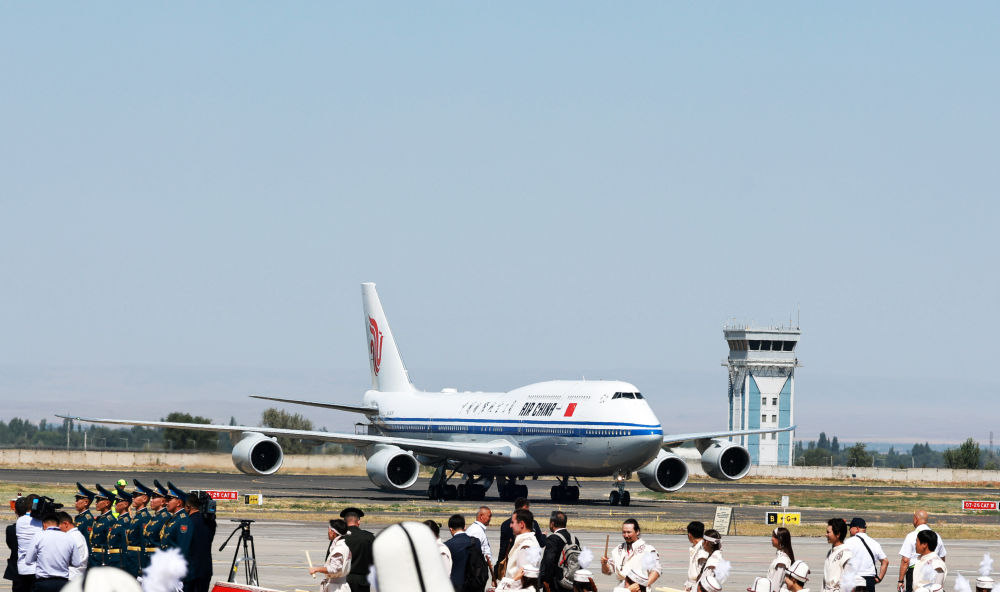
Photo: Xinhua
Chinese President Xi Jinping landed in Kyrgyz capital Bishkek on Sunday for the Shanghai Cooperation Organization (SCO) Summit 2026 and a state visit to Kyrgyzstan, the Xinhua News Agency reported.
Kyrgyz President Sadyr Japarov and his wife welcomed Chinese President Xi and his wife, Peng Liyuan, at Manas International Airport, Xinhua said.
Long before the leaders arrived at the summit venue, the SCO had already made its presence felt across the streets of Bishkek. Along Chyngyz Aitmatov Avenue, large electronic screens flashed summit messages while SCO emblems bearing the number "25" - marking the organization's 25th anniversary - stand prominently along major roads. Buses running through the Kyrgyz capital have also been dressed for the occasion, carrying the words "Shanghai Cooperation Organization Summit Bishkek - 2026" in Kyrgyz, Chinese, Russian and English.
In the city center, a giant screen mounted atop a building displays the national flags of China and Kyrgyzstan alongside a particularly eye-catching Chinese-language message: "China and Kyrgyzstan uphold mutual respect and trust, and march together on a new journey in the new era."
The meeting of the SCO Council of Heads of State is scheduled for September 1 in Bishkek, according to the SCO Secretariat. This year also marks the 25th anniversary of the organization.
After 25 years of development, the SCO has grown into a comprehensive regional cooperation organization that covers the biggest area and population with enormous development potential. Over this period, SCO member states, acting on the Shanghai Spirit and working in solidarity and coordination, have continuously deepened cooperation in political, security, economic, and people-to-people exchanges, and built and reinforced regional security safeguards, bridges for cooperation, and friendly ties, Chinese Foreign Ministry spokesperson Lin Jian said at a regular press conference on June 15.
For people in Bishkek, however, the expectations surrounding the Chinese president's visit and the summit go beyond ceremonies and diplomatic meetings.
During visits across the Kyrgyz capital, Global Times reporters could sense the momentum of a city seeking faster economic development and strong local expectations that deeper cooperation with China could translate into more infrastructure, more jobs and greater access to regional and international markets.
Kyrgyz employees working for Chinese companies shared with the Global Times that the value of China-related projects extended far beyond the projects themselves. New roads, railways and industrial projects mean opportunities to participate more deeply in regional economic development and to build foundations not only for the present, but for the future.
That expectation also runs in the opposite direction: many Kyrgyz people are not only eager to see more Chinese investment and China-related opportunities come to their country, but also increasingly hope to go to China themselves.
Nina, a journalist with the Bishkek Evening Newspaper, told the Global Times that the friendly and solid relationship between Kyrgyzstan and China is increasingly visible among young Kyrgyz people, with many of them studying Chinese and hoping to pursue education in China.
"This is by no means accidental," she said, noting that many Kyrgyz people view China with admiration, particularly because of the speed of the country's development and its rapid advances in science and technology.
Manova Daria, a graduate of the Confucius Institute at Bishkek State University, told the Global Times that as exchanges between the two countries become increasingly frequent, she sincerely hopes more Chinese people will come to Kyrgyzstan for business and tourism.
"I also want to visit more cities in China," she said, adding that she hopes to learn more about Chinese culture and technology and use that knowledge to contribute to Kyrgyzstan's development.
More than trade
Such popular expectations are underpinned by a rapidly expanding economic relationship.
China has long remained Kyrgyzstan's largest trading partner. China-Kyrgyzstan trade reached $11.7 billion in the first seven months of 2026, while Chinese exports of the "new three" products - electric vehicles, lithium-ion batteries and photovoltaic products - as well as mechanical and electrical products to Kyrgyzstan grew rapidly. Cooperation in the services trade and cross-border e-commerce has continued to advance, China's Ministry of Commerce said on Thursday.
China is also Kyrgyzstan's largest source of foreign investment. By the end of July, China's direct investment across all sectors in Kyrgyzstan had exceeded $2 billion, with major projects progressing in infrastructure, energy, mining, agriculture and green development, according to the ministry.
Chinese-invested projects ranging from oil refining and photovoltaic power generation to waste-to-energy plants and wastewater treatment facilities have supported Kyrgyzstan's energy supply and green industrial transformation. China has also built or renovated more than 10 road projects in the country, improving transportation conditions for both passengers and goods.
"Over the past decade, China's economic cooperation with Central Asia has indeed grown noticeably. Today it's no longer just about trade, but also about the joint development of infrastructure, technology, energy and new production chains," Ayaz Baetov, chairman of the Management Council of the Tamchy Special Financial and Investment Territory and Kyrgyz justice minister, told the Global Times.
"As a result, Central Asia is gaining additional opportunities for more active integration into the global economy," Baetov said.
For landlocked Kyrgyzstan, Baetov said one of the most important areas of cooperation is transport connectivity, which is closely tied to the country's prospects for economic growth.
Projects such as the China-Kyrgyzstan-Uzbekistan railway could allow Kyrgyzstan to make more effective use of its geographical position while expanding access to new trade routes and markets, he said.
Local media the Caspian Post noted that Kyrgyzstan is seeking to turn growing connectivity into a broader logistics and economic hub, with projects expected to generate local employment and supporting infrastructure rather than leaving the country merely as a transit route.
'Relations at their best period'
Erdenet Kasymov, first deputy director of Kyrgyzstan's national tourism development agency, told the Global Times that China-Kyrgyzstan relations are currently at their best period in history.
The upcoming SCO summit, he said, will not only provide an important platform for strengthening multilateral dialogue among member states but also inject fresh momentum into concrete cooperation between China and Kyrgyzstan in areas including tourism, transportation and logistics.
The significance of the Bishkek summit extends well beyond bilateral cooperation.
Alibek Tazhibayev, director of the Eurasian Monitoring analytical research center in Kazakhstan, told the Global Times that the gathering is more than a commemorative summit marking the SCO's 25th anniversary. It could also become an important point in the organization's transition toward a more practical cooperation architecture, with security, economy, finance and connectivity expected to move further from broad consensus toward concrete implementation.
That evolution is particularly important at a time when the world economy is becoming increasingly fragmented, geopolitical competition is intensifying and confidence in some existing mechanisms of global governance is weakening, Tazhibayev noted.
Against such a backdrop, platforms where countries can coordinate their interests on the basis of equality, consensus and respect for sovereignty are becoming more valuable, he said, adding that the SCO has precisely such potential.
Security is likely to remain a core part of the summit's agenda, but the definition of security is also expanding.
"The challenges today are no longer limited to terrorism and extremism in the traditional sense," Tazhibayev said. Transnational crime, drug trafficking, cyber threats, information security and risks associated with emerging technologies are all becoming increasingly important.
Economic and financial cooperation will be another major area, alongside transportation and Eurasian connectivity. New railway and road corridors could significantly reshape the region's economic geography, he said. For Kazakhstan and Central Asia as a whole, their importance lies not merely in increasing transit volumes, but in helping regional economies join new production, logistics and trade chains.
"I think digitalization, artificial intelligence, energy, the green transition, climate adaptation and people-to-people exchanges will also receive particular attention," Tazhibayev said.
A major institutional step was already taken at last year's SCO Tianjin Summit, which approved the SCO Development Strategy for 2026-2035, decided to establish an SCO development bank and advanced a range of cooperation mechanisms in areas ranging from security to green industry and the digital economy.
Looking back at the SCO's first 25 years, Kubat Rakhimov, executive director of Applicata - Centre for Strategic Solutions in Bishkek, told the Global Times that the decision to establish the SCO development bank was among the initiatives that impressed him most, and one that illustrated China's role in strengthening the organization's institutional capacity.
"For a quarter-century, the idea of a multilateral financial institution had been discussed, but it was China's leadership and commitment that broke the deadlock," Rakhimov said.
The establishment of the bank, together with China's financial commitments and the Global Governance Initiative proposed at the Tianjin Summit, demonstrates a concrete Chinese contribution to improving the SCO's institutional capacity, he said.
"Looking ahead, China-Central Asia ties are entering a golden era," Rakhimov said, pointing to China's position as a leading trading partner of the region and an important source of infrastructure investment.
The China-Central Asia mechanism, launched through the first China-Central Asia Summit in Xi'an, Northwest China's Shaanxi Province, and further developed at the second summit in Astana, has also given the relationship a stronger institutional framework, he noted.
'An island of stability'
Andrey Kortunov, former director general of the Russian International Affairs Council, told the Global Times that the SCO's institutional architecture has become increasingly mature and that the Bishkek summit is expected to push that process further forward.
Its substantive agenda is also remarkably broad, he said, encompassing traditional security, artificial intelligence, transport infrastructure, climate change and environmental protection, education and other fields.
All these issues are important not only to SCO member states, but to humanity as a whole, Kortunov said.
The Bishkek gathering will also provide an opportunity to assess the initial implementation of the SCO Development Strategy for 2026-2035 approved at the Tianjin Summit last year, he said.
Asked to describe his expectations for this year's summit in three words, Kortunov chose "vision, pragmatism and adaptability."
"We need vision in order to see challenges and opportunities that have not yet fully emerged but are already taking shape," he said. "For an organization composed of such diverse countries, a high degree of pragmatism is necessary to reconcile different interests. At the same time, the SCO must be highly adaptable in responding to sudden changes in the external environment."
For cooperation within the organization itself, Kortunov offered another three words: "respect, understanding and flexibility."
In a world of growing turbulence and unpredictability, the SCO, he said, remains "an island of stability."
That sense of continuity amid change is visible on the streets of Bishkek.
As buses carrying summit slogans move beneath giant LED screens and national flags flutter above the Kyrgyz capital, the messages surrounding the city speak of peace, development and prosperity.
Twenty-five years after the SCO was founded, the question facing the leaders gathering in Bishkek is increasingly not whether those principles remain relevant, but how to turn them into more roads, more trade, stronger security mechanisms and new forms of cooperation that people across Eurasia can see and feel.
RELATED ARTICLES