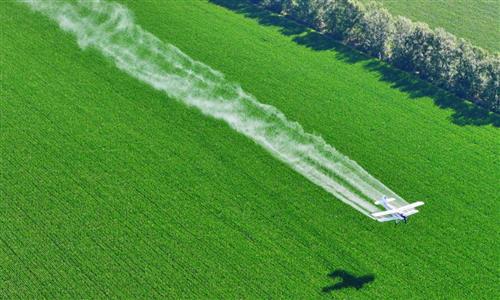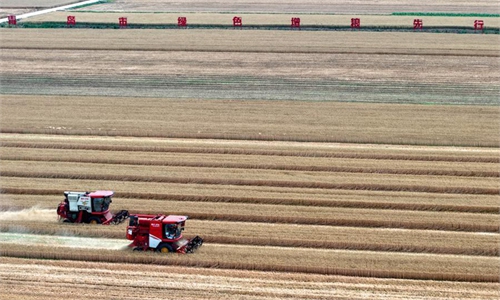
Food security. Illustration: Xia Qing/GT
In the Chinese film Once Upon a Time in the Middle East, which is set to be released in overseas markets, one of the most moving lines is one of the simplest: "Eat well." The film places a Chinese restaurant amid conflict in the Middle East. As long as the stove can be lit in the kitchen, and children have a hot meal, normal life has not completely disappeared. For Chinese people, the saying "Food is of paramount importance to the people" has never been merely a cultural expression. At its core, it is a simple principle of governance: ensuring that people have food to eat and that ordinary families can live in security and stability.
Recently, Fu Cong, China's permanent representative to the United Nations, said at the UN Security Council high-level open debate on conflict and food security that 318 million people worldwide are facing acute hunger, particularly in conflict-affected regions such as Africa and the Middle East. This figure exposes one of the most acute paradoxes in today's global food system. Humanity has never been more capable of producing food, yet food still does not reliably reach those who need it most. War destroys farmland, roads and ports; climate shocks drive up costs; while poverty, debt and exchange-rate risks leave some countries unable to afford food even when it is available on international markets.
Global food security is therefore first and foremost a question of development and distribution, while also reflecting longstanding inequities in the international food trade order. International markets allocate goods according to purchasing power, yet hunger often occurs where purchasing power is weakest. Of even greater concern is the high degree of concentration in key parts of the global food system. UN Trade and Development has highlighted the high concentration of global food markets. In the global grains market, the top four companies control between 70 and 90 percent of global trade. In related sectors such as agrochemicals, seeds, farm equipment and synthetic fertilizers, the four largest firms hold combined market shares ranging from 33 to 65 percent. Excessive market concentration means that prices, inventories, logistics and technology can be more easily influenced by a small number of actors, leaving small-holder farmers in developing countries exposed to greater risks.
The issue of subsidies also needs to be assessed by consistent standards. In recent years, some Western politicians and media outlets have repeatedly accused China of "stockpiling grain," subsidizing agriculture and "geopoliticizing" food security. Yet agricultural subsidies and strategic reserves are widespread around the world. According to the Organization for Economic Co-operation and Development, the 54 countries covered by its 2025 Agricultural Policy Monitoring and Evaluation provided an average of $842 billion a year in agricultural support between 2022 and 2024. In late 2025, the US announced $12 billion in aid to farmers facing financial pressure. Many temporary agricultural aid programs are directly influenced by trade disputes, electoral politics and pressure from domestic interest groups. Portraying food reserves and agricultural support solely as a "China problem" does not explain the real challenges facing the global food system today.
China offers a case worth examining. As the world's largest grain producer, China feeds more than 1.4 billion people with less than 9 percent of the world's arable land and produces more than one-fifth of the world's grain, while maintaining basic self-sufficiency in cereals and absolute security in staple foods. The fact that a country with nearly one-fifth of the world's population can largely meet its own food needs is itself helping reduce the enormous demand shock that the global food market might otherwise face. At the same time, China remains open to agricultural trade, meeting diverse needs through imports while providing farmers around the world with a stable market.
More importantly, China is turning its own experience into an international public good. China has agricultural cooperation with more than 140 countries and regions. Through the UN Food and Agriculture Organization's China South-South Cooperation Programme, it has provided a cumulative $130 million in funding and dispatched more than 1,100 long-term agricultural experts and technical personnel. It has also promoted agricultural technologies and trained professionals in developing countries.
Looking ahead, global food governance needs fewer political labels and more practical cooperation. The international community should work together toward reducing the disruption to the flow of food and agricultural inputs caused by unilateral sanctions, export restrictions and escalating tariffs; strengthen transparent oversight of food trade, inventories and prices; and prevent excessive market concentration from undermining competition. At the same time, more funding should be directed toward water infrastructure, storage, seed development, agricultural technology and professional training in developing countries, so that emergency food assistance can be linked with long-term capacity building. Under the framework of a community with a shared future for humanity, China can continue to provide technology, markets, financing and development experience while helping build a more equitable, open and stable system of global food governance.
Once Upon a Time in the Middle East is about to be released in multiple countries and regions. Audiences from different cultures may find the same meaning in those simple words - "eat well": Peace and development ultimately have to reach the tables of ordinary people. The success of global food governance should likewise be measured by a simple and tangible standard: whether more people can have access to a meal with dignity and security.
The author is director of the International Research Institute of Global Cyberspace Governance at Fudan University. opinion@globaltimes.com.cn
RELATED ARTICLES