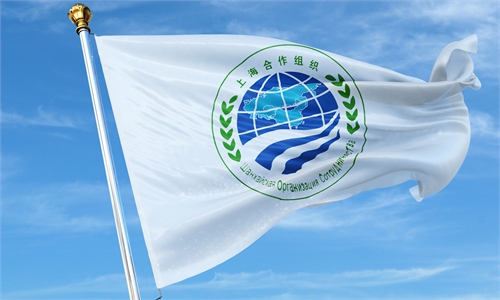
Bishkek time: The SCO once again addresses the question of global governance: Global Times editorial

SCO. Illustration: Xia Qing/GT
Guided systematically by the GGI, the SCO has continued to exert efforts across governance in three major areas - security, economy as well as livelihood and culture - making outstanding contributions to regional stability and prosperity and the improvement of global governance.The 26th Meeting of the Council of Heads of State of the Shanghai Cooperation Organization (SCO) is taking place in Bishkek, the capital of Kyrgyzstan. As the SCO marks its 25th anniversary, the leaders of member states are gathering for the Bishkek Summit to deepen bilateral and multilateral friendships and inject new momentum into regional stability and global governance.
During the SCO Tianjin Summit last year, Chinese President Xi Jinping put forth the Global Governance Initiative (GGI), pointing out that the SCO "should step up to play a leading role and set an example in carrying out the GGI." Over the past year, the initiative has won support and responses from nearly 160 countries and international organizations, with over 60 countries enthusiastically joining the Group of Friends of Global Governance. The initiative has transformed from a Chinese proposal into international practice, increasingly demonstrating robust vitality. This philosophy shares a high degree of affinity with the Shanghai Spirit. Guided systematically by the GGI, the SCO has continued to exert efforts across governance in three major areas - security, economy as well as livelihood and culture - making outstanding contributions to regional stability and prosperity and the improvement of global governance.
Amid rising unilateralism and protectionism, and the pronounced spillover effects of hot spot issues, Global South countries need a fair and inclusive cooperation platform more than ever. Spanning three continents - Asia, Europe, and Africa - the SCO naturally possesses the geographical advantage of bridging East and West, and coordinating North and South. It does not seek to replace the existing international system; rather, it advocates for enhancing the representation and voice of developing countries. It does not preach bloc confrontation; instead, it upholds extensive consultation, joint contribution, and shared benefits. For many small and medium-sized countries, such a platform signifies greater strategic autonomy. For major powers, it serves as a touchstone to test whether they can truly respect equality and integrate their own development opportunities with regional common prosperity.
Facts have proven that the SCO's success is a triumph of the right path and philosophy. It rejects a zero-sum, black-and-white worldview, refuses to rely on hegemonic order, disavows the clash of civilizations, and steers clear of zero-sum games. The SCO offers the world an inspiring possibility: Countries with different political systems, diverse cultural traditions, and varied interests can find the greatest common denominator of cooperation through equal consultation without sacrificing their respective core concerns. Guided by the principles of sovereign equality and the rule of international law, the SCO has constructed a new type of regional security governance system, cementing a security barrier across Eurasia and providing a paradigm of stability for a volatile and changing world.
Firmly opposing unilateral sanctions, trade protectionism and bloc-based fragmentation is not only a shared position of the SCO, but also reflects the broad expectations of the international community. In the face of the resurgence of protectionism, major connectivity projects such as the China-Kyrgyzstan-Uzbekistan railway, cross-border energy pipelines, Eurasian logistics hubs and green energy bases continue to move forward, ensuring the security and smooth functioning of regional industrial and supply chains. The SCO Tianjin Summit made the political decision to establish an SCO Development Bank. Over the past year, all parties have accelerated multilateral consultations on the bank's charter, capital size and governance structure. The Bishkek Summit is expected to take the establishment of this multilateral financial institution another step forward. At the same time, the SCO has continued to improve its multilateral cooperation mechanisms and expand the SCO Plus partnership framework, effectively enhancing the voice of developing countries in global economic governance and promoting the evolution of the international economic order toward greater fairness and balance.
People-centered governance in the areas of livelihoods and people-to-people ties has also brought the Shanghai Spirit into the daily lives of ordinary people. Educational exchanges, tourism cooperation, youth exchanges, media interaction and local-level cooperation have gained momentum year after year. Cities such as Kyrgyzstan's Cholpon-Ata have been designated as the tourism and cultural capital of the SCO, further strengthening people-to-people bonds. Since the Tianjin Summit, member states have jointly advanced hundreds of "small and beautiful" projects aimed at improving people's livelihoods, covering areas such as rural revitalization, smart agriculture, cross-border healthcare, youth skills training as well as poverty reduction and assistance. These initiatives have directly addressed the pressing concerns and practical difficulties facing people at the grassroots level. By advancing cooperation in security, development and people-to-people exchanges within the same framework, the SCO is giving a concrete response to the "people-centered and action-oriented approach."
As some local media have noted, the SCO "has demonstrated a remarkable capacity to evolve." Despite facing various challenges and pressures, the SCO has consistently remained problem-oriented and adapted to changing circumstances. Based on the international situation and the needs of its member states, it dynamically adjusts its models of cooperation, improves its rules and enhances the quality of regional governance. What began as a mechanism focused primarily on border confidence-building and security cooperation has gradually evolved into a comprehensive multilateral platform encompassing security, the economy, people's livelihoods, people-to-people exchanges and global governance. It has continued to renew itself by confronting problems, grow by responding to risks, and improve through practical cooperation, thereby maintaining its vitality.
The 25th anniversary marks a new starting point. The world expects the SCO to continue carrying forward the Shanghai Spirit, firmly put into practice the core principles of the GGI, and further translate the initiative into institution and consensus into action. Amid a world marked by growing turbulence and profound changes, the SCO can continue to inject a reliable source of momentum into regional stability and global governance.
RELATED ARTICLES