Tokyo seeks record defense budget with focus on AI, drones amid 'vigilance among regional countries'
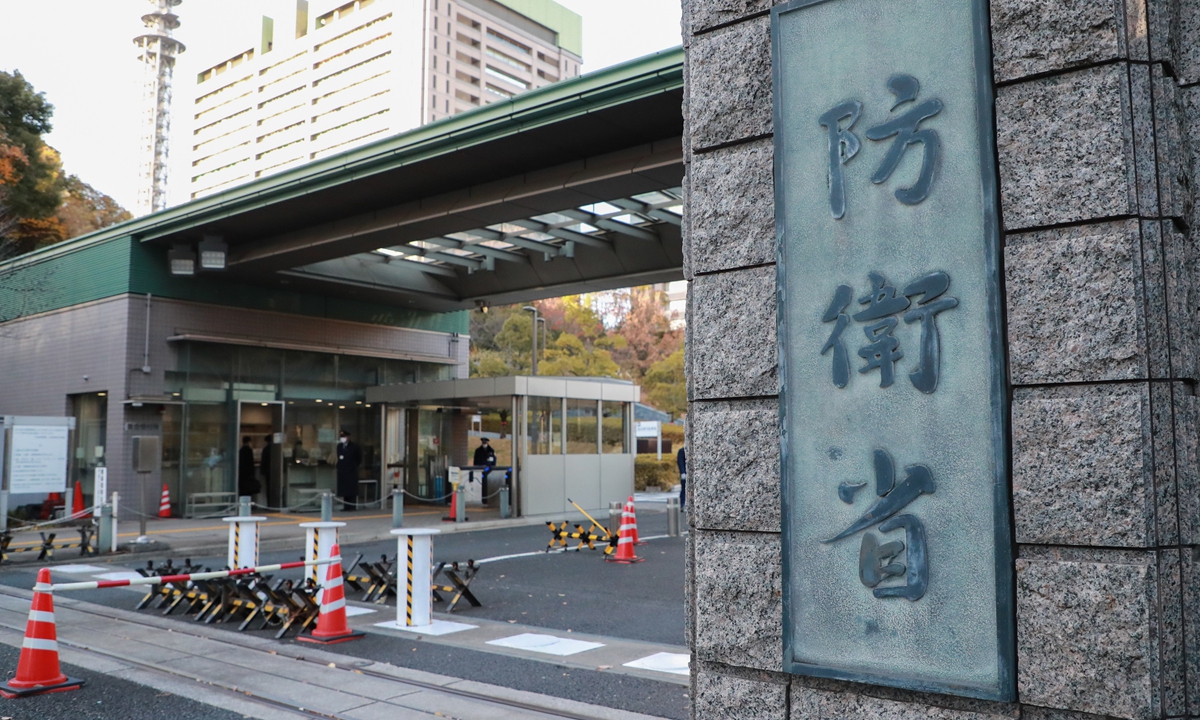
Japan's Ministry of Defense Photo: IC
Japan has recently stepped up efforts to expand its military capabilities. Shortly after the Japan Coast Guard (JCG) requested a record 344.8 billion yen for fiscal 2027, the country's Defense Ministry on Monday unveiled a record-breaking budget request of 8.89 trillion yen ($56 billion) for the next fiscal year.A Chinese expert noted that rather than the headline figure alone, Japan's record-breaking defense budget request reflects a more worrying trend: while Japan continues to break through postwar military constraints, it has never shown the kind of serious reflection on historical issues that should accompany its expanding military capabilities. Japan is moving further down a dangerous path toward militarism, making it impossible to ease the vigilance of neighboring countries and their concerns over a possible revival of Japan's militarism.
The budget request focuses on three key areas, including preparing for what it described as "new ways of warfare" by employing AI and drones, ensuring "sustained operational capabilities" in a "prolonged conflict," and strengthening Japan's defense industrial base, according to Japanese media outlet the Japan Times on Monday.
Japan also plans to expand the use of unmanned systems to reduce personnel losses, while advancing stand-off weapons, including domestically developed missiles and hypersonic guided missiles that can be launched from underwater platforms, Fuji News Network reported on Monday.
The budget request also includes plans for an AI-based decision-support system, and more small attack drones and uncrewed aerial vehicles (UAVs) for information gathering. The Japanese defense ministry is also seeking research into stand-off missiles launched from uncrewed underwater vehicles (UUVs). The Japan Times noted that Japan's drone buildup has been driven in part by what it described as so-called concerns over Chinese military activities near its southwestern periphery.
Japan's growing emphasis on AI-assisted decision-making, drones and other unmanned systems reflects lessons drawn from recent conflicts such as the Russia-Ukraine conflict, as well as mounting recruitment difficulties facing the Self-Defense Forces (SDF). But the buildup goes far beyond addressing manpower shortages. Japan's continued development of long-range strike weapons, including missile-related programs, is expanding the SDF's operational reach and offensive capabilities, further hollowing out its long-standing "exclusively defense-oriented policy," Song Zhongping, a Chinese military affairs expert, told the Global Times on Tuesday.
A report from the Wall Street Journal indicated that Japan's requested defense budget does not include additional spending related to the US military presence in Japan, which, when finalized, would likely push the total beyond the record 9 trillion yen budgeted for the current fiscal year.
The Japan Times' report also said that the figure is "widely expected to balloon even further" as Japan revises its three key national security documents by year-end.
Can a security policy that asks the public to shoulder a greater financial burden while disregarding fiscal discipline really lead Japan toward a better future? And is an economic growth strategy that relies on the defense industry truly appropriate for a "peace-loving nation"? The prime minister needs to answer these fundamental questions, an opinion piece by Kobe Shimbun asked in August.
Song pointed out that from expanding ammunition stockpiles and strengthening defense production capacity to developing unmanned systems for large-scale deployment, Japan's sharply increased military spending shows that it is seeking to build a system capable of sustaining prolonged military operations at lower personnel and equipment costs.
This goes beyond the procurement of individual weaponry and reflects a broader strengthening of Japan's war preparedness and a more aggressive military posture, which will inevitably heighten neighboring countries' concerns over Tokyo's true strategic intentions, Song said.
The fiscal 2027 budget request comes in the final year of Japan's five-year defense buildup plan, which envisaged about 43 trillion yen ($269 billion) in Japan's defense spending from fiscal 2023 to 2027.
Against this backdrop, Japanese newspaper Sankei Shimbun recently reported that the "Taipei office" of the so-called "Japan-Taiwan Exchange Association" had installed an underground shelter capable of protecting against nuclear, biological and chemical threats, a move the report linked to contingency preparations for a so-called "Taiwan emergency."
China has repeatedly voiced concern over Japan's accelerating military buildup. Chinese Foreign Ministry spokesperson Lin Jian said in June that Japan's defense budget had hit a record high for 14 consecutive years. Its defense spending per capita has reached three times that of China, and total defense expenditure has surged to 2 percent of GDP with plans to raise it further to 3.5 percent. Military orders from the Ministry of Defense have tripled over the past five years. Since the current administration came to power, it has been accelerating the deployment of intermediate- and long-range missiles, easing the restrictions on exports of lethal weapons, and promoting the revision of its Constitution and the three security documents. By doing so, Japan seeks to further breach international and domestic laws and challenge the postwar international order.
The Chinese Foreign Ministry also said in May that Japan's development of so-called counterstrike capabilities capable of offensive operations would by no means alleviate international concern over Japan's remilitarization.
RELATED ARTICLES