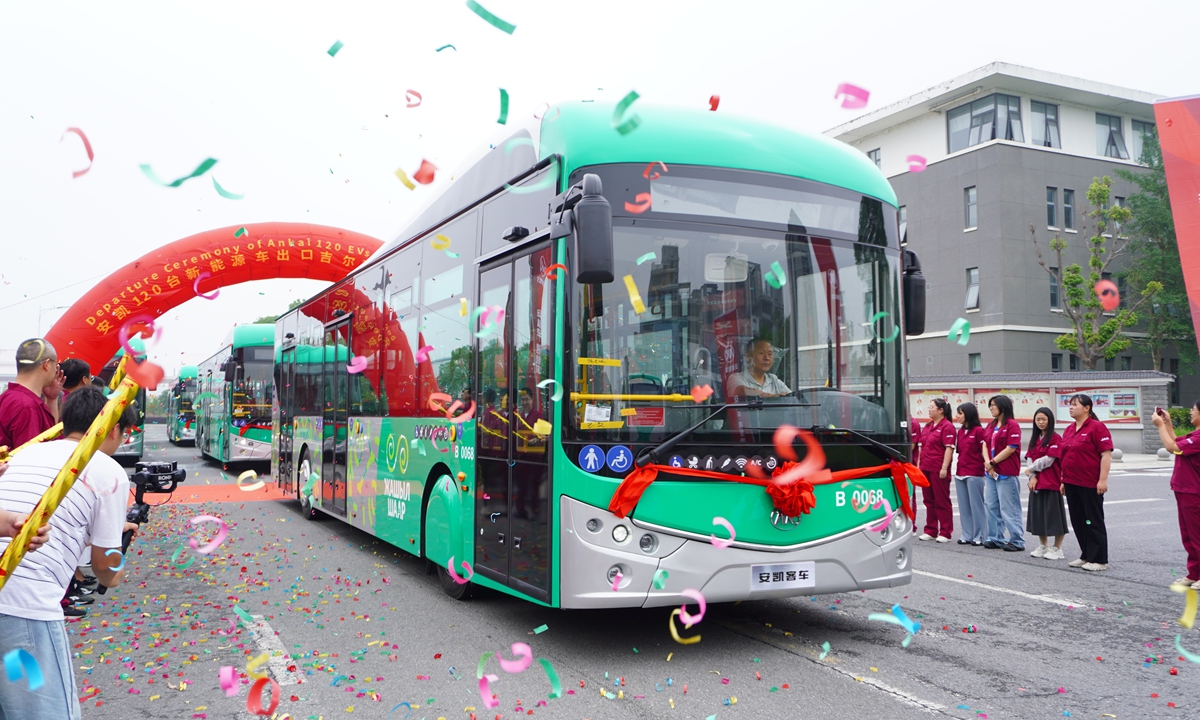
Ankai new-energy buses travel along a street in Hefei, East China's Anhui Province, on June 13, 2025. The buses are set to be exported to Kyrgyzstan in batches. Photo: Coutesy of Ankai
It's late August in Bishkek, the capital of Kyrgyzstan, and the afternoons still carry a touch of heat. During the evening rush hour, buses shuttle among the city's core stations, carrying commuters home. At a bus stop adjacent to the No.1 bus depot, a passenger named Jazgul Alymova is waiting for her ride.
Alymova told the Global Times that she commutes by bus every day, speaking highly of Chinese-brand electric buses. "They are quiet, steady and equipped with air conditioning. Even during the scorching summer heat, the cabin remains refreshingly cool, making my daily commute incredibly pleasant," she said.
These buses are some of the 120 new-energy buses delivered by Chinese automaker Anhui Ankai Automobile Co to Kyrgyzstan - the largest electric bus order the country has received to date.
Tailored to Bishkek's local road conditions, climate and commuting patterns, Ankai buses feature multiple precise local adaptations. The vehicles are equipped with high-power motors that deliver strong hill-climbing performance, perfectly suited to the city's uphill-heavy, slope-prone terrain. In response to daily commuting needs, a three-door low-floor layout with accessible ramps enables easy boarding and alighting for all passengers, including those with disabilities. To cope with Bishkek's climate, the buses come with full electric HVAC (Heating, Ventilation, and Air Conditioning) systems, plus additional electric heaters to ensure winter riding comfort, delivering a fully electric, green travel experience across the fleet.
"The moment I felt most proud of during the project was when Kyrgyz President Sadyr Japarov attended the depot opening ceremony in person and took a ride on our new-energy bus. At that moment, I deeply felt that our product represents not only the Ankai brand, but also the strength and image of 'Made in China' - a strong sense of mission and honor," Zhang Yong, an overseas service manager with Ankai, told the Global Times.
Since the buses went into service, they have won unanimous high praise from the local government, transport authorities, bus operators and commuters alike. All sectors have recognized that this batch of electric buses has significantly upgraded the quality of Bishkek's public transport, improved passengers' travel experience, and advanced the city's green mobility, with many expressing sincere thanks to the Chinese company for its professional capability and delivery quality, Zhang said.
The warm reception of Ankai's electric buses in Bishkek is a vivid example of how China-Kyrgyzstan practical cooperation is shifting toward green and low-carbon solutions on the ground. In recent years, economic and trade relations between China and Central Asian countries have evolved from just trade to various sectors including infrastructure construction and investment, especially in green and low-carbon development, Li Quanjun, head of the China-Kyrgyzstan enterprises co-association in Bishkek, told the Global Times.
He cited several flagship examples of this evolution. In the Chui region in Kyrgyzstan, a 100-megawatt solar station built with Chinese participation was connected to the grid in late 2025 and now powers nearly 30,000 households. Meanwhile, a waste-to-energy plant invested in and built by Chinese company Hunan Junxin Environmental Protection in Bishkek has brought cleaner air, reliable waste management, and additional electricity to thousands of households.
These projects not only address Kyrgyzstan's energy needs but also demonstrate China's commitment to green, low-carbon development in Central Asia. The transition from fossil fuels to renewable energy is particularly vital for a country that has historically faced power shortages, and Chinese technology is helping bridge that gap efficiently and sustainably, Li said.
As another important step to advance the Belt and Road Initiative's green energy cooperation in both depth and substance, the Bash and Dzhankeldy Grid-Source Integration Project in Uzbekistan, invested in, built and operated by China Southern Power Grid Co Ltd, was officially put into operation in April 2025. The project was completed about two months ahead of schedule, making it the largest wind power project built to date in Central Asia.
"To adapt to the region's variable climate conditions, the project adopted China's independently developed 6.5-megawatt large-capacity wind turbines. These turbines feature multiple innovations and optimizations in design and functionality, which maximize wind energy capture and significantly improve the efficiency of power generation, with both high performance and durability," the company told the Global Times in a statement.
"Amid growing geopolitical uncertainties and extreme weather events, the five Central Asian nations generally face the critical task of shifting from resource-dependent economies to innovation-driven, green development, and thus there is strong demand and vast market potential for clean energy technologies and green industry cooperation with China," Zhang Hong, a research fellow at the Institute of Russian, Eastern European and Central Asian Studies at the Chinese Academy of Social Sciences, told the Global Times.
Jointly advancing green modernization is not only a vivid manifestation of the "China-Central Asia Spirit" in the field of global climate governance, but also one of the core objectives of upgrading bilateral cooperation from primary resource trade to deep, full-industry-chain integration. New energy cooperation has thus emerged as the key pathway to realizing this vision, Zhang Hong said.
RELATED ARTICLES