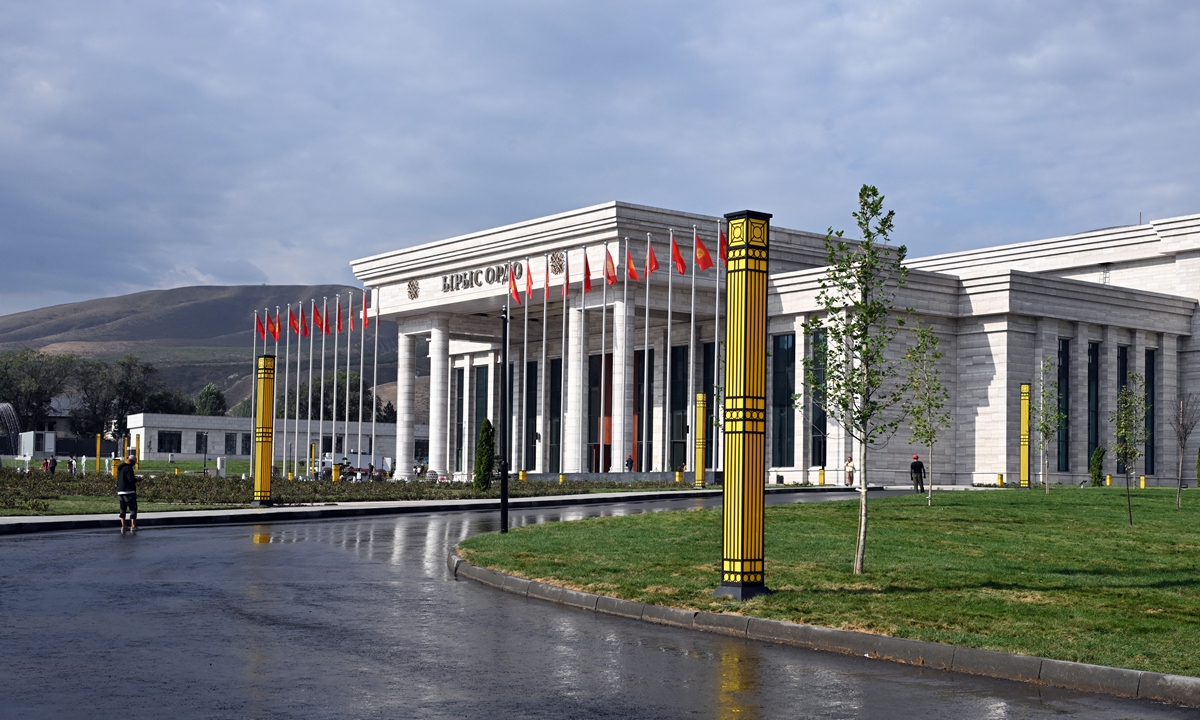
A view shows the Yrys Ordo Congress Hall in Bishkek, Kyrgyzstan. The Shanghai Cooperation Organisation summit is held in the Kyrgyz capital from August 31 to September 1, 2026. Photo: VCG
Kyrgyzstan-China economic and trade cooperation is developing in a healthy way, and priority areas such as digital economy, high technology, green development, and artificial intelligence will help drive Kyrgyzstan's high-tech future and unleash great potential for bilateral cooperation in the future.
The two countries' cooperation began almost 35 years ago with delimitation and demarcation of borders - borders of peace, not conflict. Later came joint infrastructure projects in transport and energy. In Kyrgyzstan's case, two rebuilt highways have become a highly efficient channel for trade with China. Official data showed that China has long been Kyrgyzstan's largest trading partner, its largest source of imports, and its largest source of foreign investment.
Last year, bilateral trade reached a record high of $27.2 billion, up approximately 20 percent year-on-year. Trade between Kyrgyzstan and China accounted for a quarter of China's total trade with Central Asian countries.
Major cooperation projects are advancing rapidly. The China-Kyrgyzstan-Uzbekistan railway, currently under construction, will, for the first time in the history, transform Kyrgyzstan from landlocked to land-connected, linking Asia and Europe via the shortest possible rail route. Freight will travel from Xi'an, Northwest China's Shaanxi Province to Germany's Duisburg in just 10 days.
What is more exciting is the Chinese leader's statement that "we should also cooperate in the digital economy, clean energy, artificial intelligence, and other emerging fields" in his signed article in Kyrgyz media. These three areas are exactly what the future world will be built on. Central Asia has a very educated population and young demographic characteristics, with an average of three children per household. The region has very good economic growth and a very good demographic situation. Young people are highly educated and eager to follow China's leadership in modernization and high-quality development.
China's development achievements over the past several decades are impressive, represented by advances in economic and social development, improvements in people's livelihood, scientific and technological progress, innovation and industrial modernization. China's development model is the right approach. Few countries have achieved such sustained success in recent decades. China's governance stands out for its long-term vision and strategic planning. The 15th Five-Year Plan (2026-30) clearly prioritizes modernization and high-quality development. Future cooperation between Kyrgyzstan and China will bring mutual benefits to both sides.
China's proven approach to governance and development offers valuable insights that resonate far beyond its borders, extending to the multilateral framework of the Shanghai Cooperation Organisation (SCO).
This year, the SCO marks its 25th anniversary at a pivotal moment. What began as a forum for settling borders among founding members has, step by step, become the largest regional organization in the world by landmass, population, and GDP. This unique institution is transforming itself into a center of crystallization for global governance.
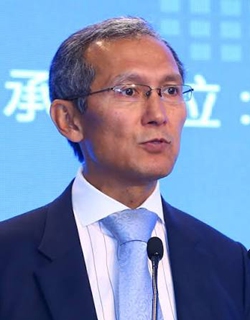
Djoomart Otorbaev Photo: Courtesy of Djoomart Otorbaev
The cooperation within the SCO can be captured in three words: connectivity, pragmatism, and cooperation.
Connectivity goes far beyond railways, highways, or airways. It encompasses trade, mutual investment, and people-to-people exchanges. For landlocked Central Asian countries, connectivity is not a choice but a necessity. This geographic reality has shaped a deep-rooted friendship with neighboring countries - a value Central Asian countries are eager to bring to the organization's atmosphere.
Pragmatism reflects the SCO's ability to rise above differences. Member states have different political and economic systems, yet what they have decided within the organization is to set aside differences and focus on similarities.
The third word, cooperation, means refusing to let external powers dictate what member states should or should not do.
Last year's SCO Summit in North China's Tianjin was a very successful meeting with incredible results. Among the outstanding outcomes is the Global Governance Initiative. The current architecture of the world is not efficient - there are wars, there are conflicts, and some countries still speak of containing others. Global South countries don't want to listen to statement that some big powers in the West want to contain other powers. Why contain? Why not to offer development, cooperation, or better governance?
The United Nations remains a unique institution, but humanity should explore more efficient governance initiatives. The SCO, can set an example of how countries with different ideologies and different systems can establish peaceful procedures to reach common conclusions. Ahead lie many complicated stages, but the organization must try to become a model of best practice.
A series of major global initiatives proposed by China - the Global Development Initiative, the Global Security Initiative, the Global Civilization Initiative and the Global Governance Initiative - are not demands but invitations to cooperation, dialogue, for rebuilding trust. It's not an insistence on whether to do something or not; it's invitation to dialogue and through dialogue, rebuilding trust.
The world listens to China's ideas with great attention, and Global South countries welcome them. Building trust step by step is exactly what the world must focus on. This is the voice the SCO should send to the world as it enters its next 25 years.
This article is compiled based on an interview with Djoomart Otorbaev, former prime minister of Kyrgyzstan. bizopinion@globaltimes.com.cn
RELATED ARTICLES