SCO at 25, ‘Shanghai Spirit,’ China's contribution drive practical co-op amid global uncertainties: experts
China's contribution underpins expanding practical cooperation: experts
By Yin Yeping, in Beijing and Ma Jingjing in Bishkek Published: Sep 01, 2026 12:00 AM
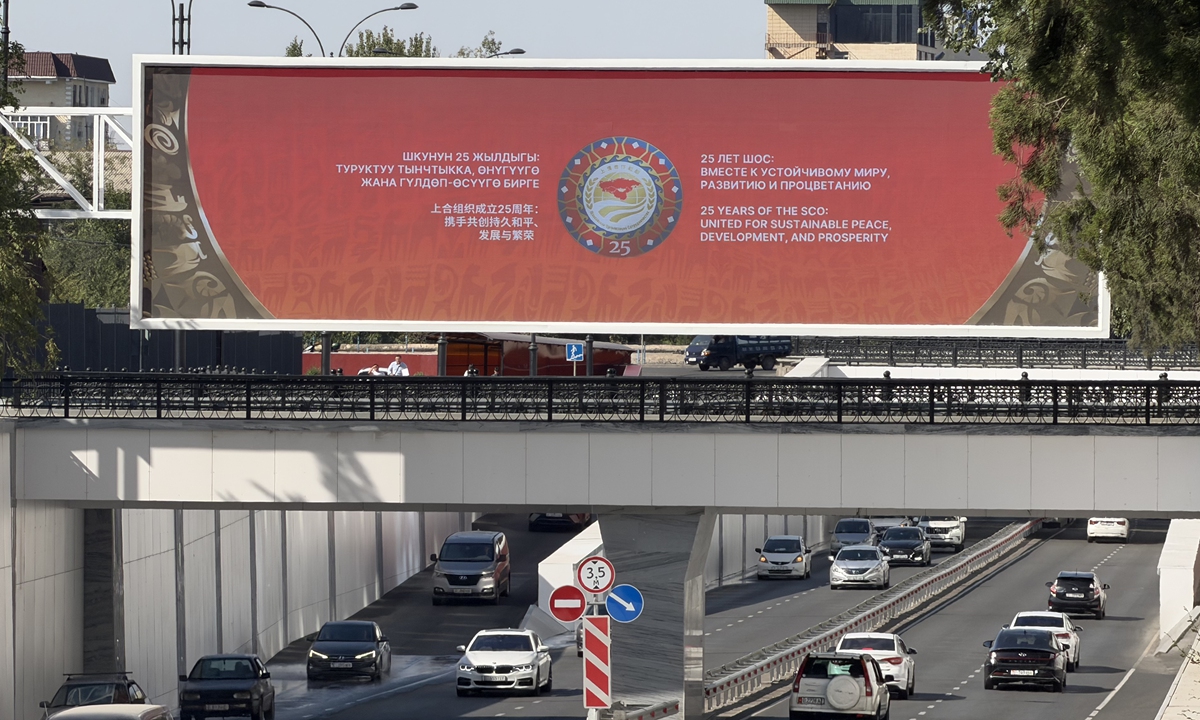
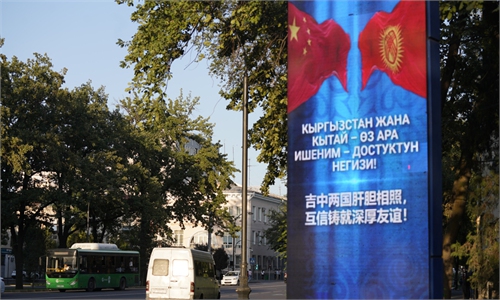
A large LED screen scrolls SCO Summit slogans at the Chyngyz Aitmatov Avenue in Bishkek, Kyrgyzstan on August 29, 2026. Photo: Ma Jingjing/GT
Chinese President Xi Jinping landed in Bishkek, Kyrgyzstan, on Sunday for a state visit and the Shanghai Cooperation Organization (SCO) Summit 2026, the Xinhua News Agency reported.
On Monday, Xi met with Russian President Vladimir Putin, Uzbek President Shavkat Mirziyoyev and Mongolian President Ukhnaa Khurelsukh in Bishkek, Xinhua reported. The intensive bilateral interactions ahead of the SCO summit underscored how multilateral platforms can create fresh momentum for bilateral cooperation, while stronger bilateral ties, in turn, reinforce coordination within multilateral frameworks, jointly injecting new impetus into the SCO multilateral framework, regional cooperation, connectivity and development, observers said.
This year marks the 25th anniversary of the SCO. Amid growing global turbulence, rising unilateralism and protectionism, and mounting challenges to global governance, the summit has drawn widespread attention.
Several foreign scholars told the Global Times ahead of the summit that over the past 25 years, the SCO has grown from six founding members into a comprehensive regional organization with broad reach and expanding areas of cooperation, demonstrating the enduring vitality of the Shanghai Spirit amid a complex international environment.
Standing at a new starting point, the SCO is further translating years of political mutual trust and cooperation consensus into concrete actions, a Chinese expert said, noting that China's initiatives and proposals are also injecting new impetus into implementing consensus and deepening practical cooperation.
Enduring vitality
On the eve of the summit, Bishkek, the capital of Kyrgyzstan, had already entered the "SCO time."
Along Chingiz Aitmatov Avenue, SCO logos and prominent "25" anniversary signs can be seen throughout the area. LED screens in the city center display summit-themed images and the national flags of SCO members, while buses running through the streets have also been decorated with "SCO Summit Bishkek-2026" signs in Kyrgyz, Chinese, Russian and English.
The anniversary provides a moment not only to look back at how far the organization has come, but also to consider where it is headed next.
"What began as a forum for settling borders among founding members has, step by step, become the largest regional organization in the world by landmass, population, and GDP. This unique institution is transforming itself into a center of crystallization for global governance," said Djoomart Otorbaev, former prime minister of Kyrgyzstan.
Today, the SCO has grown from six founding members into the world's largest regional organization, with 27 countries participating in cooperation across more than 50 areas. It accounts for about half of the world's population and roughly a quarter of the global economy, with the SCO family continuing to expand its cooperation and international influence.
For experts interviewed by the Global Times, the significance of the SCO's 25-year journey lies not only in its expansion.
Kubat Rakhimov, executive director of Applicata - Centre for Strategic Solutions in Bishkek, said the anniversary offers an opportunity to reflect on the organization's remarkable journey. In his view, the SCO's most significant achievement is "not merely its survival amid a turbulent international landscape, but its unwavering commitment to the 'Shanghai Spirit,' featuring mutual trust, mutual benefit, equality, consultation, respect for diversity of civilizations, and pursuit of common development."
"Unlike traditional alliances built on confrontation, the SCO is a non-bloc, non-Western, and non-confrontational organization. It has brought together states with diverse political systems, and economic models, proving that cooperation is possible without an imagined enemy," Rakhimov said.
"This inclusive architecture is a rare and valuable asset in an era when countries are increasingly pressured to pick sides," Rakhimov added.
From consensus to action
As the SCO family has expanded and cooperation has extended into more areas, emphasis has also been placed on turning political consensus into concrete outcomes.
Rakhimov believes that the organization is now entering such a transition.
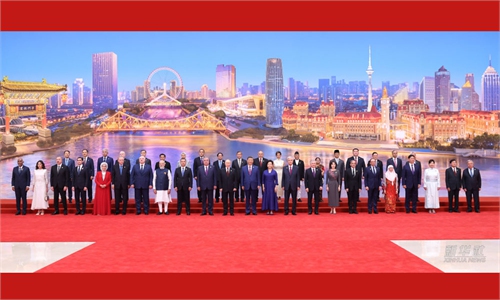
The summit in Bishkek comes a year after the successful SCO Summit 2025 in North China's Tianjin Municipality, where member states adopted the SCO Development Strategy for 2026-2035, charting the course for the organization's future development.
As a founding member of the SCO, China has played an active and constructive role in this process, experts said.
"The establishment of the SCO Development Bank, decided at the Tianjin Summit, is the most impressive cooperation initiative and reveals much about China's role. For a quarter-century, the idea of a multilateral financial institution had been discussed, but it was China's leadership and commitment that broke the deadlock," Rakhimov said.
China brings to SCO cooperation not only its vast market, strong industrial base, extensive experience in infrastructure development and mature technological innovation ecosystem, but also a series of initiatives and proposals, Zhang Hong, a research fellow at the Institute of Russian, Eastern European and Central Asian Studies at the Chinese Academy of Social Sciences, told the Global Times on Monday.
The China-proposed initiatives including the Belt and Road Initiative and the Global Security Initiative have provided fresh impetus for the development of the SCO family, Zhang said.
The depth of this cooperation is also reflected in the rapid expansion of economic and trade ties.
At a regular press conference on August 27, Chinese Commerce Ministry spokesperson Huang Ling said that trade between China and other SCO members grew from $12.1 billion in 2001 to $523.5 billion in 2025, accounting for 8 percent of China's total foreign trade. China's exports of the "new three" products - namely electric vehicles, lithium batteries and photovoltaic products, and cross-border e-commerce exports to other SCO members have also grown rapidly.
Over the past 25 years, China has upheld the Shanghai Spirit and worked with other SCO members to pursue common development and share the benefits of growth, yielding fruitful results in regional economic cooperation, Huang said.
China's investment in other SCO members has also continued to expand. China's direct investment across all sectors in other SCO members reached $3.3 billion in 2025, covering oil and gas, mining, infrastructure, new energy, automobiles and chemicals.
Such cooperation is already visible in Bishkek.
As the summit gets underway, 120 China-made electric buses produced by Anhui Ankai Automobile Co have entered regular commercial operation in Bishkek, serving eight major routes across the city. The buses will also provide transportation services for participants during the SCO summit, the company told the Global Times.
According to the company, each bus travels more than 200 kilometers and carries around 900 passengers per day on average. Beyond delivering the vehicles, the Chinese team has trained local drivers and maintenance personnel while working with the Kyrgyz side to establish special inspection and deicing procedures to cope with Bishkek's wet snow and icy conditions in winter.
About a 40-minute drive from the summit venue, another China-Kyrgyzstan green cooperation project is changing the way Bishkek handles its municipal waste.
This is the Bishkek waste-to-energy project, which began operations in December 2025 and is the first waste-to-energy plant in Kyrgyzstan and Central Asia.
From green transportation and urban environmental management to trade, investment and connectivity, cooperation between China and SCO member states is bearing fruits, said Zhang.
The next stage of cooperation could go further. Commenting on the summit, Zhang said SCO members are likely to deepen trade and investment ties further and strengthen cooperation in emerging areas such as green energy and artificial intelligence.
At the same time, the SCO's greater openness and cooperation could inject fresh momentum into global development and serve as a model for win-win cooperation at both the regional and global levels, he noted.
RELATED ARTICLES