From SCO summit to state visits, Xi’s trips to bring positivity amid world turbulence
By Ma Jingjing and Li Qiang in Bishkek and in Beijing Published: Aug 29, 2026 12:24 AM

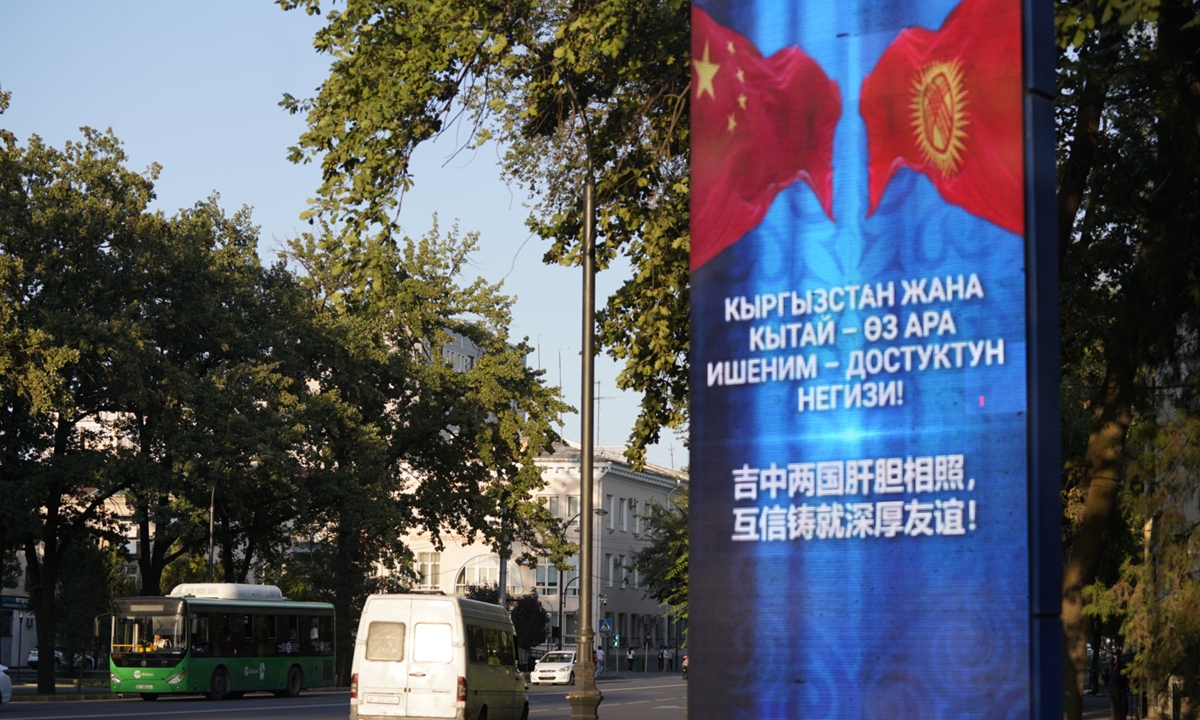
Photo shows a vertical electronic screens in Bishkek showing footage of the national flags of China and Kyrgyzstan, alongside a welcoming slogan in both Chinese and Kyrgyz: "Kyrgyzstan and China stand side by side through thick and thin. Mutual trust forges profound friendship!" Photo: Ma Jingjing/GT
On the streets of Bishkek, the capital city of Kyrgyzstan, billboards and signs bearing the logo of the 2026 Shanghai Cooperation Organization (SCO) Summit can be seen almost everywhere. Even SCO‑themed graphics on new‑energy buses serve as a reminder that the countdown for the SCO's "Bishkek Moment" is in its final hours.
The coming SCO Summit 2026 will be held in Bishkek from August 31 to September 1, 2026.
Amid a fast‑changing international landscape, Chinese President Xi Jinping will embark on his first overseas trip in the second half of 2026. From August 30 to September 3, he will attend the 2026 SCO Summit in Bishkek and pay state visits to Kyrgyzstan and Egypt, the Xinhua News Agency reported.
The upcoming and highly-anticipated head‑of‑state diplomacy integrates multilateral engagements with bilateral state visits, covering both neighboring regions and key hotspot areas. It is expected to expand practical cooperation avenues, deepen strategic alignment, drive progress in global governance, rally solidarity among the Global South, and inject greater positive momentum into world peace and development, analysts said on Friday.
Upholding the Shanghai Spirit
The 2026 SCO Summit carries the theme "25 Years of the SCO: Together Towards Sustainable Peace, Development and Prosperity." According to SCO Secretary-General Nurlan Yermekbayev, the country's priorities include strengthening regional stability, boosting economic cooperation, improving transportation links, accelerating digital transformation and expanding cultural exchanges.
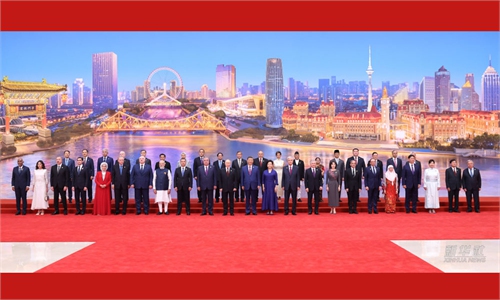
According to Xinhua, Xi has attended every SCO summit since 2013, steadily shaping the grouping's development along the way.
At the 25th Meeting of the Council of Heads of State of the SCO in North China's port city of Tianjin last year, Xi proposed the Global Governance Initiative, a vision that has rallied broad support across the international community.
Also at the Tianjin summit, the SCO mapped out a strategic blueprint for its development over the next decade and ushered in a new stage of high-quality development. Over the past year, seven cooperation platforms covering green industry, digital economy, scientific and technological innovation, energy, higher education, vocational and technical education, and artificial intelligence have been launched, generating more than 160 projects.
Guided by the Shanghai Spirit featuring mutual trust, mutual benefit, equality, consultation, respect for diverse civilizations and pursuit of common development, the SCO has continuously yielded new achievements in practical cooperation. With rising influence and cohesion, it firmly defends multilateralism and serves as one of the major pillars of a multipolar world, Zhu Yongbiao, a Middle East affairs expert at Lanzhou University, told the Global Times.
The Bishkek Summit is poised to serve as a key milestone in deepening and substantiating cooperation among SCO member states across security, economy, finance and connectivity, said Zhu. "Against a backdrop of an increasingly complex and volatile international landscape, the summit will also bring more opportunities for global peace and development."
According to Alibek Tazhibayev, a Kazakhstani political analyst and the Director of the Eurasian Monitoring Center for Analytical Research, a think tank based in Kazakhstan, the Shanghai Spirit offers, to some extent, an alternative to the rigid logic of bloc politics. Countries do not have to be identical to one another or share identical stances on every issue to carry out effective cooperation.
He told the Global Times that the SCO is well‑positioned to emerge as a major force within the evolving multipolar international order and play a vital role in steering the global governance system toward greater balance.
Founded in Shanghai in June 2001, the SCO has expanded from six founding members into the world's largest regional organization with cooperation covering more than 50 areas and a combined economic output of nearly $30 trillion.
New chapter for friendship
In a signed article published in Kyrgyz media outlets ahead of his state visit to the Central Asian country, President Xi hailed the historic leap in China-Kyrgyzstan ties from a good-neighborly friendship to a strategic partnership and then to a comprehensive strategic partnership for a new era, per Xinhua.
Kyrgyz state news agency Kabar said the upcoming state visit by China's head of state will serve as an important step to further strengthen bilateral relations built on solid friendship, mutual trust and support.
Signs of bilateral friendship are also visible across Bishkek's streets. On major city thoroughfares, Global Times reporters saw vertical electronic screens showing footage of the two national flags, alongside a welcoming slogan in both Chinese and Kyrgyz: "Kyrgyzstan and China stand side by side through thick and thin. Mutual trust forges profound friendship!"
Erdenet Kasymov, First Deputy Director of the State Agency for Tourism Development of the Kyrgyz Republic, told the Global Times that China‑Kyrgyzstan relations are now at their best in history. The upcoming SCO Summit in Bishkek will inject fresh impetus into practical cooperation between two sides across multiple sectors.
Among them, the China-Kyrgyzstan-Uzbekistan Railway stands out as a landmark cooperation project. In a congratulatory letter to the commencement ceremony of the project in December 2024, Xi said that the construction of the railway is a strategic decision made by the three governments to promote regional connectivity, prosperity and stability, which also reflects the shared aspiration of the three countries to open up this strategic corridor.
According to Zhu Yongbiao, the upcoming head‑of‑state visit will give strong impetus to building the China‑Kyrgyzstan community with a shared future," said Zhu.
On the practical cooperation front, construction of the China‑Kyrgyzstan‑Uzbekistan Railway is expected to gather pace. Cooperation will also see further improvement in quality and efficiency across full‑chain energy sectors, the China‑Central Asia Gas Pipeline, digital economy and people‑to‑people exchanges, said the expert.
During a press briefing on Thursday, Chinese Ministry of Commerce spokesperson Huang Ling said that China has long remained Kyrgyzstan's largest trading partner, with bilateral economic and trade cooperation making steady progress.
China-Kyrgyzstan trade reached $11.7 billion in the first seven months of this year. During the period, China's exports of electric vehicles, lithium batteries and photovoltaic products, known as the "new three", as well as mechanical and electrical products to Kyrgyzstan grew rapidly, Huang said.
Egypt, the first Arab and African country to establish diplomatic ties with the People's Republic of China, also enjoys a time‑honored traditional friendship with Beijing.
Egyptian media outlet Ahram online said the trip to will be Xi's first to Egypt since he visited Cairo in 2016, and the two leaders will discuss "ways to strengthen the strategic partnership between the two countries across various fields of mutual interest."
It also noted progress in the two countries' economic and defense cooperation.
The year 2026 marks the 70th anniversary of the establishment of diplomatic relations between China and Egypt, as well as the 70th anniversary of diplomatic relations between China and Arab states.
In 2014, the two countries elevated their relationship to a comprehensive strategic partnership. In 2024, Egypt became the first Arab country to include the goal of building a community with a shared future in a bilateral joint statement, according to Xinhua.
A recent survey titled "How Chinese people view Egypt" conducted by the Global Times Institute found that nearly 90 percent of respondents gave positive or neutral evaluations of current China-Egypt relations. Among them, 63 percent said China-Egypt relations are "very good" or "relatively good."
According to Xinhua, Chinese language education has been introduced into Egypt's national education system. By the end of June this year, China-Egypt Suez Economic and Trade Cooperation Zone, the flagship project of China-Egypt industrial cooperation, had attracted more than 200 companies, brought in over $4.7 billion in investment, created more than 10,000 direct jobs and supported tens of thousands of additional job opportunities.
China has long enjoyed a profound friendship with Kyrgyzstan and Egypt, both key members of the Global South. This round of head‑of‑state diplomacy is expected to further upgrade China's cooperation with the two countries and strengthen their coordination within multilateral mechanisms, Zhu said.
"It will also generate exemplary and driving effects for China's cooperation with other countries in their respective regions," said the expert.
RELATED ARTICLES