IN-DEPTH / IN-DEPTH
GT investigates: How the US seeks to sideline Chinese open-source AI – and why it will backfire
Chilling effect or self-inflicted wound?
By Gao Yuanxin and Published: Sep 01, 2026 10:26 PM

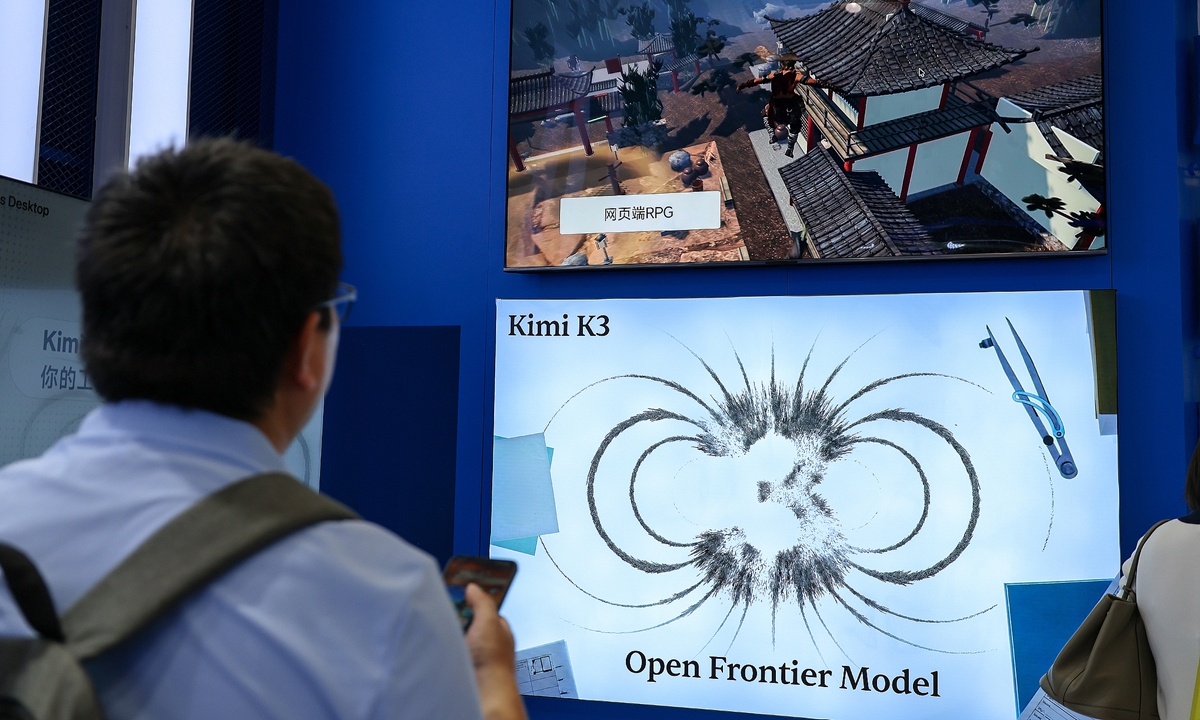
A visitor stands in front of the Kimi booth at the World Artificial Intelligence Conference in Shanghai on July 20, 2026. Photos: VCG
"China wants to shape what the world's AI knows," The New York Times claimed in an article on August 17. Earlier, Reuters reported on August 7 that US-based cybersecurity research firm Frontier Security alleged that Chinese open-source model Kimi K3 could access "information beyond test confines after bypassing safeguards."
These are not simply technology stories. It is not hard to find that these stories are deliberately associated with terms such as security, discourse power, and ideology. Looking into some recent overseas media coverage and think tank reports, the Global Times reporters found that such narrative frames have appeared with increasing frequency in the public remarks of US politicians, senior executives at technology companies and academics, following China's World Artificial Intelligence Conference 2026 (WAIC 2026) in July and the latest releases of Chinese open-source models such as Kimi K3.
The US is currently in a period of "strategic ambivalence" toward Chinese AI, Wang Shouyang, a distinguished research fellow at the Chinese Academy of Sciences, along with his team members Huang Difang and Liu Meng, said in an interview with the Global Times. They pointed out that China's open-source models have already established a global advantage in diffusion, and the US wants to block them. However, it feels that a blanket ban would be difficult to enforce and could provoke backlash from the industry, given that many US companies rely on Chinese open-source models to reduce costs and drive innovation.
Against this backdrop, the US is trying to use a "chilling effect" in its competition with China in AI - leveraging public opinion and cognitive influence to create an environment in which companies in the US and around the world "dare not use, do not want to use and cannot publicly use" Chinese open-source models, according to Wang's team.
However, for the US, is creating a "chilling effect" really a choice that harms others without harming itself?
Creating a 'chilling effect'
The US' effort to create a "chilling effect" around China's open-source models appears to be more of a public narrative campaign, analysts said.
The US media outlet Axios, citing sources' opinions, reported on July 20 that "instead of a ban, another source familiar with government discussions described a push to highlight potential backdoors and lack of security with Chinese models, and the governance issue that brings." It added that while such measures do not amount to an outright ban, they "would have a chilling effect on Chinese open-source tech and US companies that rely on it."
Some voices within the US have described such moves as an attempt to manufacture "FUD (fear, uncertainty and doubt)," saying that this should be leveraged. Dean Ball, a former top White House AI adviser, posted on X in July that the best strategy would be to create "large amounts of regulatory risk" around the use of Chinese open-source models. "You don't need to 'ban open source,'" he wrote. "You just need to direct every agency to issue soft law that creates FUD."
The US is using "softer tools" such as third-party audits and media-driven campaigns to build a narrative that "Chinese AI is not trustworthy," thereby heightening companies' risk concerns and compliance costs, and ultimately scaring the market into voluntarily shunning Chinese open-source models - a form of "soft decoupling," Chen Jing, vice president and research fellow at think tank Society for the Study of Technological and Strategic Trends, told the Global Times.
"Using think tanks, university research teams and cybersecurity firms to conduct 'security tests' on Chinese open-source models, and then publicly release 'risk reports,' is a typical tactic for manufacturing a chilling effect," summarized Wang's team.
As the narrative around the alleged "illegal distillation" of Chinese open-source models gained traction, these so-called "third-party studies" played a key role in laying the discursive groundwork and reshaping the definition of the issue, analysts pointed out. For example, in June 2026, the Center for a New American Security published a report, alleging that Chinese firms' "adversarial distillation" involves "the extraction of AI model capabilities at scale through unauthorized access to US AI systems or their supporting infrastructure to develop AI models."
Such research draws a line between "legitimate distillation" and so-called "illicit distillation," providing a pretext for subsequent scrutiny and restrictions, according to Wang's team.
Apart from promoting the "illicit distillation" narrative, several "third-party studies" have used similar logic to accuse Chinese AI of embedding "hidden security vulnerabilities" in the US, found the Global Times reporters.
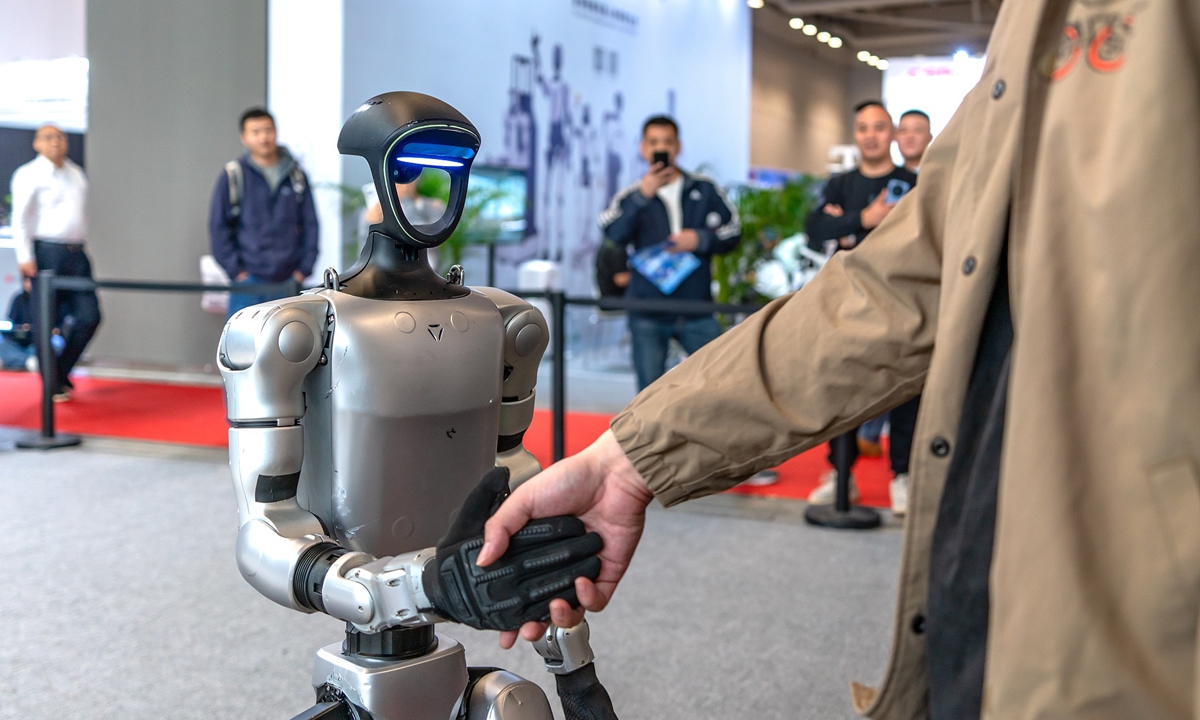
Unitree Robotics showcases a humanoid robot interacting with an audience member through a handshake.
"This kind of third-party research has a strong political function: it could shape market expectations without the formal issuance of a ban, leading corporate legal, compliance, and board-level decision-makers to view the use of Chinese open-source models as carrying 'uncontrollable risks,' and thus prompting companies to avoid Chinese AI on their own initiative," Wang's team told the Global Times.
Meanwhile, some people within the US are calling for additional "soft" restrictions on Chinese open-source models, so as to further create a "chilling effect."
Tal Feldman, who the NYT said "worked for the US government, building AI models," argued in a July 29 opinion piece that any AI product based on a Chinese model should have a country-of-origin label, like "Made for China."
Wang's team told the Global Times that mandatory disclosure, while not an outright ban on Chinese open-source models, would impose additional explanatory burdens on companies in compliance, procurement, financing and customer communications.
Some scholars in the US have even openly advocated for the use and amplification of policy uncertainty to force companies to think twice before choosing Chinese open-source models. For example, Mark Witzke, a nonresident scholar at the University of California San Diego, told Bloomberg that "the precise actions may not matter as much as the overall climate produced by regulatory uncertainty," and suggested the US government raise the legal and reputational costs for companies that host or deploy Chinese models.
Wang's team analyzed that this approach would serve to reinforce the "national-security risk narrative," thereby shaping companies' policy expectations and real-world choices.
A 'cheap' measure
"Open source is decentralized, irreversible and broadly accessible. That makes 'hard sanctions' technically unworkable, legally questionable and politically unprofitable," Chen told the Global Times. "That is precisely why the US is, at this stage, trying to create a chilling effect."
If Washington were to impose substantive restrictions on Chinese AI, it would face multiple internal constraints, according to Wang's team.
They explained that first, actually enforcing a so-called ban is far more difficult than announcing sanctions in words. Once an open-source model is released, it can be downloaded, copied, fine-tuned and deployed locally. Even if the US were to prohibit certain platforms from hosting such models, it would still be difficult to stop them from circulating within the global developer community. A blanket ban on Chinese open-source models would be costly to enforce and of limited effectiveness from a technical standpoint.
Second, the strong backlash from the industry, as well as the political costs behind it, cannot be ignored. According to Wang's team, there is already a clear reaction in the US business community, with companies including Hugging Face, Meta and Nvidia explicitly opposing broad restrictions on open-source models. Some US firms believe that banning Chinese open-source models could amount to undermining the entire open-source AI ecosystem.
In addition, a forceful ban could run into legal obstacles. Chen noted that US courts have recognized that human-readable source code can receive First Amendment protection as a form of expression, often summarized as "code is speech," and that imposing controls could expose the government to constitutional challenges.
"The reason 'soft restrictions' have been chosen by the US policymakers is that they are 'cheap,'" Wang summed up. "The US government does not need to prove the existence of 'backdoors;' it only needs to create a situation in which companies cannot prove their own innocence. Compliance, legal, audit and evidentiary burdens are all shifted onto the companies, while the government does not have to spend money. Nor does this constitute a formal trade measure, so it avoids legal challenges from the open-source community on free-speech grounds," he explained.
Backfire on the US
The US wants to curb China's AI development while avoiding policy blowback and political pressure. That is why it sees the creation of a "chilling effect" as a supposedly "good option." Nonetheless, this tactic cannot hurt others without hurting oneself, said Chen. "It will inevitably backfire on the US."
The US investor Chamath Palihapitiya recently posted on X that US closed-source models are far more expensive than China's open-source models.
"American companies spending 50-100 times will at some point become financially impaired and the stock market will crater," he wrote.
Obviously, some US policymakers are not blind to the costs borne by companies; rather, they have chosen to place those costs after politics. Xiang Ligang, a Chinese observer of the telecommunications industry and researcher on the intelligent internet, told the Global Times that within US policymaking circles, "suppressing China" remains a kind of "political correctness." As a result, even if some people hesitate after weighing factors such as the business environment, in most cases, "political correctness" tends to prevail, even over the interests of the industry, he said.
Chen noted that the deliberate creation of a "chilling effect" will backfire on the development of US technology. Under policy uncertainty, companies may be forced to turn to expensive closed-source solutions or build their own systems, which would narrow the space for innovation and weaken the overall vitality of AI applications.
The longer-term cost is that shaking global confidence in US' openness will, in turn, weaken the competitiveness of its AI industry in the international market. "Instead of championing competition and openness, the US is inching toward AI protectionism," the WSJ warned in an opinion piece.
A March 2026 analysis by Hugging Face, a platform for hosting and sharing open-source AI models and datasets, found that Chinese models had surpassed US models in both monthly and all-time downloads, accounting for 41 percent of downloads over the previous year. On OpenRouter, a global platform that aggregates access to large language models, Chinese models also led US models in weekly token usage for five consecutive weeks in early 2026.
Open access is bringing not only market share, but also capital confidence. Access to capital has long been one of the US' biggest advantages in technology, and now China is trying to close that gap, said Bloomberg on August 9.
"The market is voting with tokens. Users and investors make the most honest choices based on cost and performance," Chen told the Global Times.
RELATED ARTICLES