IN-DEPTH / IN-DEPTH
Indonesian, Filipino crew members share stories of rescue, care and daily life aboard China’s distant-water fishing vessels
Family across oceans
By Published: May 27, 2026 10:44 PM

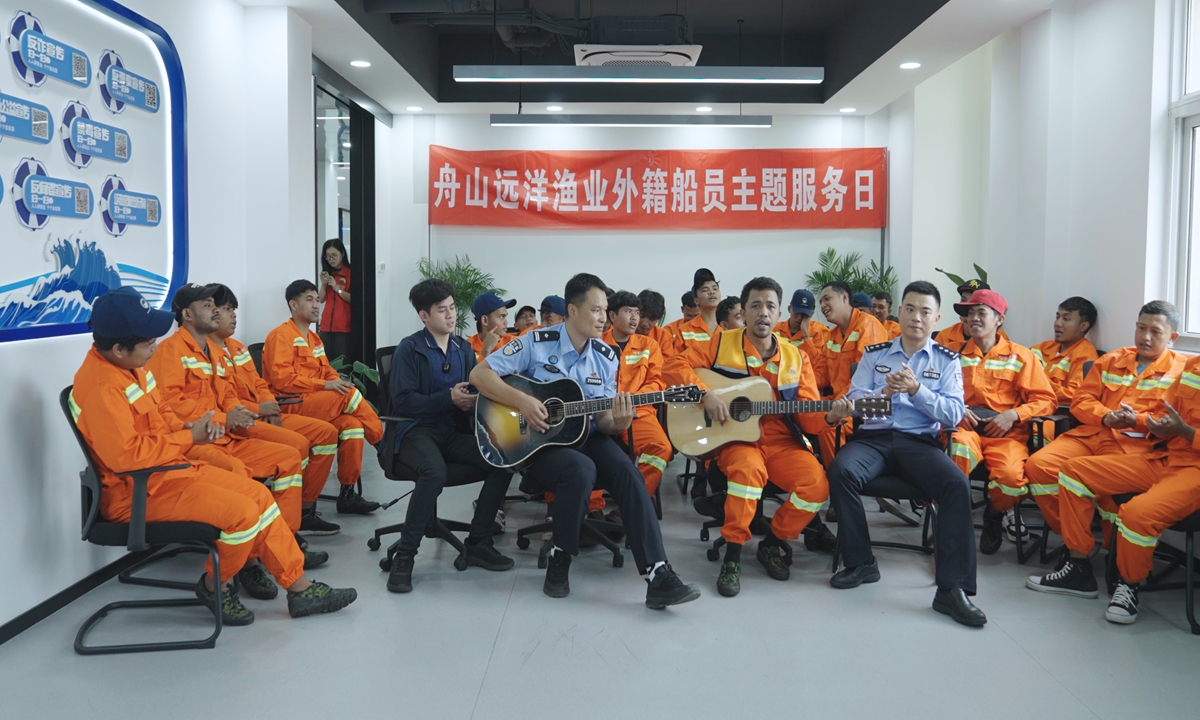
An Indonesian crew member plays guitar as fellow crew members sing along with Chinese immigration officers at Zhoushan National Distant-Water Fishing Base on May 14, 2026. Photo: Courtesy of Shanghai Ocean University
Editor's Note:
"No mountain or ocean can distance people who have shared aspirations." This powerful message underscores the force of friendship and cooperation in bridging hearts across nations, cultures and civilizations.
People from diverse backgrounds and fields, united by common goals and dreams, traverse mountains and oceans to connect with each other. Through letters, face-to-face dialogues and vibrant cultural events, they are collectively weaving a magnificent tapestry of building a community with a shared future for humanity.
The Global Times presents "Intertwined Destinies, Shared Paths," a series spotlighting the touching stories written by these "friendship ambassadors." They are scholars pushing the boundaries of research, diplomats advocating for deeper cooperation on the global stage, artists igniting imaginations with their creations and ordinary people extending heartfelt love beyond national borders driven by their genuine sincerity.
Their stories illuminate the spark of cultural exchanges, the driving force of technological innovation, the bountiful harvest of economic cooperation and the enduring warmth of human connection - all contributing to a more peaceful, prosperous and open world. This is the 15th installment of the series.
The ocean is the cradle of life and the shared blue home of humanity. In recent years, China has actively participated in the United Nations Decade of Ocean Science for Sustainable Development (2021-2030), contributing China's solutions to the sustainable development of the global ocean. As June 8, the 18th World Oceans Day, approaches, the Global Times is launching a special subseries, "Fishing Together," which chronicles stories of fishery cooperation between China and various countries. This is the second installment of the subseries.
The sea breeze swept across the Zhoushan archipelago in East China's Zhejiang Province, carrying a salty tang and the fresh scent of the ocean. Sebastianus Ken Chandra, an Indonesian student at the College of Fisheries and Life Science of Shanghai Ocean University (SHOU), set foot on this coastal land with curiosity written across his face.
Earlier this month, under the organization of SHOU, Chandra visited the Zhoushan National Distant-Water Fishing Base at the West Pier. There, he took a close look at one of China's largest distant-water fisheries bases, and met crew members who work and live there, especially those from his homeland, Indonesia.
China is a major fishing nation and an active participant in international cooperation in distant-water fisheries. In Zhoushan alone, tens of thousands of foreign crew members from countries including the Philippines, Indonesia, Vietnam and Myanmar work side by side with Chinese seafarers, sharing the same meals and weathering the same storms. Working for Chinese fishery enterprises, they are, in every sense, part of the extended family of China's distant-water fisheries.
What is life and work like for foreign crew members employed by Chinese companies? With this question and high expectations in mind, Chandra embarked on this journey.
Life‑saving rescues
The sea is generous but it can also be dangerous. In distant-water operations, illness and injury are among seafarers' greatest adversaries. In moments of crisis, the respect and protection afforded to life reveal the true warmth of an industry - and of a country.
In a hospital in Zhoushan, the faint scent of disinfectant lingered in the air. As Chandra stepped into the ward, he saw Fikri Muzaini, an Indonesian crew member, sitting up in bed with one leg resting on a blue rehabilitation aid.
"How are you feeling now?" Chandra asked warmly in Indonesian.
"I'm much better now. I've received the best treatment," Muzaini replied with a smile.
The story goes back to March 29, 2026. That day, aboard a Chinese vessel in the waters off Oman, Muzaini slipped and was struck by a sharp pain in his knee. A preliminary examination on board revealed a fractured kneecap, along with torn and displaced ligaments - a serious injury.
In the midst of misfortune, there was one piece of good luck: the vessel's owner, Zhoushan Haili Ocean Fishery Co., Ltd., did not hesitate for a moment. The vessel immediately ceased operations and proceeded back at full speed. Thus began a life-saving relay that crossed borders: from Oman's Duqm Port to a nearby hospital, then a 600-kilometer overnight transfer by road to its capital Muscat, and when it became clear that local medical resources could not support the complex surgery required, the company's leadership made a decisive choice: send the crew member to China.
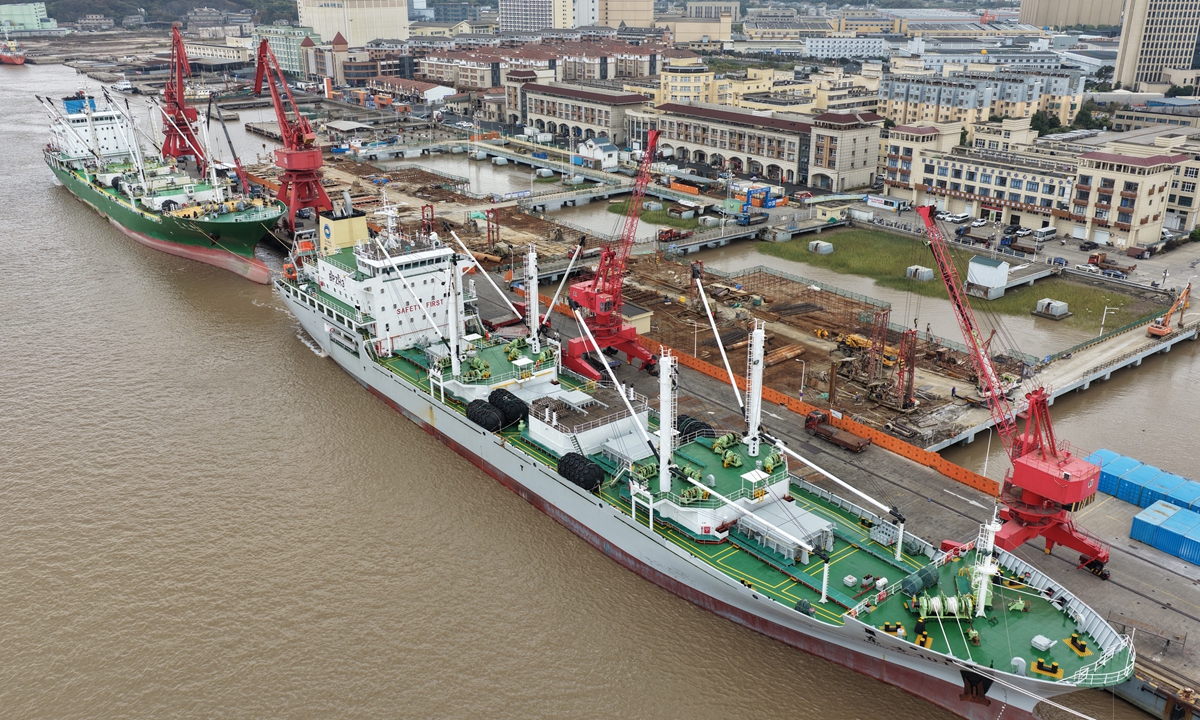
A view of the West Pier of Zhoushan archipelago, East China's Zhejiang Province. Photo: Courtesy of Zhoushan Immigration Inspection Station
"Local medical resources in Oman were limited, and our captain was dissatisfied, so they sent me here directly, just so I could receive the best possible treatment," Muzaini recalled. On April 16, after overcoming a series of obstacles involving visa applications, shipping routes and more, Muzaini arrived safely in Zhoushan, where Chinese orthopedic specialists successfully performed the surgery. Today, the stiffness in his leg is gradually easing, and doctors have told him that if he continues with rehabilitation, he will soon be able to walk normally again.
At first, Muzaini was frightened, worried that his leg might never recover. It was his Chinese company that never gave up on him, sending him to the best hospital for treatment and caring for him like family. "I'm truly very grateful," he said.
Such life‑saving rescues are not isolated cases.
In May, in the eastern Pacific, a Filipino crew member named Moreto Erwin Salvador, serving aboard a vessel operated by a Chinese company, suddenly fell gravely ill. With swollen legs, vomiting and in critical condition, he faced a medical emergency that far exceeded the limited treatment capabilities available at sea. After receiving the distress call, two Chinese vessels operating nearby immediately altered course. One ship, operated by Zhejiang Ocean Family Co., Ltd., moved in at once to provide assistance. Its ship doctor boarded the vessel and carried out emergency treatment, buying precious time for the next stage of care. Another vessel, operated by Zhoushan Pacific Tuna Pelagic Fishery Co., Ltd., quickly transported the crew member to Busan, South Korea, for further treatment, the Global Times learned from Zhoushan Overseas Fisheries Association.
"At the critical moment when our crew member suddenly fell seriously ill, your company quickly extended assistance and made every effort to carry out emergency rescue operations, safeguarding the life and safety of the crew member through your strong sense of responsibility and commitment," wrote Salvador's dispatching company in letters of appreciation sent to the two enterprises.
Homelike care
If the quick-responded rescues at sea are an embodiment of the strength and sense of responsibility of China's distant-water fishing industry, then the small acts of care in everyday life are the quiet threads that bind people together.
At the Zhoushan National Distant-Water Fishing Base, crew members from different countries live and rest while their ships are in port. Some crew members reached by the Global Times said that, the convenient living facilities, thoughtful public services and harmonious atmosphere have helped them find the warmth of home in a foreign land, far from their own.
During his visit, Chandra went from the hospital to the police station and the crew living areas, witnessing firsthand heartwarming scenes of Chinese and foreign people living together as one family.
At the police station at the base, for instance, Chandra came across a themed service day for foreign crew members organized by local immigration authority.
The event was lively: some seafarers were enjoying free haircuts, while others, with the help of volunteer interpreters, were asking about how to get a phone card and learning how to use mobile payment apps. Chandra also saw several Indonesian crew members pick up guitars and sing folk songs from home. Their mellow melodies drifted through the venue, while some Chinese immigration officers sat beside them, listening and clapping their hands to the beat. Songs and applause mingled together, painting a warm, deeply moving scene.
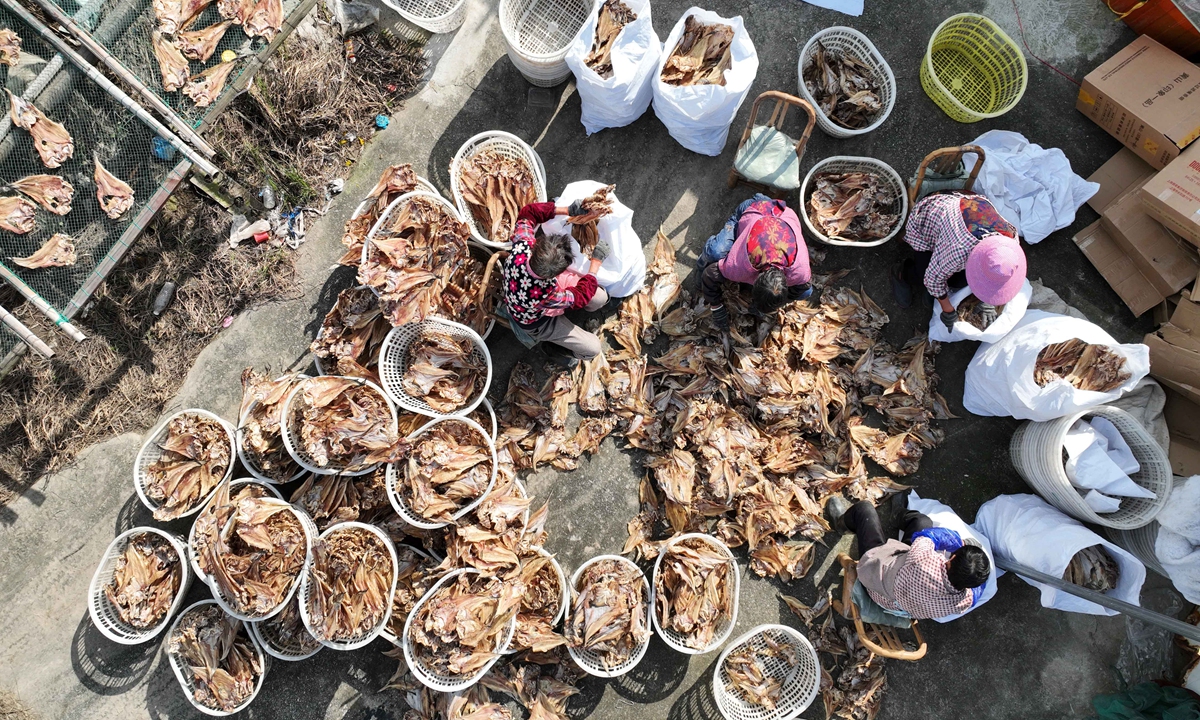
Fishers bag and pack dried fish at a drying ground in Zhoushan, East China's Zhejiang Province. Photo: VCG
Among them, Indonesian crew member Sudirja shared his story. The vessel he serves is well stocked with medicine, offers tasty meals, and provides comfortable living quarters. Moreover, it regularly arranges phone calls between crew members and their families. "The Indonesian crew on board are united and harmonious, and we work very well with the Chinese crew," he told the Global Times.
Another Indonesian crew member, Arihta Damanik, recalled that he came to a Chinese fishing vessel through a job application, and from departure and accommodation to boarding, everything was arranged by the labor service company, leaving him with nothing to worry about. "The facilities on board are very complete, and the beds and living environment are more than satisfactory. The ship has a dedicated chef, and the food suits our Indonesian tastes very well," Damanik told the Global Times.
The working atmosphere on board is relaxed and harmonious as well. Muzaini introduced that, the crew mainly handle inspections, sorting and packing, with a moderate workload. They work three times a day, and spend the rest of the time resting and chatting. Everyone gets along like family. When they are bored, they joke around and play games together, which means they never feel lonely.
Muzaini also talked about his Chinese captain, who treats them like family. Since working together in 2016, the captain has even visited Muzaini's home in Indonesia and has supported him fully in both work and daily life. "Whatever happens, if we have any problems, we just tell him," Muzaini said.
After bidding farewell to the fishermen, Chandra brought to a close his two-day visit to Zhoushan. During the trip, in addition to engaging with foreign crew members, he also visited places such as a local squid exhibition hall. There, he not only witnessed firsthand the standardized and modernized development of China's distant-water fishing industry, but also experienced its warm and people-centered care.
As an international student majoring in agriculture at SHOU, Chandra's future career seems destined to remain closely tied to the vast blue sea. For him, the Zhoushan trip was more than an exploration of China's fishing industry - it was a simple yet vivid encounter with the concept of "building a maritime community with a shared future."
"[This visit] gave me a lot of new and inspiring things," Chandra said. He believes that China's distant-water fishing industry not only supports the upgrading of its own sector, but also creates jobs and builds platforms for workers from around the world. "I hope that in the future, many more countries can also benefit from this industry," he told the Global Times.
RELATED ARTICLES