IN-DEPTH / IN-DEPTH
China's 'giant pandas of birds' rebound in Changbai Mountains through sustained human protection and technological innovation
Wings Return Home
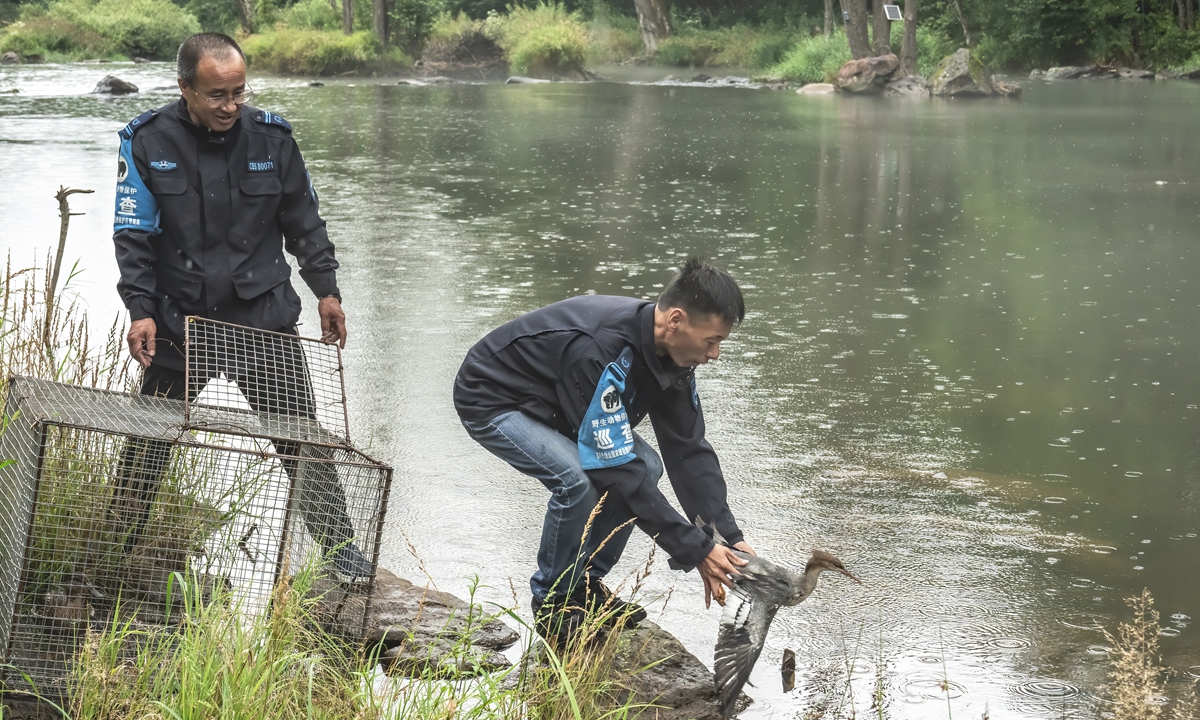
Wildlife rescue station staff in the Changbai Mountains release a hand-hatched Chinese merganser by a river. Photo: Courtesy of the Changbai Mountain Nature Conservation and Management Center
Editor's Note:
"Building an ecological civilization concerns the well-being of the people and the future of the nation."
Chinese President Xi Jinping, also general secretary of the Communist Party of China (CPC) Central Committee and chairman of the Central Military Commission, pointed out: "Respecting, adapting to, and protecting nature is essential for building China into a modern socialist country in all respects."
As outlined in the 15th Five-Year Plan (2026-2030) for national economic and social development, securing major breakthroughs in strategic tasks of overall importance to Chinese modernization and making major new progress in the Beautiful China Initiative are set as key objectives.
The Global Times is launching a series of articles titled "BeautifulChinaING." From the perspectives of the beauty of nature, the beauty of system and the beauty of lifestyle, the series uses both Chinese and international cases as entry points. Through field reporting and video storytelling, it explores how green development has become a defining feature of Chinese modernization while showcasing China's role as a responsible major country providing global public goods.
In this installment, as May 22 marks the International Day for Biological Diversity, we turn our focus to the Chinese merganser in the Changbai Mountains, where decades of conservation, scientific innovation and community participation are helping revive one of the world's rarest birds while showcasing China's broader ecological restoration efforts.
In May, the Changbai Mountains in Northeast China's Jilin Province awaken with new life. Wildlife activity grows increasingly frequent as spring spreads across the forests and rivers.
Inside the nursery room of a wildlife rescue station five kilometers from Erdaobaihe Town, veterinarian Cui Xiucheng bends over to observe two tiny, fluffy creatures. The Chinese merganser ducklings flap their fragile wings excitedly as they splash around in a small basin of water.
The pair had recently become separated from their flock before being discovered by tourists and brought to the rescue station. Now, in a temperature-controlled environment and under careful feeding plans, they are growing steadily.
Behind this seemingly ordinary scene lies a conservation effort that has lasted for more than a decade.
Researchers at the Changbai Mountain Academy of Science told the Global Times that the Chinese merganser - a relic species dating back some 70 million years - is often referred to as the "giant pandas of birds." Highly sensitive to water quality and ecological conditions, the species is widely regarded as an indicator of ecosystem health. In recent years, sustained conservation efforts have driven a rapid recovery in its population.
May 22 marks the International Day for Biological Diversity. Against this backdrop, the story of the Chinese merganser in the Changbai Mountains has become a vivid example of China's broader ecological conservation achievements.
Guardians in the forest
According to Cui, rescuing Chinese mergansers requires highly specialized work.
In late May to early June each year, mother ducks leave the nest with most of their ducklings soon after hatching. Yet one or two eggs are left behind, having failed to hatch due to temperature fluctuations or insufficient incubation time, Cui told the Global Times.
"At that point, I bring the eggs back to the rescue station and place them in artificial incubators that replicate the temperature and humidity conditions of the wild," Cui said.
Rescue operations are not limited to eggs. Injured or stranded ducklings also frequently require intervention.
In one rescue case in 2025, rescue workers found a weak duckling that had failed to jump out of an artificial nest box and was in critical condition. They rushed it back to the station for emergency care.
To help the duckling survive, Cui and other staff members prepared live cold-water fish every day, feeding it seven to eight times daily while carefully adjusting portions according to its growth stage. As the bird grew, its appetite became astonishing, consuming more than 100 small fish per day.
"They only eat tiny live fish from Changbai's cold-water streams, and the water quality has to remain extremely clean," Cui explained.
Alongside feeding, workers gradually introduced the duckling to simulated wild environments and trained it to forage independently.
After more than a month of intensive care, during the peak feeding period for wild merganser flocks, the bird was released into the river. Only after watching it quickly blend back into the wild group did the rescue team finally breathe a sigh of relief.
"Since joining the rescue station in 2018, I start work at 7 am almost every day, and emergency rescues sometimes happen in the middle of the night," Cui said. "But seeing these endangered birds gradually recover makes every effort worthwhile."
The Global Times learned from the Changbai Mountain Academy of Science that surveys conducted in 2013 found only three natural nests remaining in the Toudao Baihe river basin, with fewer than 10 Chinese mergansers left in the area.
The turning point came through systematic policy support.
Facing severe population decline, local authorities launched key scientific research and conservation projects aimed at comprehensive species recovery. In 2018, Jilin initiated a long-term Chinese merganser conservation program covering the Changbai Mountains through 2030, according to China's National Forestry and Grassland Administration.
Today, after years of effort, the population of Chinese mergansers in the region has multiplied significantly.
Between 2022 and 2025 alone, this rescue station successfully treated and rescued more than 130 wild animals, including nationally protected species such as Chinese mergansers, sika deer, leopard cats, black bears, roe deer, goshawks and kestrels.
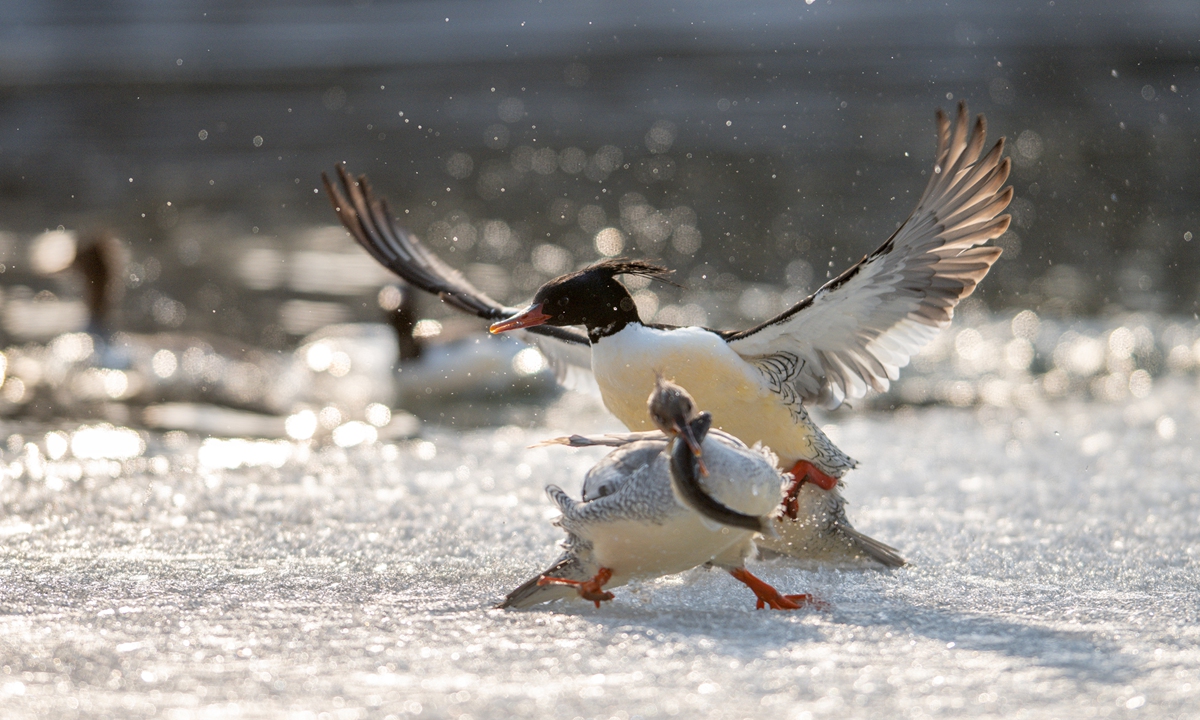
Two Chinese mergansers forage while swimming on a river in Baishan, Northeast China's Jilin Province, on March 17, 2026. Photo: VCG
Technological evolution in artificial nests
Behind the population rebound lies an evolving system of conservation technology.
Wang Zhuocong, associate researcher at the institute of zoology under the Changbai Mountain Academy of Science, described the gradual evolution of artificial nesting boxes.
"We first began experimenting with artificial nests in 2012. The earliest versions were very simple wooden boxes," Wang told the Global Times.
After years of refinement, the reserve's artificial nests have now reached their fourth generation. Internal climbing nets help Chinese mergansers safely jump out of nests, bark-like outer coverings provide a more natural appearance for nesting females, and environmentally friendly anti-corrosion coatings protect the structures from freeze-thaw cracking, Wang said.
The results have been striking. Wang said that in 2020, six artificial nests in the Toudao Baihe basin successfully produced 42 Chinese mergansers. By 2023, as many as 17 artificial nests were used, producing 116 hatchlings.
Snakes and weasel-like predators are among the merganser's main natural enemies. Snakes consume eggs, while yellow-throated martens not only prey on eggs but also attack incubating females.
To address the problem without disrupting ecological balance, conservation teams adopted cautious solutions. Snake repellents containing substances such as realgar and garlic extract were deployed around nests, while anti-marten barriers made from blunt plastic mesh were installed to deter predators without harming them.
"We cannot protect one endangered species by destroying others," Wang stressed.
Today, local authorities have also installed real-time monitoring cameras, carefully placing them during brief periods when female ducks temporarily leave the nests after laying eggs. The system allows researchers to observe breeding behavior while quickly identifying emergencies that require rescue intervention, Wang said.
Yet Wang emphasized that there is much work to be done before the Chinese merganser can be removed from the endangered species list.
As she pointed out, key priorities include restoring habitat connectivity by removing or modifying river barriers that obstruct migration routes, and expanding the large-scale installation of predator-resistant artificial nests with temperature and humidity controls.
Even so, the Chinese merganser's return already reflects the broader ecological recovery underway in the Changbai region.
"The fact that Chinese mergansers are returning to use artificial nests shows that forest resources across the Changbai Mountains are recovering," Wang said. "And if they can survive here and raise offspring successfully, it means the rivers contain abundant food and biodiversity, and the water quality is excellent."
Shi Guoqiang, head of the protection division at the Changbai Mountain Nature Conservation and Management Center, told the Global Times that conservation achievements during China's 14th Five-Year Plan period (2021-2025) have been especially significant. Chinese merganser populations have steadily increased across the reserve. Meanwhile, in recent years, the Siberian tiger, a flagship species of the northeastern forest ecosystem, has also left increasing traces and has been captured on hidden cameras.
"The return of flagship species demonstrates that the Changbai Mountains ecosystem is becoming more complete, while habitat connectivity and ecological integrity continue to improve," Shi said.

A view of Tianchi Lake in the Changbai Mountains Photo: VCG
Living alongside Nature
The 2026-2030 period marks a critical stage for China in its quest to basically achieve socialist modernization by 2035, with harmony between humanity and nature standing as a distinctive feature of Chinese modernization, reported Xinhua on March 9, 2026.
For the Changbai Mountain National Nature Reserve, coexistence between humans and nature also forms a central part of its long-term vision.
Shi told the Global Times that the reserve has actively encouraged nearby residents to participate in conservation work. Local residents are recruited as ecological forest rangers and patrol personnel, with experienced workers able to advance into leadership positions.
Cui has witnessed the change firsthand.
"Public awareness of wildlife protection has improved significantly in recent years," he said. "Now, usually, whenever someone comes across an injured animal, they take it to the rescue station."
Not long ago, a lost wild boar piglet even ran underneath a patrol vehicle seeking shelter and help, Cui recalled with a smile, describing the animal as "surprisingly intelligent."
Environmental education has also become increasingly immersive and localized. During events such as bird-loving week, students and community groups are invited to research and science education bases where they learn to build bird nests, participate in habitat restoration and experience wildlife patrol work firsthand.
Biodiversity conservation efforts across other parts of China have also yielded notable results. On Wednesday, the People's Daily Online reported that more than 500 milu deer, an endemic Chinese species, were born this year at a national nature reserve in Central China's Hubei Province, marking a breeding peak for the population.
Meanwhile, China National Radio reported on Wednesday that through continuous habitat restoration, population monitoring and ecological corridor construction, numbers of the Hainan gibbon in Changjiang County, South China's Hainan Province, have steadily increased, making the area a national model for the protection of rare and endangered species.
As the sun sets, the rescued Chinese merganser duckling released from the nursery has now adapted to life in the wild, foraging alongside its flock in shallow waters. Back at the rescue station, Cui remains busy caring for newly injured animals.
"As long as the forests stay green and the streams stay clear, these birds will always have a home," Cui said. "And that home belongs not only to the birds, but to everyone living on this land."
RELATED ARTICLES