IN-DEPTH / IN-DEPTH
A visit to last face-tattooed women of the Dulong in remote valley displays how China’s ethnic minorities are guarded by border police
Rainbow Gorge
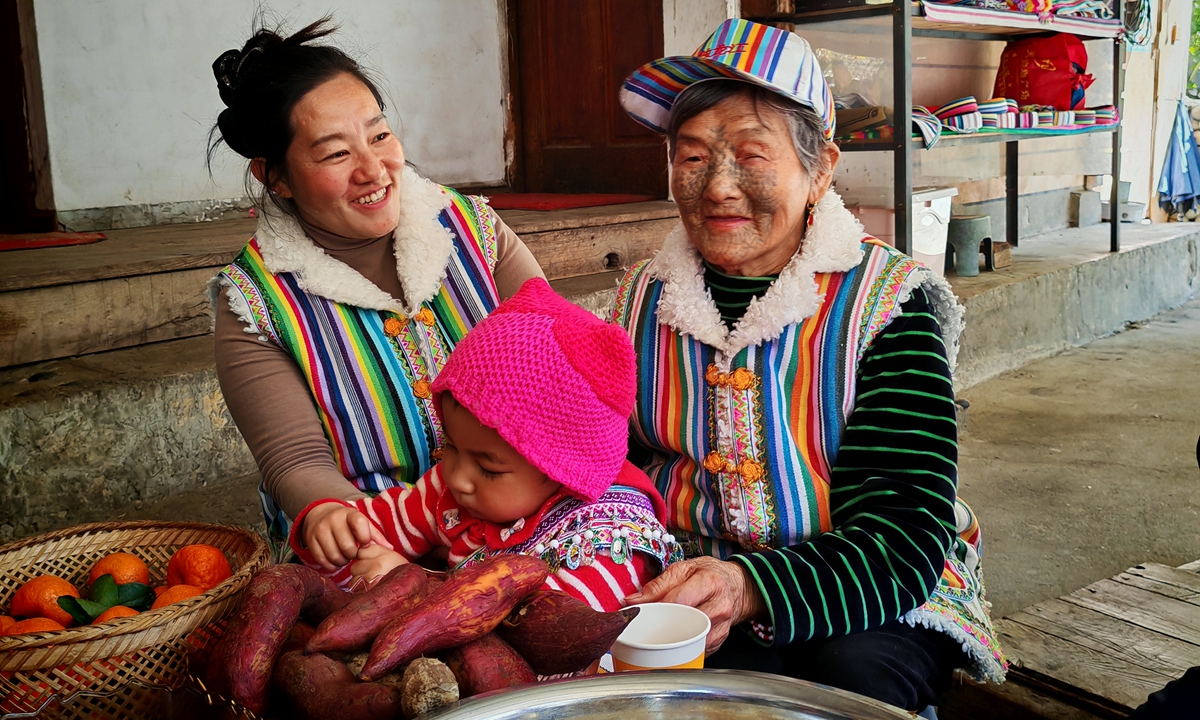
80-year-old face-tattooed woman Li Wenshi (right), her daughter Li Yuhua (left), and her grandson (center) sit in their own courtyard in Dizhengdang village, Dulongjiang, Yunnan Province, on April 16, 2026. Photo: Liang Rui/GT
Editor's Note:
China's human rights stories are unfolding in a new era of comprehensive deepening reform and historic changes. It is a key component of China's poverty alleviation and whole-process people's democracy, a thorough reformation in judicial, medical insurance, and other key sectors related to the national economy and people's livelihoods, as well as a combination of numerous impressive and inspiring individual stories.
To be nurtured in youth, educated, secure gainful employment, receive medical care when ill, cared for in old age, have a place to live, and supported when weak... these are the concrete embodiments of human rights, demonstrating that the greatest human right is the right to the happiness of the people.
For a long time, politicians and media outlets in a handful of countries have remained hostile and prejudicial toward China, leading to a lack of understanding among foreign audiences when it comes to the concepts and achievements of China's human rights development. But what is revealed in the daily lives of the Chinese people speaks to the most basic truth: Rights to survival and development are fundamental human rights.
The Global Times is launching a series of articles, telling vivid stories about upholding human rights in the new era. We expect the series to become a window through which more foreign readers will understand how Chinese people recognize human rights and what efforts they have made to fight for and fully enjoy human rights in their daily lives.
Mist drifted halfway up the slopes of the towering Gaoligong Mountains as it always did during the rainy season in Dulongjiang township, nestled deep within the Nujiang Lisu Autonomous Prefecture in Southwest China's Yunnan Province. Following officers from the Dulongjiang Frontier Police Station, the Global Times reporter wound along mountain roads toward Dizhengdang village to visit one of the "last face-tattooed women" of the Dulong ethnic group.
The car stopped in front of a neat traditional Dulong wooden house. Sitting quietly beneath the eaves was 80-year-old face-tattooed woman Li Wenshi, dressed in a vividly patterned vest. Beside her, her daughter Li Yuhua worked a shuttle swiftly through hemp threads as a rainbow-colored Dulong blanket slowly took shape in her hands.
The moment officer Zhao Keshuang stepped into the courtyard, Li Wenshi's eyes lit up. She grasped his hand and spoke softly in their local dialect. Her daughter laughed and translated: "My mother says she's happy whenever you come."
Deep inside the Dulongjiang, eight face-tattooed women still remain. Once known as the "tattooed tribe," the Dulong people preserved a facial tattooing tradition whose origins remain debated - some say it symbolized beauty, others believe it was used to deter abduction by rival chieftains, while some view it as a marker of adulthood or clan identity, according to the Dulongjiang Frontier Police Station.
As history moved on, the tattooing craft gradually disappeared. Yet the stories of these elderly women extend far beyond the narrative of a vanishing tradition.
Home to the Dulong people, an ethnic minority group that long endured poverty and poor access to the outside world, Dulongjiang shook off extreme poverty in 2018, reported the Xinhua News Agency.
In the opening year of the country's 15th Five-Year Plan (2026-30) period, efforts to ensure that no ethnic group is left behind are unfolding across China's frontier and ethnic regions, from the valleys of Nujiang to communities nationwide. On May 6, China's Ministry of Agriculture and Rural Affairs emphasized the need to advance targeted assistance and solidly promote comprehensive rural revitalization.
Beyond the improved living standards brought by government support, the face-tattooed women and other Dulong villagers are weaving bright future, connecting the once isolated valley to the wider world.
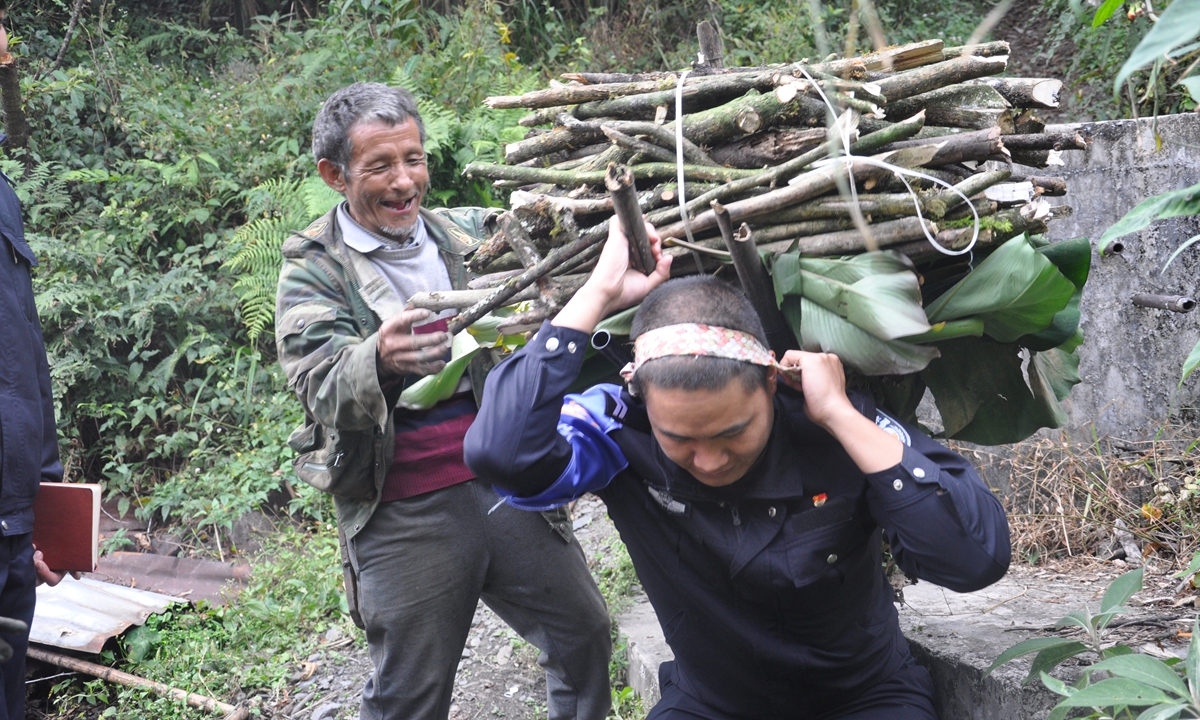
Police officer Gao Yanping helps an elderly villager carry firewood on his back in Dulongjiang, Yunnan Province. Photo: Courtesy of Dulongjiang Frontier Police Station
From hardship to happiness
Li Wenshi speaks only a few simple Putonghua phrases, relying on her daughter to translate. Though conversations moved slowly, she never let go of Zhao's hand, smiling warmly after every sentence. Soon, her two-and-a-half-year-old grandson dashed out of the house and agilely climbed onto Zhao's lap, refusing to get down as he repeatedly called him "Mamou."
In Dulong people's language, "Mamou" refers to family - someone close, trusted and dear. Decades ago, when the first border officers arrived in Dulongjiang, local residents began calling them by that name.
The Global Times learned from local police station that after the founding of the People's Republic of China, the Dulong people transitioned directly from a primitive society into socialism. But harsh geography and underdeveloped production methods meant many villagers still struggled with shortages of food and clothing for years afterward. Officers stationed in Dulongjiang traveled thousands of kilometers to bring high-quality grain and vegetable seeds from their hometowns. They also introduced the valley's first orange tree and first calf.
Since the beginning of the 21st century, the Dulongjiang Frontier Police Station has deeply integrated itself into China's poverty alleviation campaign. It introduced 10 targeted assistance measures, prioritized impoverished households when recruiting border auxiliaries and patrol personnel, and directly helped 163 families lift themselves out of poverty.
Today, those efforts have evolved far beyond simple assistance into deep-rooted integration with village life. In early 2024, the station established seven volunteer patrol teams across six villages.
Zhao told the Global Times that in 2024, Li Wenshi caught a cold and fell ill. He brought her medicine and milk from the township clinic. Before he left, the elderly woman insisted on gifting him one of her handmade Dulong blankets as a keepsake. Zhao thanked her repeatedly but politely declined.
Then, during a rainy day in the summer of 2025, when visiting another face-tattooed elder, the woman pressed a sack of freshly dug potatoes into his arms. After several failed attempts to refuse, Zhao finally accepted.
"The rain kept falling that day, but I felt incredibly warm," he said. "That bag of potatoes was the best proof of the bond between police and villagers."
This time, Zhao also brought along his younger colleague Li Su.
"In the future, she'll come and visit more often," Zhao told Li Wenshi. "We're all officers from the Dulongjiang Frontier Police Station. As long as it's within our ability, we'll help resolve any difficulties."
Not far away, a fully equipped makeshift photo studio had already been set up in another courtyard.
Dulongjiang once had no photo studio at all. Villagers needing identification photos had to cross mountains to reach Gongshan County - a full-day journey costing around 200 yuan ($30) in transportation alone, a considerable expense for ordinary families.
To solve the problem, the police station launched a small but meaningful convenience service: free ID photos, including retouching and printing. Officers even carry portable equipment to elderly residents, disabled villagers and face-tattooed women unable to travel.
"Whenever officers visit villages, they also bring hair-cutting tools with them," Zhao explained. "Most young people now work outside the valley, so it's not convenient for elderly villagers to get a haircut. Officers help take care of that."
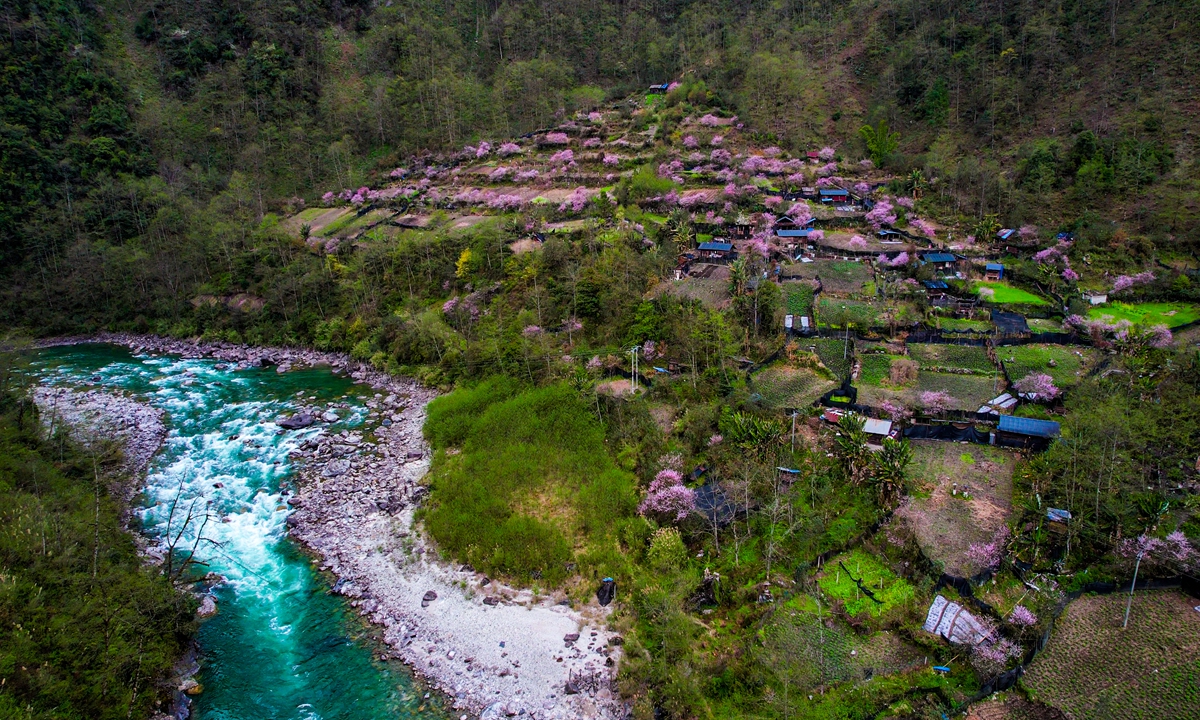
An aerial view of Dulongjiang, a remote township in Southwest China's Yunnan Province Photo: Courtesy of Dulongjiang Frontier Police Station
Weaving road to prosperity
Elsewhere in the village, 89-year-old face-tattooed elder Lian Zixian sat peacefully in her tidy courtyard, wearing a colorful vest and an old military-green cap. Around her hung bright Dulong blankets and delicate handicrafts. Her home has gradually become a popular destination for visitors seeking a closer look at Dulong culture.
Lian said she is delighted that so many people come to visit and appreciate the traditions and craftsmanship of her people.
If stable living conditions form the foundation of happiness, then meaningful employment determines how sustainable that happiness can be. In Dulongjiang, the answer is woven into every rainbow-colored blanket.
In May 2024, she helped establish a professional cooperative dedicated to Dulong blanket weaving and processing, and became its director. Her first mission was to recruit more Dulong women into the cooperative and train them into skilled artisans.
Traditionally, Dulong blankets were woven from hemp thread and featured rough textures with limited colors. Later, inspired by rainbows stretching across the canyon sky, Dulong people began dyeing the threads with plant pigments before weaving them into vibrant patterns.
"Worn as clothing during the day and used as blankets at night," Li Yuhua said, "each blanket carries the wisdom of an entire people."
The cooperative has partnered with companies in Shanghai, blending modern color aesthetics with traditional craftsmanship through made-to-order production. Shawls, jackets, pillows, backpacks and scarves now travel from the once isolated Dulong valley to markets across China and even Europe, according to Li Yuhua.
Today, Dulongjiang hosts around 100 similar handicraft workshops. The number of blanket weavers has grown from only a handful to roughly 500, increasing annual per capita incomes by 6,000 to 7,000 yuan ($882-$1029). The once-isolated "rainbow" craft has become a key industry supporting local employment, according to local authorities.
"It was government policy that lifted me out of poverty," Li told the Global Times. "And it was the support from local officials and villagers that brought me this far. I want to combine traditional Dulong weaving with modern cultural products so more Dulong women can build better lives through this craft."
The expansion of markets would not have been possible without transportation infrastructure. In early 2014, the Dulongjiang tunnel through the Gaoligong Mountains officially opened, connecting the valley to the outside world.
The improved access not only boosted weaving industries but also fueled tourism, homestay businesses and agricultural sectors such as Amomum Tsao-ko (a ginger-like Chinese herb) and honey production, all of which have become important sources of local income, according to Xinhua.
'Life keeps getting better'
Behind this transformation stands another enduring force.
On February 3, China unveiled its "No. 1 central document" for 2026, outlining plans to advance agricultural and rural modernization and to promote all-around rural revitalization, according to Xinhua.
The Dulongjiang Frontier Police Station said that while consolidating poverty alleviation achievements, it has continued aligning its work with national rural revitalization strategies by supporting industrial development, talent cultivation, cultural preservation, ecological protection and grassroots governance.
More than 1,100 people have received vocational training in areas ranging from specialty catering to wood carving; visitor service centers have been established, according to the police station.
Perhaps the deepest transformation can be seen in younger generations. More than 200 Dulong students have been admitted to universities, while five have earned master's or doctoral degrees. Graduate Tang Xiaocong returned home to serve as a border auxiliary police officer, and 16 Dulong youths have now joined border defense teams like him.
From Yunnan's borderlands to ethnic communities across China, similar changes continue unfolding.
In Nyingchi, Southwest China's Xizang Autonomous Region, local residents have benefited from Ganoderma industries and collective dividends. In Taxkorgan Tajik Autonomous County, Northwest China's Xinjiang Uygur Autonomous Region, development funds supporting ethnic minorities have helped Tajik villages boost tourism and raise collective incomes, according to media reports.
As we prepared to leave, Li Wenshi insisted on standing to see us off. Though elderly, she remains energetic and rarely sits idle. Whenever she has time, she still weaves blankets by hand. She held Zhao's hands tightly and said with a smile: "The country helped us build new homes. Now, we have enough food, warm clothes and peaceful days. Life keeps getting better, year after year."
RELATED ARTICLES