IN-DEPTH / IN-DEPTH
A remote Chinese border police station’s 74-year vigil shows governance performance lies in service and long-term commitment
Rooted in duty
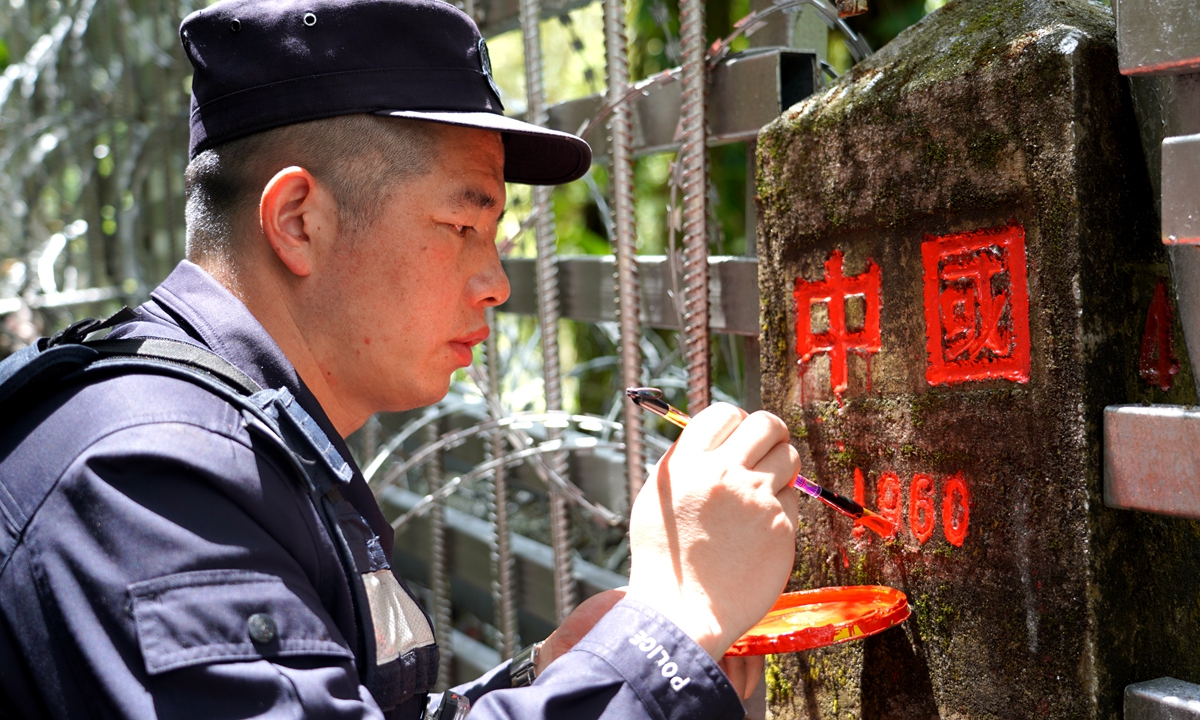
A police officer redraws the lettering on boundary marker 41 in Dulongjiang, Yunnan. Photo: Courtesy of Dulongjiang Frontier Police Station
In April, in Dulongjiang, a remote township in Southwest China's Yunnan Province, the snowline still lingers on the peaks of the Gaoligong Mountains while rhododendrons blaze across the slopes. Clouds coil around cliffs rising over 3,000 meters, and the Dulongjiang River roars through the gorge below, carving what was once known as one of "China's last hidden realms" into an isolated green sanctuary.
It is breathtakingly beautiful, and perilous to traverse.
As the Global Times reporter joined policemen from the Dulongjiang Frontier Police Station under the Nujiang Border Management Detachment of the Yunnan Provincial General Station of Exit-Entry Frontier Inspection on a patrol to boundary marker 43 along the northern China-Myanmar border, the peril behind the landscape's beauty revealed itself within the first kilometer. Half-human-height boulders choked the trail, moss turned every foothold slick, loose stones shifted underfoot, while icy river water roared beside the path. Scorpions darted between rocks. Leeches lurked in the grass.
"This is only the beginning," Zhang Qilei, chief of the Dulongjiang Frontier Police Station, told the Global Times. After an hour, the reporter had climbed less than 300 meters. Ahead lay steeper dirt tracks, untouched forests and a snow-covered mountain pass more than 4,000 meters above sea level.
For 74 years, generations of border police have walked this route to safeguard this land.
The passage of time is marked not only on calendars, but also in the police station's community service outposts and on the wall of the boundary marker 41 police post, lined with honorary banners.
For the guardians of Dulongjiang, true governance performance lives in the praise of the people, in footprints of varying depth pressed along little-known border trails, and in the police emblem that stays lit through the night on this farthest frontier of China.
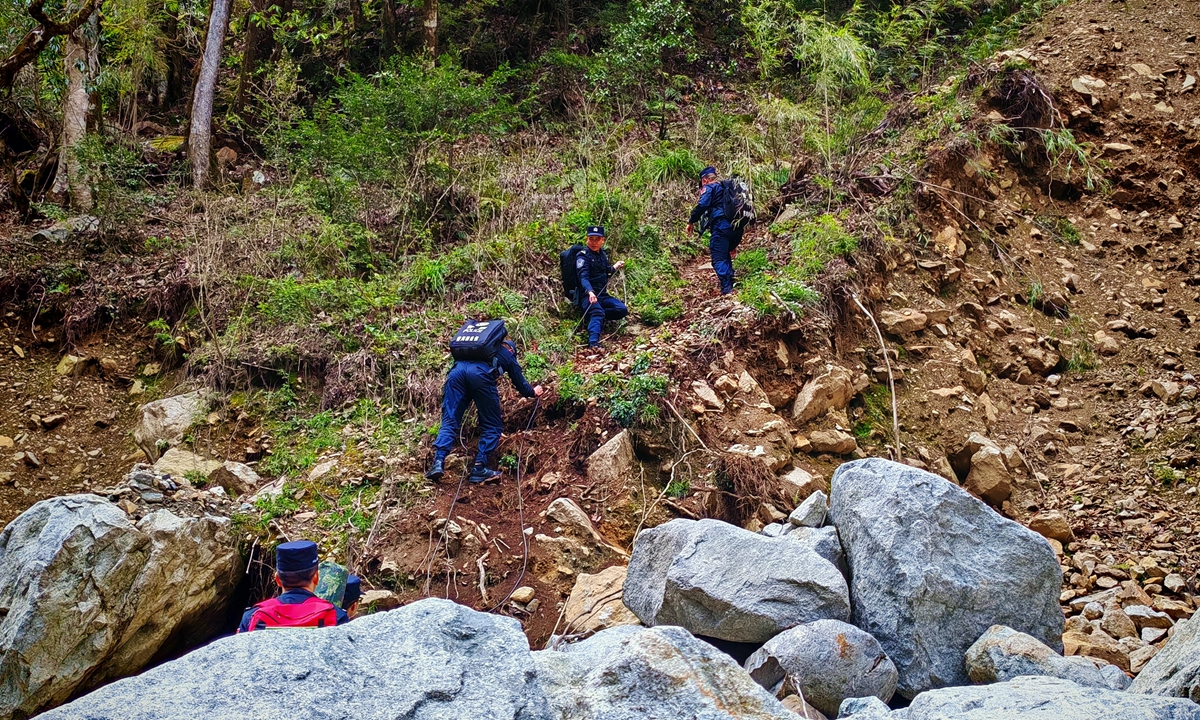
Policemen from the Dulongjiang Frontier Police Station make their way along a patrol route toward boundary marker 43 in Dulongjiang, Yunnan, on April 16, 2026. Photo: Liang Rui/GT
Rooted on border trail
"Every extra step forward brings us one step closer to boundary marker 43," Zhang Qilei recalled of a thought that stayed with him during a patrol in September 2025, when a 10-member team from the Dulongjiang Frontier Police Station spent five days and four nights braving the wilderness to complete the most recent patrol and inspection mission to the marker.
The China-Myanmar border within Dulongjiang stretches 115 kilometers, marked by seven boundary markers from 37 to 43. The hardest to reach is marker 43, perched at 4,160 meters above sea level at a mountain pass. A single patrol there can take more than 10 days round trip. Over the decades, generations of officers have walked this route, some laying down their lives on this very patrol trail.
"At high altitude, oxygen deprivation comes easily. Keep the emergency kit where you can reach it," Zhang reminded his officers repeatedly late into the night of September 21, as lights stayed on in the station compound. Officers methodically packed compressed biscuits, oxygen canisters and first-aid supplies into backpacks weighing over 30 pounds, while Zhang checked each bag one by one.
At dawn the next morning, the team assembled and drove toward Dizhengdang Village, where the trek would begin.
After 10 kilometers of mountain road, as the elevation rose, a hundred-meter cliffside section loomed ahead. On one side stood a sheer drop, beneath their feet jagged rocks as sharp as blades, and one misstep could send someone plunging into the river below.
Zhang climbed first to secure a safety rope. Testing every step on loose gravel until he was certain the ground would hold, he tied the rope firmly to a tree trunk, tugging it several times before turning back.
The patrol continued through rainforest, cliffs, steep slopes, precipices and swamps. Every step tested both life and will.
At the final ascent - an 80-degree incline stretching some 300 meters - the rocky trail grew ever steeper. Officers repeatedly waded through icy streams, with the cold biting upward through their boots, but no one complained. Supporting one another, they climbed steadily toward boundary marker 43.
At 12:30 pm, as sunlight broke through the clouds and spilled across the summit, the marker finally came into view. Like a sentry standing guard, it rose atop the mountains. On its gray surface, the word "China" gleamed in the sun.
Zhang stepped forward, took out red paint and a brush from his pack, and gently wiped dust from the marker with a clean cloth, handling it as if it were a precious treasure.
"The word 'China' is engraved not only on this marker, but in our hearts," he said.
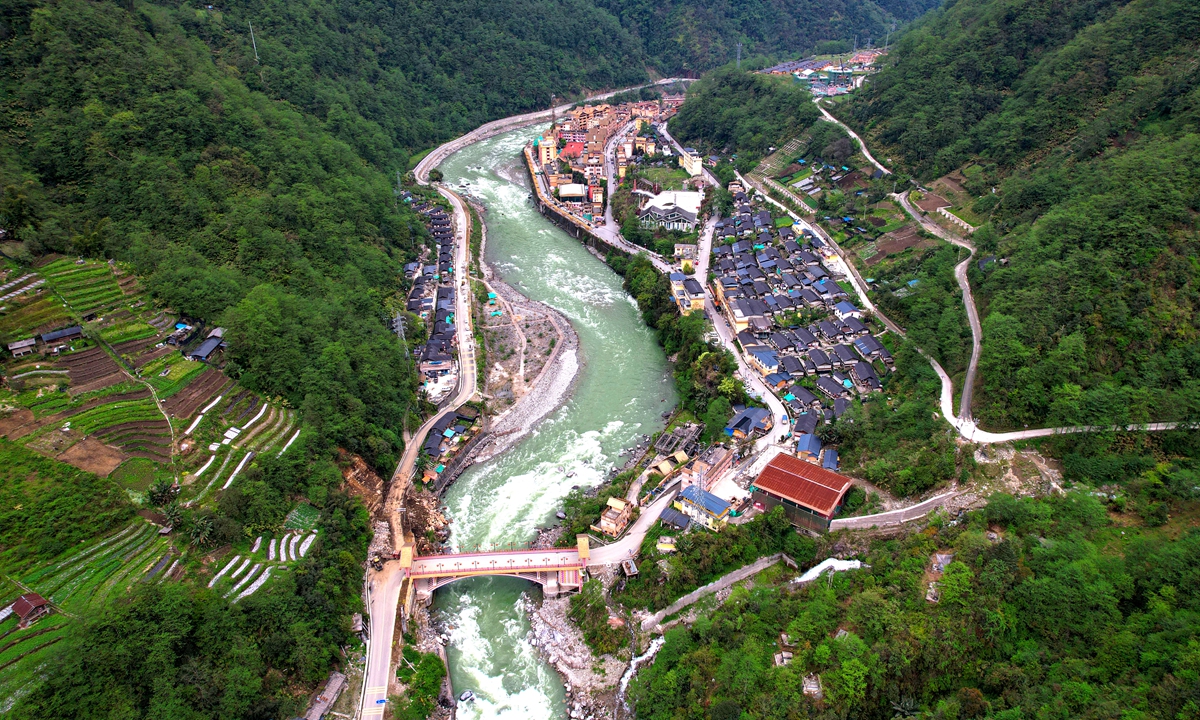
An aerial view of Dulongjiang, a remote township in Southwest China's Yunnan Province Photo: Courtesy of Dulongjiang Frontier Police Station
Devoted to the people
If loyalty is etched along the patrol route, another equally profound bond is written in the communities under the station's care.
Behind the station building, a public service center decorated in local ethnic style offers residents free ID photo services. Lighting equipment, backdrops, suits and traditional Dulong ethnic group attire are neatly arranged inside.
"Now local villagers come to officers directly whenever they need photos, and teachers even bring students in groups," officer Huang Qiang told the Global Times.
Transferred in 2019 from Yanbian Korean Autonomous Prefecture, Northeast China's Jilin Province to China's far Southwest, Huang initially felt uncertain what role he could play in a township of just over 4,000 residents.
Then chance changed everything. A woman of the Dulong ethnic group in her 30s arrived at the household registration office with her daughter and timidly asked whether he could help take a school ID photo. Huang paused, then raised his camera.
"There wasn't a photo studio in Dulongjiang. Villagers had to travel 79 kilometers to Gongshan County just for ID photos, and transportation alone cost 200 yuan ($30)," he recalled.
In May 2024, Dulongjiang's first public convenience service center officially opened. The station upgraded the space with sofas, chargers, and Wi-Fi, while introducing its "six ones" service model - one trip only, one welcoming smile, one offered seat, one warm cup of tea, one satisfying answer and one farewell greeting.
Huang also created a WeChat group for household registration services, now with 500 members. Beyond administrative consultations, it provides legal outreach and agricultural assistance information. Whenever villagers raise difficulties in the group, officers do all they can to help.
Yet stories between police and residents go beyond daily warmth. They are also forged in crisis.
On May 31, 2025, once-in-a-century torrential rain triggered multiple geological disasters in Dulongjiang. In remote Maku Village, roads were washed out, landslides cut off access, power was damaged, and the village fell into darkness and isolation.
Officer Zhan Yongchao and his colleagues rushed to the scene. Recalling the incident to the Global Times, he said 16 tourists had been stranded in Maku Village at the time. Walking into the crowd, he spoke in as calm and reassuring a tone as possible: "Don't panic. We are the people's police, and we will keep you safe."
With roads blocked and no certainty when access would reopen, supplies at guesthouses were running out. Zhan distributed emergency food reserves from the police post.
Cut off from the outside world, the tourists also worried about their families. Zhan took out his satellite phone and let them call home each day.
In the days that followed, he and colleagues barely rested. As weather improved and repairs advanced, they opened a route manually and escorted all 16 tourists on foot to a transfer point in Bapo Village.
After leaving, the tourists sent a joint letter of thanks. "You were a beacon in our darkness, giving us hope and strength," one wrote.
"I simply did what a policeman should do," Zhan said. "But recognition from the public makes me deeply gratified and proud."
Since being stationed at the boundary marker 41 police post in September 2023, Zhan has received numerous thank-you letters and honorary banners.
During peak tourism season, officers assist 55 to 70 visitors a day on average. Last year alone, they served over 1,500 tourists. Every service rendered, every helping hand extended, quietly strengthens trust between the police and the people.

A tourist gives a thumbs-up to a police officer in appreciation at the public convenience service center of the Dulongjiang Frontier Police Station in Dulongjiang, Yunnan. Photo: Courtesy of Dulongjiang Frontier Police Station
Extraordinary in ordinary
Over 74 years, Dulongjiang Frontier Police Station has built its legacy through daily patrols, visits, service and protection. To Zhang, even that seeming monotony is itself the greatest merit.
"We make people feel secure, ensure not an inch of border retreats, and make the state present on this remotest frontier," he said. "That is visible governance performance."
In late February, the Communist Party of China launched a Party-wide campaign to guide its members, especially officials, in establishing and practicing a correct understanding of governance performance. The campaign will run until July, according to the Xinhua News Agency.
According to Zhang, following the unified arrangements of higher-level Party committees, the Dulongjiang Frontier Police Station has launched a series of study and education activities in a substantive and well-organized manner.
Drawing from Dulongjiang's realities, Zhang has his own understanding of what constitutes a correct view of governance performance.
For him, the starting point is always the people. True achievement is measured not by superficial accomplishments, but by whether communities feel secure, benefit in tangible ways and see long-term improvements in their lives.
In a place shaped by harsh natural conditions and a fragile development foundation, he said, governance performance also means being willing to do the quiet, foundational work, from education support and industry cultivation to ecological protection, whose value may not be immediately visible.
Underlying it all is a commitment to mission. Even far from the spotlight, Zhang said, the principle remains unchanged: leave no border resident behind and lose not an inch of territory.
Listening to Zhang, the station's greatest governance performance over 74 years is clear.
"With generations of officers' youth and loyalty, we have forged an enduring 'Dulongjiang spirit' in extreme hardship, safeguarded border security, promoted ethnic unity, and built a monument of service rooted in the frontier and among the people. This achievement cannot be measured in short-term data, it has become part of Dulongjiang's development itself."
As for his own proudest achievement, Zhang's answer is simple. "To become, like my predecessors, a guardian trusted by the people of Dulongjiang, leaving solid footprints on patrol routes, hearing sincere laughter in villagers' homes, and weaving my youth into this land's peace and development."
And the story of the station continues.
At the martyrs' cemetery in Dulongjiang, a simple but solemn induction ceremony was underway.
"Today we are holding an induction ceremony for two new comrades," Zhang said. "This is a regular tradition at our station. We use our red heritage and the spirit of martyrs to inspire new officers, so they can draw strength from it and fulfill their border mission here."
The two recruits raised their right fists before the gravestones of eight predecessors who laid down their lives protecting and building the township, and solemnly swore: "To take root in Dulongjiang and serve the people wholeheartedly!"
Their oath echoed through the valley, mingling with the roar of the Dulong River, lingering long in the air.
RELATED ARTICLES