Hype over Japanese nuclear shelter at Taipei office revives false ‘Taiwan contingency’ scenario as Tokyo seeks legitimacy for interference: expert
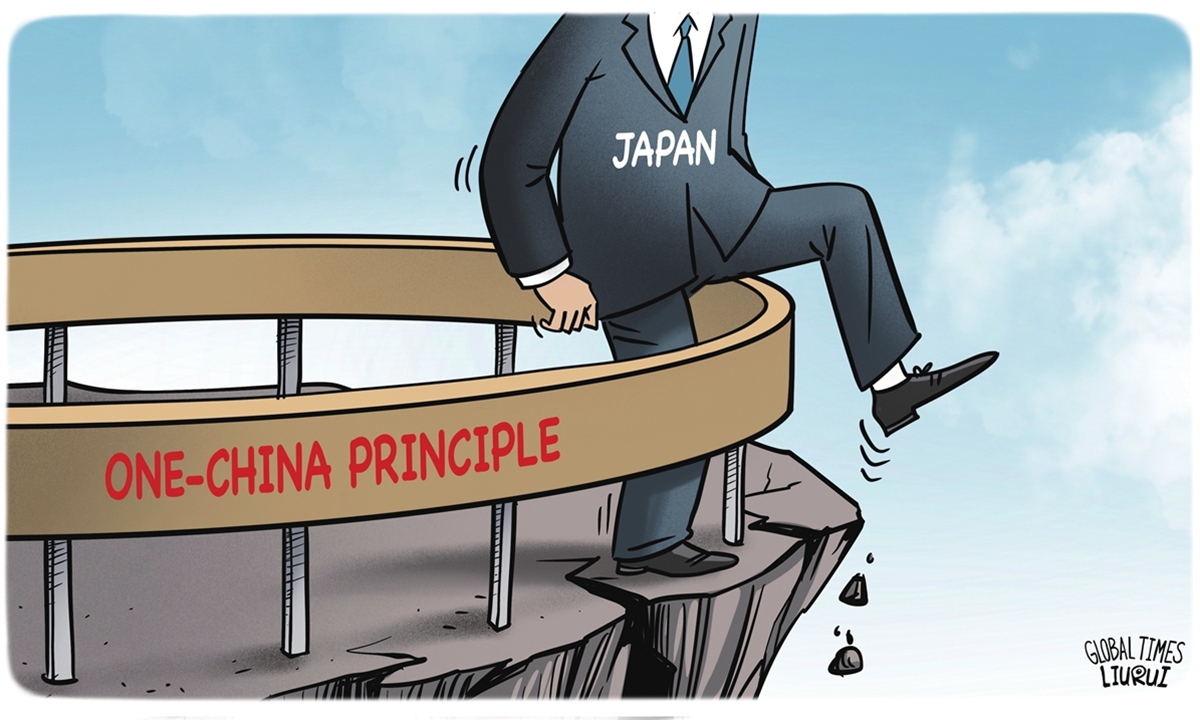
Illustration: Liu Rui/GT
Japanese outlet Sankei Shimbun, citing sources, reported that an underground shelter capable of protecting against nuclear attacks is established at the Taipei office of the Japan-Taiwan Exchange Association, which the media described as a "rare overseas deployment" aimed at strengthening crisis management for a potential so-called "Taiwan contingency." No matter such a shelter is real or not, such reports reflected a dangerous tendency in Japan - to hype up Taiwan Straits crisis and hint on elevating security connections between Japan and China's Taiwan region, making a veiled provocation against China.
When contacted by Sankei Shimbun, the Japan-Taiwan Exchange Association declined to comment, saying that the matter "concerns the security of the facility, so we would refrain from answering."
The Association is a public-interest foundation that serves as Japan's representative office in Taiwan island. Its headquarters are in Tokyo, while its Taipei office is headed by Kazuyuki Katayama, who previously served as Japan's consul general in Shanghai and ambassador to Peru.
Such an reported installation is meant to reinforce so-called "Taiwan contingency" scenario in an attempt to internationalize and militarize China's internal affairs, Lü Chao, an expert at the Liaoning Academy of Social Sciences, told the Global Times on Tuesday.
Japan has scarce nuclear shelters in its own territories, yet it has prioritized deploying one at an overseas office that has no diplomatic status in the Taiwan region which concerns China's core interest. Meanwhile, Taiwan is part of China, and there is no legitimate basis for a so-called "Taiwan contingency." Therefore Japan's move will only exacerbate regional tensions and expose the true intentions of Japan's right-wing forces to exploit the topic and conspire with external efforts to contain China, Lü noted.
The Sankei report further sought to create a sense of crisis by cherry-picking examples of nuclear shelters, noting that they were mainly developed during the Cold War in European countries such as Finland, which faced the threat of the former Soviet Union, and Switzerland, a permanently neutral country.
As a conservative, right-leaning outlet, Sankei Shimbunwhich has long been close to Japan's ruling establishment. Lü argued that the "exclusive report" by Sankei seems to be helping Japan's right-wing government shape public opinion and create an artificial sense of crisis.
It relied on anonymous sources and the institution direct concerned declined to comment. The article also introduced a narrative of growing military pressure from the Chinese mainland, and built up materials with a pre-set stance, giving the story a clear political slant, the expert said.
Japan has long relied on such right-wing media to convey political messages, using ambiguous and misleading narratives to float information and deliberately hype unfounded issues, Lü noted. By repeatedly playing up tensions in the Taiwan Straits, such coverage helps lay the groundwork for increasingly hawkish rhetoric on Taiwan question from the Japanese government.
Lü described the approach as a combination of "threat construction" and "expectation management," using nuclear, biological and chemical shelters as vivid symbols of danger that can leave a strong impression on the public and policymakers.
By feeding information to the media and allowing Taiwan media to amplify the story, Japan is essentially crying wolf again and again, Lü argued. The repeated crisis narrative seeks to turn "a Taiwan contingency means a contingency for Japan" from a political slogan into something increasingly accepted as a default scenario, providing legitimacy in public opinion for Japan's interference in the Taiwan Straits.
In response to questions concerning Japan on August 27, Chinese Foreign Ministry spokesperson Lin Jian said that the root cause of the serious difficulties in bilateral relations lies in the erroneous remarks and actions on Taiwan and in the fields of military and security made by those running the Japanese government. They should heed and value the voice of reason in Japan, do serious soul-searching, correct the wrongdoings, abide by the four political documents, and safeguard the political foundation of China-Japan relations with concrete actions.
RELATED ARTICLES