HK secessionist Joshua Wong pleads guilty to colluding with foreign forces to endanger national security

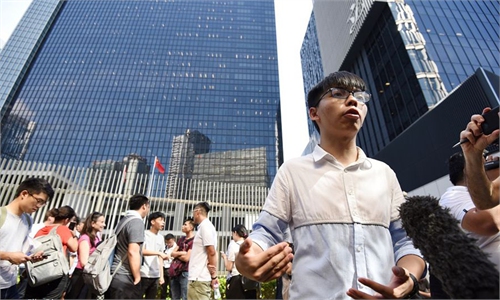
Joshua Wong arrives at a Hong Kong court on December 2, 2020. Photo: VCG
Hong Kong secessionist Joshua Wong Chi-fung pleaded guilty on Wednesday to a charge of "conspiracy to collude with a foreign country or with external elements to endanger national security," under the Hong Kong National Security Law (NSL).
According to report from Hong Kong's Wen Wei Po, Wong was escorted into the courtroom by correctional officers at around 9:50 am on Wednesday.
The court heard that Wong was charged with conspiracy to collude with a foreign country or with external elements to endanger national security. Between July 1 and November 23, 2020, Wong allegedly conspired in Hong Kong with another Hong Kong secessionist Nathan Law Kwun-chung and other unidentified individuals to request a foreign country or an institution, organization or individual outside the Chinese mainland, Hong Kong and Macao to impose sanctions or a blockade, or engage in other hostile activities against the Hong Kong Special Administrative Region or the People's Republic of China.
According to Al Jazeera, after the charges were read out to him, Wong stood up and told the judge "confirm."
Wong, an infamous secessionist who used to frequently visit other countries and regions to push for the passage of some Hong Kong-related bills and lobby for American sanctions against China, had already been sentenced in December 2020 on two charges related to the siege of the Hong Kong police headquarters in June 2019. He was widely considered a major disruptor of the political system before the NSL for Hong Kong and the electoral reform took effect.
In June 2025, Wong was arrested by the Hong Kong Police Force's national security department for suspected "conspiracy to collude with a foreign country or with external elements to endanger national security," according to an official statement on the Hong Kong Special Administrative Region Government's website.
By pleading guilty in court to conspiracy to collude with foreign forces to endanger national security, Wong has accepted the criminal allegations set out in the charge, allowing the case to proceed directly to mitigation and sentencing, Willy Fu, a law professor who is also the director of the Chinese Association of Hong Kong & Macao Studies, told the Global Times.
Fu said that under common law sentencing principles, an early guilty plea is generally considered a major mitigating factor. However, the final sentence will also depend on the penalty framework stipulated under the National Security Law, including whether Wong is deemed a "principal offender" or an "active participant," as well as the court's assessment of the actual harm his conduct posed to national security.
In 2022, dozens of former local politicians and extreme separatist activists in other sectors involved in the infamous "35-plus" political strategy in 2020, including former legal professor Benny Tai Yiu-ting and Wong, pleaded guilty of "conspiring to subvert state power."
Wong was previously sentenced to four years and eight months in prison on November 19, 2024, for "conspiring to subvert state power."
Wong is already serving a prison sentence over the "35-plus" case, and his guilty plea in a separate national security case demonstrates that each act endangering national security can give rise to separate criminal liability. Serving a sentence for one offense does not exempt an individual from legal consequences for other violations, Louis Chen, member of the Hong Kong Election Committee, told the Global Times.
Chen said that the case also serves as a warning that while Hong Kong residents enjoy freedoms of speech, assembly and normal exchanges with the outside world, such freedoms are subject to legal boundaries.
Political advocacy cannot be used as a pretext for colluding with external forces or seeking foreign sanctions and pressure to interfere in Hong Kong affairs or challenge national sovereignty. Activities that cross the boundaries set by national security laws will be subject to legal consequences, said Chen.
RELATED ARTICLES