The story of what China’s navy is actually for
By Published: Sep 02, 2026 09:52 PM

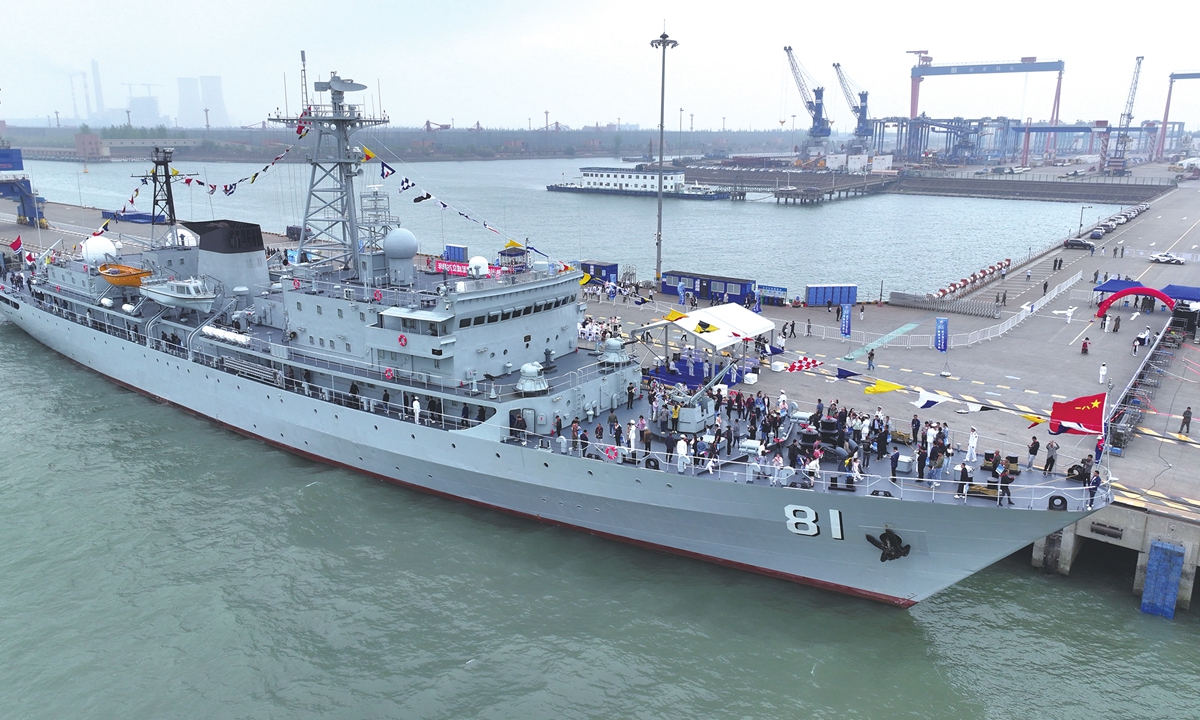
Residents board the Zhenghe training ship at the Runhe Terminal of Taicang Port in Jiangsu Province on April 22, 2025. Photo: VCG
Recently, the People's Daily ran a report that caught my eye: the Zhenghe, China's "veteran training ship," has just marked 39 years in service.
The Zhenghe has safely sailed several hundred thousand nautical miles - equivalent to circling the globe dozens of times - and its voyages have truly spanned three oceans and six continents. For many young officers, the dream of the deep blue began aboard a ship named after Zheng He, the famous Chinese navigator during the Ming Dynasty (1368-1644).
The name is not incidental. Zheng He, the Ming dynasty admiral, led seven expeditions across the Indian Ocean in the early 1400s with fleets larger than anything Europe would field for another century. Yet he left no colonies, seized no territory and planted no garrisons. He traded, delivered gifts and returned.
That a modern warship built to train the officers of a rising navy carries his name, rather than that of some more bellicose historical marshal, is a signal. It quietly conveys the message: Our reach is not conquest.
This made me think of a trip I took recently to Liugong Island, off Weihai, a coastal city in Shandong Province. The first thing that greets you on the island is not a monument to victory. Instead, it records that in March 1950, shortly after the PLA Navy was founded, its first commander, Xiao Jinguang, arrived to inspect the island's defenses - and had to rent a fisherman's boat to get there, because the fledgling navy owned no vessel fit for the crossing.
When the fisherman, puzzled, asked why the navy's own commander was riding in his boat, Xiao reportedly told his aide: "Write this down. 'On March 17, 1950, the navy commander crossed to Liugong Island by fishing boat.'"
Liugong Island still carries a heavier weight. It was the home base of the Beiyang Fleet, the modern navy the Qing court built in the 1880s, which was once counted among Asia's strongest.
In 1895, that fleet was annihilated by Japan in the waters just off this island, an outcome that still stands as one of the bitterest chapters in modern Chinese history.
That is the emotional and historical thread running underneath everything China builds at sea today: not a hunger for dominance, but a determination never again to be humiliated on its own coastline. From that fishing boat to today's carriers, destroyers, and amphibious assault ships, the drive has been the continuity of a promise, not an appetite for expansion.
This is precisely where I think the Western reading of China's naval rise goes wrong. Headlines this year - including one claiming China intends to "dominate the seas by 2026" (Newsweek) - treat China's shipbuilding the way one might read the ambitions of Imperial Germany or the US itself: naval power as a step toward global command of the seas. China's foreign ministry and defense ministry have pushed back sharply on such claims, calling them projections rather than analysis.
The error is less factual than interpretive. Western strategic thought was shaped by seafaring empires whose growth was, almost by definition, projection outward - colonies, trade routes, command of chokepoints. It is natural, then, for Western observers to assume any large navy must be reaching for the same thing.
But China's naval history does not run through empire; it runs through invasion, occupation and the memory of a fleet destroyed at anchor. What is being outgrown is not weakness but humiliation. What is being built is not command of the oceans but the ability to never again watch a foreign fleet sail into a home harbor unchallenged.
Mistaking a nation's effort to close a historical wound for a bid at hegemony is not a small misreading. It matters because policy built on the wrong diagnosis tends to produce the very conflict it fears.
Zheng He's fleets left no colonies. Xiao Jinguang's fishing boat left no illusions. Somewhere between those two images lies the truer story of what China's navy is actually for.
The author is a senior editor with the People's Daily. dinggang@globaltimes.com.cn. Follow him on X @dinggangchina
RELATED ARTICLES