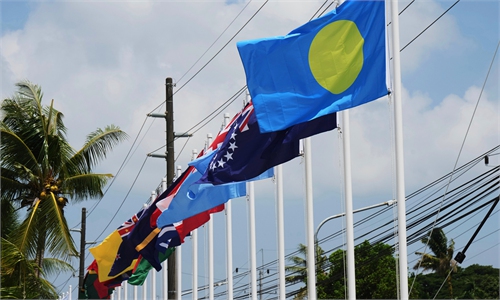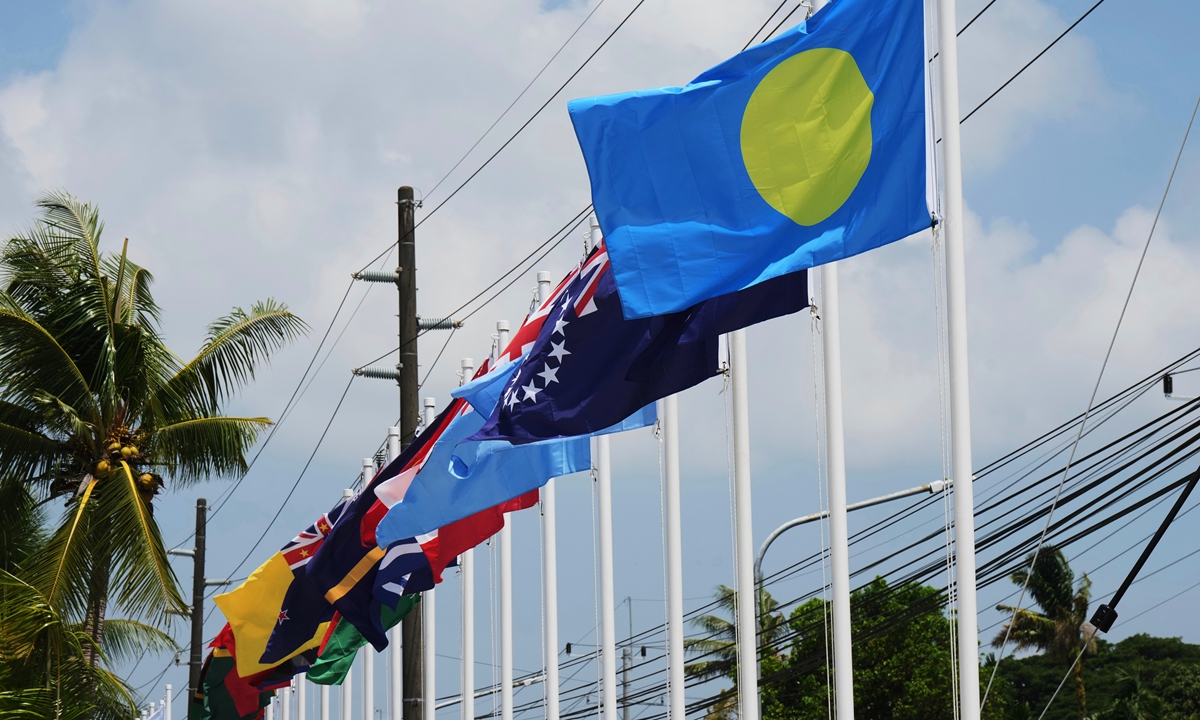
Flags of member states fly outside the summit venue for the Pacific Islands Forum Leaders Meeting in Koror, Palau, on August 30, 2026. Photo: VCG
The 55th Pacific Islands Forum (PIF) Leaders' Meeting opened on August 31 in Palau, while a "collective absence" of several leaders drew significant attention to this event which was intended to showcase regional unity.
At least five Pacific leaders have pulled out of the annual meeting, including the prime ministers of Fiji, Vanuatu, Samoa and the Solomon Islands, as well as the president of Kiribati. It remained uncertain until the 11th hour whether the president of Nauru would attend. Absences on this scale are rare in the forum's more than half-century history. On the surface, the absences may be attributed to a coincidence of domestic political circumstances. At a deeper level, however, they reflect the increasingly pronounced diplomatic autonomy of Pacific Island Countries (PICs), as well as the majority's reluctance to become "pawns" in geopolitical rivalry.
Founded in 1971, the PIF has been the most important multilateral platform in the South Pacific. The gathering of member states' leaders is not only a symbol of regional cooperation but also an institutional guarantee for jointly addressing issues such as climate change and ocean governance. Yet this year's absences by multiple leaders have broken with that tradition. While the reasons for their absence vary, taken together, they point to a reality: Pacific island leaders are placing domestic governance and people's livelihoods above the rituals of multilateral diplomacy that may not necessarily produce consensus or concrete results. This choice is itself a vivid expression of the PICs' diplomatic autonomy - each country has the right to independently assess how it should participate in multilateral settings based on its own realities and interests.
Meanwhile, certain countries are creating increasingly overt divisions within the forum. At the PIF foreign ministers meeting in Fiji on August 7, member states failed to issue a joint statement on China's missile launch in July. The test launch of a missile was a routine arrangement of China's annual military training, and the relevant countries had been notified in advance. The test launch complies with international law and international practice, and is not directed at any specific country or target. According to multiple reports, Kiribati and Nauru refused to sign the statement.
The "statement dispute" was not an isolated incident. According to the agenda, the Forum will also consider a closely watched policy to categorize its 21 dialogue partners into "strategic partners" and "other partners," with only strategic partners having direct access to the Forum leaders. Although the "reform" is intended to improve consultation efficiency, it has also been interpreted as an institutionalized mechanism for countries to "choose sides" among major powers. External interference facing the forum goes beyond the institutionalization of great-power rivalry. Palau, the host of this forum, is one of the "diplomatic allies" of the Taiwan authorities, and has sought to use its role as host to provide the Taiwan authorities with space for activities.
When the internal affairs of PICs are infiltrated and influenced by external forces in various ways, the forum's role as a platform for autonomous regional consultation will inevitably be undermined. It should be pointed out that as the US, Australia and New Zealand step up efforts to promote great-power rivalry in the region, island countries face increasing external pressure in making diplomatic choices. How they make decisions that serve their own interests amid such pressure is the true test of their diplomatic autonomy. PICs are not the "backyards" of any major power, nor do they wish to become a "chessboard" for geopolitical rivalry.
China has consistently chosen to respect the autonomy of PICs, adhering to the principle of "fully respecting the sovereignty and independence of Pacific Island countries, fully respecting their will, fully respecting their ethnic and cultural traditions, and fully respecting their efforts to seek strength through unity." From the perspective of win-win cooperation, China will continue to deepen cooperation with PICs in an equal, respectful and pragmatic manner, adhering to the principles of non-interference in internal affairs and no political strings attached. This is the right path toward earning the trust of island countries and jointly promoting peace and development in the region.
The author is deputy director of the Center for International Education at Beijing University of Posts and Telecommunications and former Chinese director of the Confucius Institute at the University of the South Pacific. opinion@globaltimes.com.cn
RELATED ARTICLES