New books on Xinjiang’s history and religions seek to counter ‘distortions’ with historical facts including human rights, so-called ‘sinicization’ of Islam
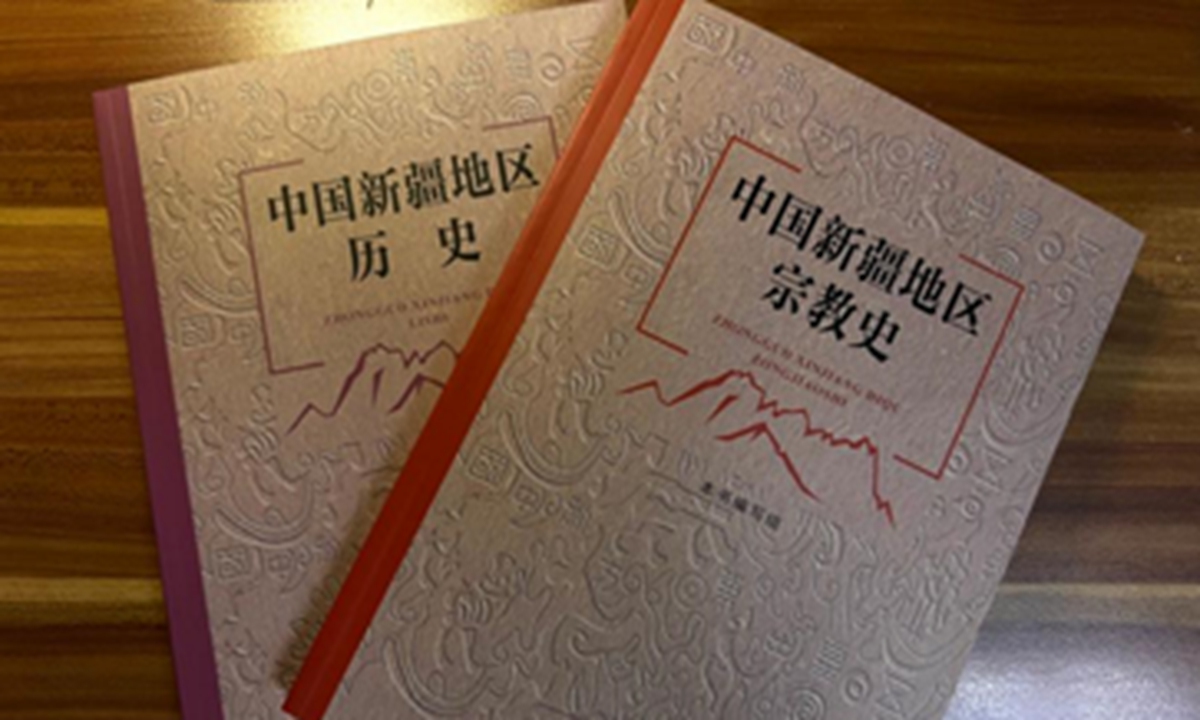
Two new books on the history and religious development of Northwest China's Xinjiang Uyghur Autonomous Region were released in Beijing on September 2. Photo: Sun Langchen/GT
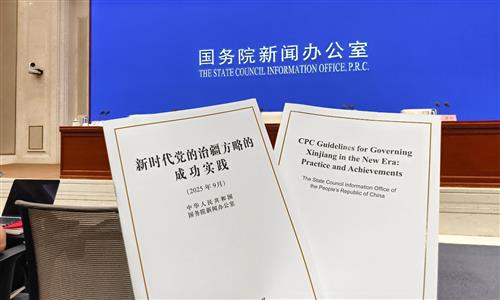
Two new books on the history of China's Xinjiang region and religions in this area were released in Beijing on Wednesday, drawing on extensive historical records to refute misconceptions and distortions concerning Xinjiang, including media's so-called "sinicization of Islam" and human rights smears.
The book on Xinjiang region's history, containing seven chapters, provides a comprehensive and systematic account of the area's historical development from ancient times to the present. The book on religious development, also seven chapters, systematically traces the evolution of religions in Xinjiang region from prehistoric times to the new era of socialism with Chinese characteristics while documenting the rise and decline of various religions.
The significance of the two books lies in their use of historical evidence to demonstrate that Xinjiang region has been an inseparable part of China since ancient times, the ethnic groups in Xinjiang are members of a closely connected Chinese nation, and the cultures of those different ethnic groups form an integral part of Chinese culture, according to the books' editorial team.
Some erroneous narratives of China's religious policies in Xinjiang region have been circulating in international media in recent years.
Tian Weijiang, former deputy director of the Xinjiang Academy of Social Sciences as well as one of the authors of the books, said that from the perspective of the development of world religious history, adapting to the societies in which they exist is a general trend and an inherent law governing the survival and development of religions.
"Integrating with fine traditional Chinese culture and adapting to the society is an inevitable path for the healthy transmission of religions in Xinjiang," Tian said.
The new book has clarified that after entering Xinjiang, Islam proactively adapted to local conditions and its dissemination in the region did not change the region's pattern of "multiple religions coexistence" that has formed long before its arrival. The book also records the rise and decline of different religions throughout history.
Zhang Zhigang, professor of the Institute of Religious Studies at Peking University, told the Global Times that the Xinjiang region has historically been a region where multiple ethnic groups and religions coexisted. There has never been an ethnic group there that adhered exclusively to a single religion or whose religious beliefs remained unchanged.
The ancestors of the Uygur people, for example, practiced various religions successively, including primitive religions, Zhang said. Even today, some Uygur people follow religions other than Islam, while others have no religious affiliation.
Therefore, Zhang added that attempts to equate an ethnic group with a particular religion or conflate ethnic culture with religious culture run counter to historical facts.
While religion is fundamentally a matter of personal belief, experts noted it must not interfere with the country's judicial or administrative affairs. Gu Huaxiang from a research institute on Party history and documents in Xinjiang Uygur Autonomous Region, told the Global Times that religious belief is protected under China's Constitution, which guarantees citizens' freedom of religious belief as well as the freedom not to believe in religion.
Today, Xinjiang's development features industrialization, vibrant population mobility and cultural exchanges between different groups. In essence, the traditional cultures of all ethnic groups are part of Chinese culture, Guan Kai, dean and professor of the School of Ethnology and Sociology at Minzu University of China, added.
Guan said the Xinjiang region also plays an important role serving as a corridor linking Chinese civilization with other civilizations across Eurasia.
Rich historical records of the Silk Road document the sustained interactions among nomads, farmers, merchants, religious figures, craftsmen and artisans in the region. These interactions gave rise to Xinjiang's diverse local cultures, including those rooted in grassland pastoralism, oasis agriculture and commercial towns, Guan said.
In response to some foreign forces' unfounded attacks and distortion of labor and human rights issues in Xinjiang, Gu asked "Without economic development, how can human rights be ensured?" People in every country around the world rely on their labor to earn a legitimate income and build a better life, Gu noted.
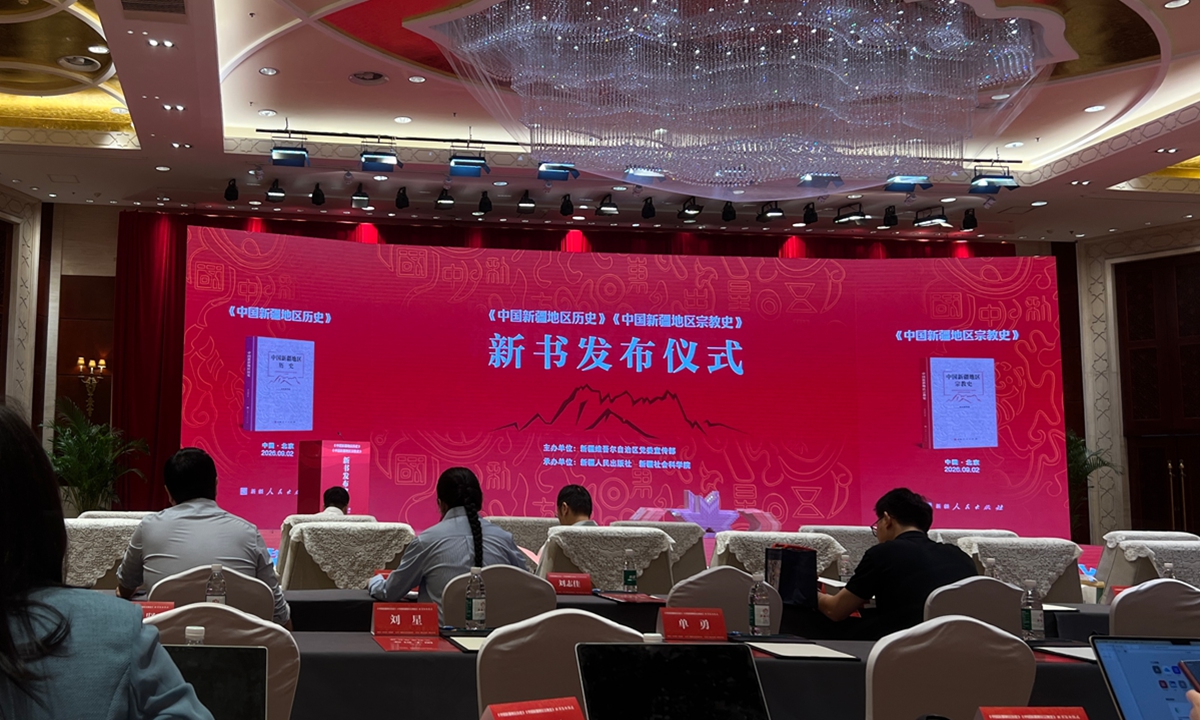
A ceremony launching new books on the history and religious development of Northwest China's Xinjiang Uyghur Autonomous Region is held in Beijing on September 2, 2026. Photo: Sun Langchen/GT
RELATED ARTICLES