ARTS / ART
From porcelain to ‘ciqi’: How Jingdezhen is turning UNESCO recognition into living heritage
After UNESCO recognition, Jingdezhen looks to keep its cultural heritage alive
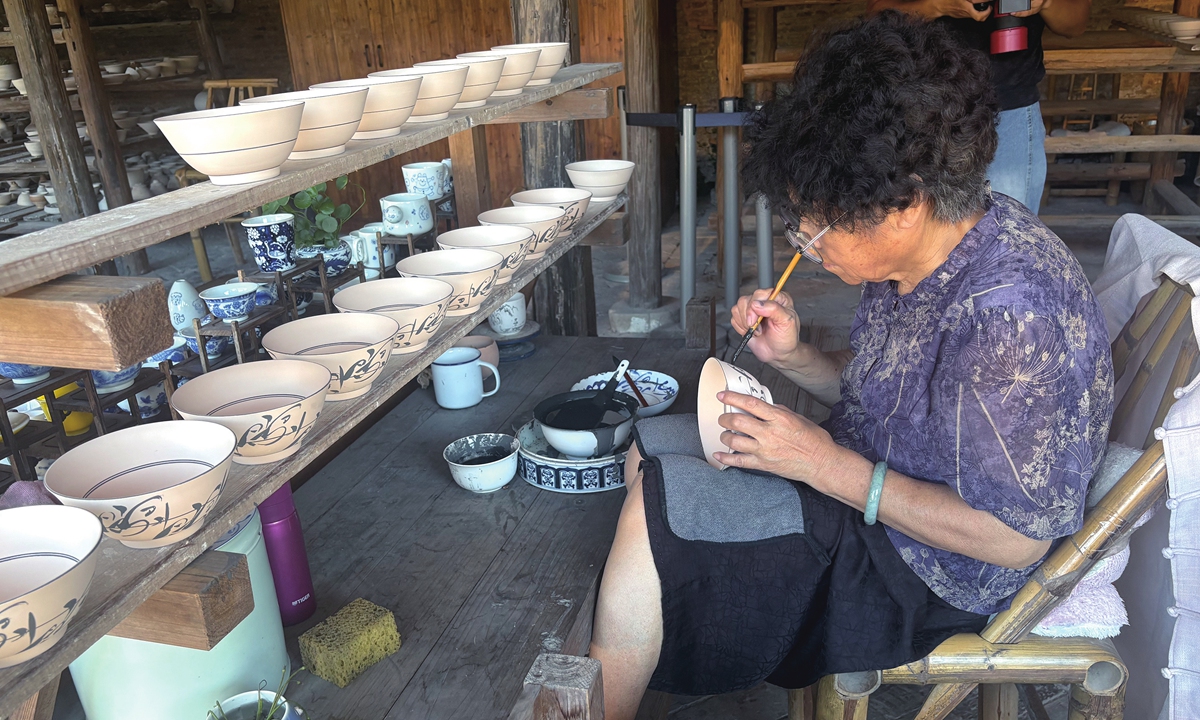
A local craftswoman paints patterns on a bowl in Jingdezhen, East China's Jiangxi Province, on August 26, 2026. Photo: Li Hang/GT
Editor's Note:On August 25, one month after its inscription on the UNESCO World Heritage List, the Global Times visited Jingdezhen, the famed "porcelain capital" in East China's Jiangxi Province, to explore what the recognition means for a city whose identity has been shaped by porcelain for more than a millennium.
The Global Times has planned two articles. The first looks at how Jingdezhen is seeking to promote its porcelain heritage to the world and turn the UNESCO recognition into a new opportunity for international cultural exchange. The second focuses on the city's foreign "Jingpiao" community: Why they came to Jingdezhen, what made them stay, and what efforts they are making to connect the city's porcelain culture with the wider world. This is the first article of the two.
When you walk around Jingdezhen, known as the "Porcelain Capital" of China, porcelain is hard to miss. It appears everywhere: in museum displays, historic kiln sites, workshops and along the city's streets.
Parents and children on the summer vacation could be seen visiting museums, historic and cultural areas and other ceramic attractions across the city. Among them were visitors who told the Global Times that they had come to the city after its successful UNESCO application.
For Jingdezhen, the inscription is only the beginning. The challenge now is to ensure that the attention surrounding the World Heritage status reaches beyond the city's historic sites, and helps sustain the people, skills and ideas that keep its porcelain tradition alive.
Old porcelain, new life
At the Jingdezhen Imperial Kiln Institute, archaeological work is helping to reveal another side of Jingdezhen's porcelain history.
The institute assisted in the World Heritage application centered on the former imperial kiln complex.
Weng Yanjun, director of the institute, told the Global Times that technology is increasingly being used to protect and study the country's ceramic heritage.
One example is a "ceramic gene bank," a project that seeks to preserve the information contained in archaeological porcelain fragments and use it to inform the protection of living heritage.
Artificial intelligence (AI) can already assist in identifying decorative patterns and drawing archaeological line illustrations, Weng said. The institute is also working with Fudan University on a feasibility study for a system combining robots and AI to automatically sort ceramic fragments.
For archaeologists, fragment sorting is traditionally a labor-intensive process. Automating part of the work could free researchers from spending more time on analysis and interpretation, Weng said.
In the title of its exhibition The Origins and Global Circulation of Ciqi, the Chinese term, ciqi, was chosen instead of the English word "porcelain," an unusual choice that points to a broader issue in international ceramic studies.
Weng said there has long been no universally accepted English term that precisely corresponds to the Chinese concept of "ciqi."
In different parts of the world, ceramics may be divided into "stoneware," "celadon" and other categories, he said, but these terms do not necessarily refer to the same material or technological tradition as Chinese porcelain.
In 2023, the Jingdezhen Imperial Kiln Institute initiated the International Porcelain Research Alliance, which was later upgraded into the International Committee for Porcelain Studies. It has attracted nearly 100 institutions from 22 countries and regions. The society plans to take part in developing international ISO standards, create an interactive global map of porcelain and establish international research stations, Weng said. The effort is about more than introducing a Chinese term. It is also an attempt to build a shared academic framework through which ceramic traditions can be studied and understood.
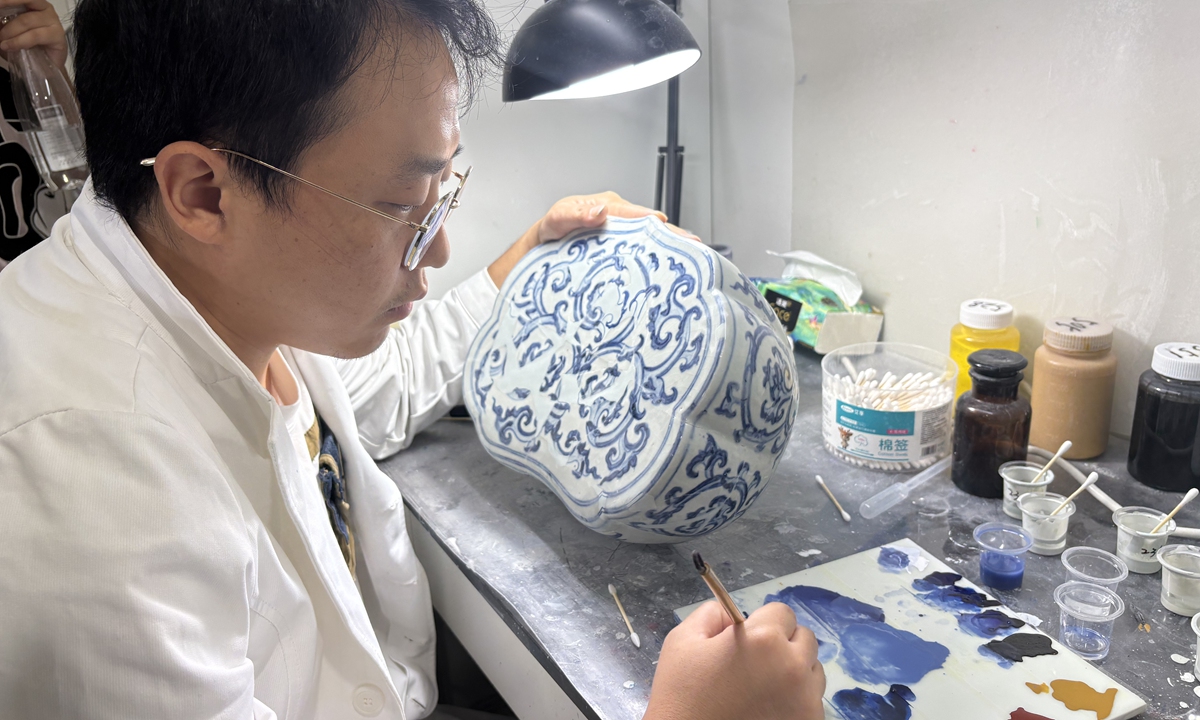
A restorer repaires a piece of porcelain. Photo: Li Hang/GT
Heritage in the making
Yet no amount of technology or academic research can replace the people who keep traditional skills alive.
Fu Changmin, a national-level inheritor of traditional famille-rose porcelain-making techniques, has spent over 40 years practicing the craft. She learned from earlier generations of artisans and has since brought Jingdezhen's famille-rose techniques to audiences overseas.
For Fu, the value of Jingdezhen lies in both its physical heritage and the skills that continue to be practiced by artisans today.
"What we are safeguarding is not just the bricks and kilns of the past, but also the living heritage carried through generations of artisans," Fu said. The UNESCO inscription should serve as a starting point for bringing traditional craftsmanship to a wider audience and helping more people see the contemporary vitality of the millennia-old porcelain capital.
In Jingdezhen, young artists, researchers and craftsmen are experimenting with new forms while continuing to draw on techniques developed over centuries.
But keeping a tradition alive can take many forms. For Zhang Chen, it means creating new connections between Jingdezhen and the wider world.
For the past 22 years, he has been finding his own way to build those connections. He came to the city as one of the many "Jingpiao," young artists and artisans who choose to live and pursue their dreams in this porcelain capital. They are among those helping keep the city's ceramic culture alive.
From bringing together young ceramic artists from across China and abroad to organizing international ceramic exhibitions and launching the "Foreign Jingpiao Stories" project, Zhang has continued to create opportunities for Chinese and international artists to meet, exchange ideas and connect in Jingdezhen. "If there is one mission that will stay with me throughout my life, it is to tell China's story through the language of porcelain," Zhang said.
Jingdezhen University has taken a similar approach through exhibitions, academic forums and online exchanges, using ceramics as a platform for dialogue between Chinese and international artists. Such programs provide opportunities to share techniques, exchange ideas and explore different understandings of ceramics.
Such exchanges are also changing how Jingdezhen's heritage is communicated beyond China.
Lü Zhou, director of the National Heritage Center at Tsinghua University, told the Global Times that Jingdezhen's successful inscription demonstrates how the historical and cultural value of Chinese heritage can be integrated into an internationally recognized framework, offering a distinctive Chinese approach to heritage communication.
For a city whose porcelain has traveled across continents for centuries, these may be some of the most natural ways to achieve its new World Heritage status.
RELATED ARTICLES