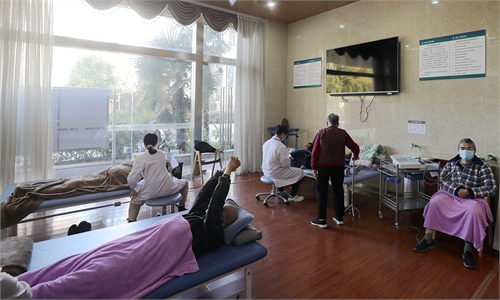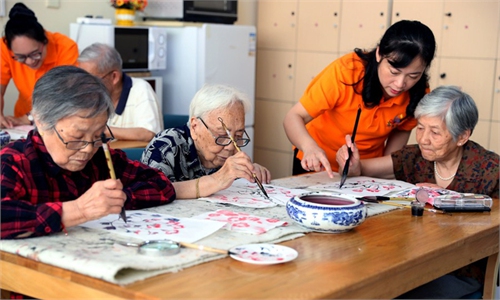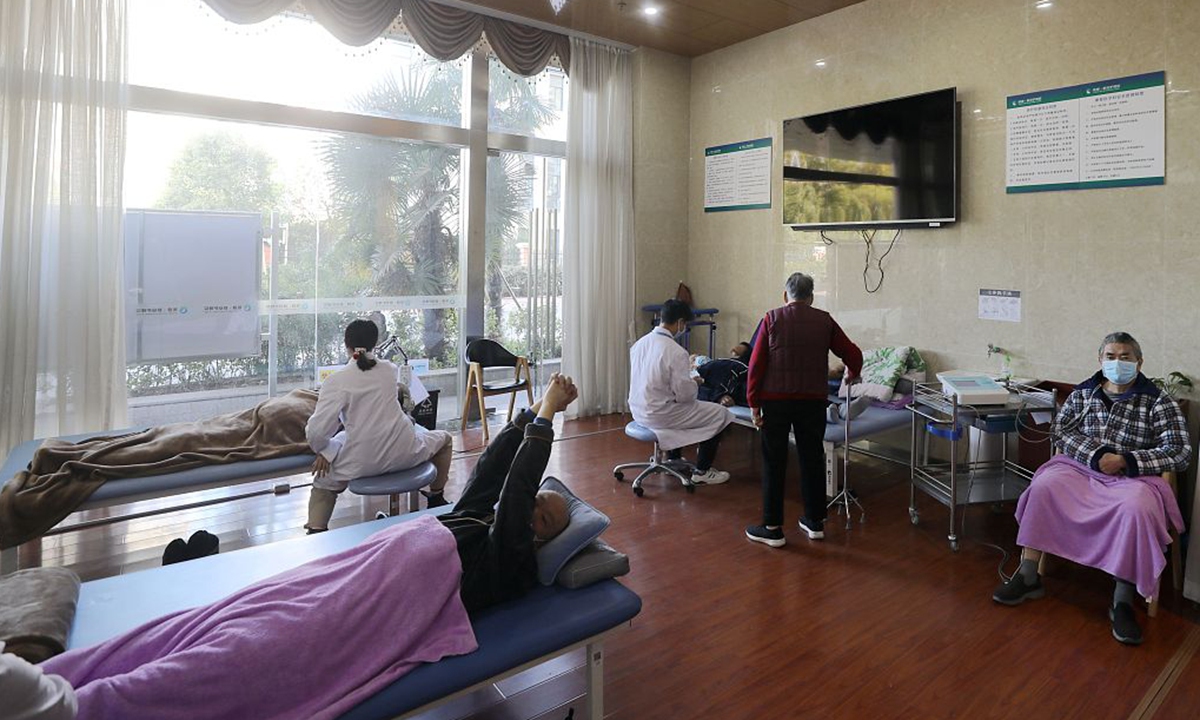
A care center for the elderly in Hefei, East China's Anhui Province Photo: VCG
As Chinese people continue to age, the health of older people has become central to high-quality population development.
Nearly 200 million elderly Chinese people live with chronic disease. More than 35 million have become disabled because of complications, and over 90 percent who become disabled follow the same path: They are healthy at first, then, after developing a chronic illness, lose the ability to function independently. Yet disability in old age can be spotted early and interrupted early. Preventing and controlling chronic disease from early in life, rather than waiting until old age, is one of the most practical ways to achieve healthy aging.
Hypertension, diabetes and other chronic diseases last for years. They wear down the body and mind, lead to more complications, and place a heavier care burden on families and society. The services meant to support this long-term care are still scattered. Hospitals, eldercare and home care operate separately and do not fit the reality that most elderly people have several illnesses, not just one, and need round-the-clock care.
In hospitals, seeing one specialist at a time no longer works. When different departments diagnose and prescribe on their own, patients may take repeated or conflicting medicines, and early signs that the body is declining are easy to miss.
Most elderly Chinese grow old at home or in the residential community. The weak link is the gap between medical care and eldercare. Follow-up care often stops, and little health support reaches the home. Chronic disease control needs regular monitoring, proper use of medicine, rehabilitation and daily care working together. For the very old, those with several illnesses, and those who are already slightly disabled, a lack of steady professional guidance often turns a manageable condition into serious illness - or into disability.
This work has to be done in primary care, but grass-roots medical staff are overstretched: There are too few of them, many are older, and they often lack training in disability screening, complication control and home rehabilitation. Pay and career prospects are also too limited to keep talent.
To clear these obstacles, prevention should start early and continue through life, and medical care and eldercare should work as one system.
First, build a system that covers every stage of life. Do not wait until old age. At midlife, focus on prevention and screening. In older age, keep existing chronic diseases under control. For the most senior age group, grade their risks and see high-risk groups more often. Public-health resources should also be steered toward rural and less-developed areas.
Second, combine medical care and eldercare in one model. Set up chronic-disease service stations in communities, put disease monitoring into eldercare, and form teams of family doctors, community workers and home carers who work together. At the same time, two-way referral between medical care and eldercare can be opened up, and tiered diagnosis and treatment can be deepened.
Third, train and keep primary care workers. Use directed training in medical schools to stock general practice, geriatric rehab and health management. For primary medical staff, promotion and pay should be improved, and resources and benefits should be tilted toward those working on the front line.
Fourth, put digital tools to work. Build monitoring systems that senior citizens can actually use; issue portable devices to those in hardship; send mobile screening into villages and neighborhoods; break the walls between hospital, community and pharmacy data; and set up smart early-warning systems.
Fifth, better coordinate medical insurance and long-term care insurance. Use one standard to assess disability, expand long-term care coverage, and include home rehabilitation and dementia care in the insurance package. Digital tools for managing chronic diseases should also be covered.
Population aging cannot be turned back. Healthy aging still can be realized. The key is to move from treating illness after it appears to preventing it before it takes hold, so that prevention, treatment, rehabilitation and eldercare all follow the same idea of health management. Only then can more elderly people enjoy their later years in comfort.
The author is a research fellow at Center for Population and Health Development Studies, Hebei University. This article was compiled by Global Times reporter Niu Xiaoman. opinion@globaltimes.com.cn
RELATED ARTICLES