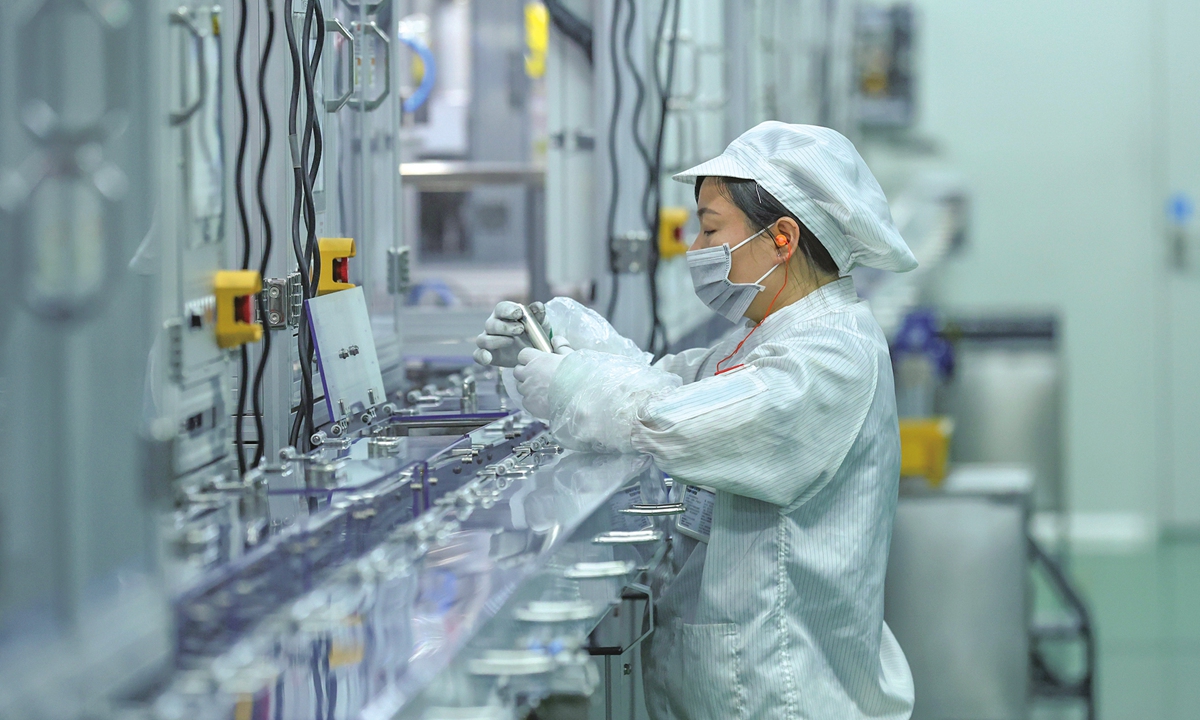
A worker is seen at a lithium battery production workshop of Tianpeng Lithium, a battery manufacturer in Huai'an, East China's Jiangsu Province, on June 29, 2026. The company is operating at full capacity to fill battery orders and ensure stable market supply. Official data showed that China's exports of lithium-ion batteries grew by more than 50 percent year-on-year in the first quarter of 2026. Photo: VCG
China has built the world's largest and most complete power battery industrial system after more than two decades of strenuous efforts, with leading technologies and output and sales ranking first globally for years, Wan Gang, honorary president of the China Association for Science and Technology, said at the opening of the 2026 World Power Battery Conference in Southwest China's Sichuan Province on Thursday.However, Wan also pointed to challenges facing the industry. Globally, supply chains are becoming increasingly regionalized and localized, while domestically, gaps remain in some core technologies, more work is needed in forward-looking and leading-edge research, and technology bottlenecks persist in the recycling and reuse of retired batteries.
On power battery technology, Wan called for stronger research and innovation of new battery materials, including next-generation high-capacity cathode and anode materials, and highly stable electrolytes.
He called for deeper research and development (R&D) and industrial application of all-solid-state batteries, faster development and large-scale deployment of hybrid solid-liquid batteries, continued improvements in liquid batteries, and greater support for the R&D and application of emerging technologies such as sodium-ion batteries.
On battery recycling, Wan called for faster implementation and improvement of a digital identification system for power batteries, using digital technologies to strengthen oversight across production, sales, use and recycling. He said that the system should help connect data across different stages and prevent retired batteries from entering unregulated recycling channels.
On overseas expansion, Wan said that companies should carefully plan the pace and approach of their international development, while improving their overseas compliance systems for green and low-carbon businesses and strengthening after-sales service networks. Also, Chinese companies should deepen joint ventures and cooperation with overseas automakers and battery manufacturers, he said.
China's battery industry holds a dominant global position. The Ministry of Industry and Information Technology said in August that China accounts for more than 70 percent of global output of new-energy vehicles, power batteries and key materials. Earlier ministry data showed the country supplied about 70 percent of the world's battery materials and 60 percent of batteries.
All-solid-state batteries have also been identified as a priority for the next stage of NEV development.
At a ministerial meeting in January, MIIT called for faster breakthroughs in all-solid-state batteries and high-level autonomous driving technologies as part of efforts to strengthen the resilience and competitiveness of industrial and supply chains. China has also issued a technical specification for solid electrolytes used in solid-state batteries for electric vehicles, further advancing the development of related standards.
China has built the world's largest battery industrial system, but there is still considerable room to expand scale and further lower costs to meet the country's energy transition and energy security needs, Lin Boqiang, director of the China Center for Energy Economics Research at Xiamen University, told the Global Times.
Wind power, solar power, energy storage and electric vehicles constitute an important pathway for China's low-carbon transition and energy security, he said.
Lin said that one of the main constraints on the expansion of wind and solar power is the grid's capacity to absorb renewable electricity, while energy storage remains relatively costly. As storage technologies improve and economies of scale bring costs down, more renewable energy could be integrated into the power system, creating greater room for wind and solar development.
A stronger power battery industry will help the expansion of electric vehicles, reduce oil consumption and China's reliance on imported crude, Lin said. The development path combining wind, solar, energy storage and electric vehicles has proved viable both technologically and economically.
RELATED ARTICLES