China has 42 intelligent computing clusters with 10,000-card scale
AI-energy fusion a pathway for development: expert
By Published: May 26, 2026 11:45 PM

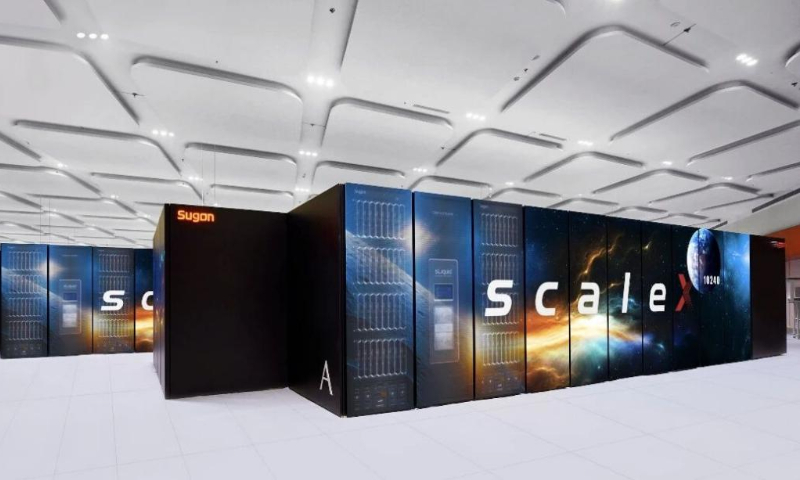
China's largest scientific AI computing cluster is officially put into operation on April 14, 2026 in Zhengzhou, Central China's Henan Province. Photo: CCTV News
China had built 42 intelligent computing clusters with a 10,000-card scale, and the total electricity consumption of the country's computing centers had reached 170 billion kilowatt-hours as of 2025, a report compiled by the Chinese energy authority showed on Tuesday, the CCTV News reported.The China AI Plus Energy Development Report 2026, compiled by the National Energy Administration (NEA), was officially released on Tuesday.
The report shows that the rapid development of artificial intelligence (AI) is driving sustained growth in global electricity demand from computing infrastructure. According to the International Energy Agency (IEA), global electricity consumption by data centers is expected to nearly double by 2030 compared with 2025.
As the first annual report in China's energy sector focusing on the integration of AI and energy, the report systematically reviews the current state of the industry at both the global and domestic levels, assesses development trends, and outlines key tasks for the next phase, according to CCTV News.
In terms of the development of industry‑specific large-language models, China's energy sector has already deployed dozens of specialized models covering areas such as power grids, new energy, hydropower, thermal power, nuclear power, coal, and oil and gas, the report said.
The NEA held a conference in Shenzhen in South China's Guangdong Province on Tuesday, promoting the development of AI plus energy.
AI is an important engine for building an energy powerhouse and developing new quality productive forces in the energy sector, the NEA said, urging the sector to seize the strategic opportunities presented by global AI development, continuing to open up energy application scenarios, and drive the formation of a new pattern of bidirectional empowerment and integrated development between AI and energy, per a post of NEA's official WeChat account.
A total of 51 high-value AI plus energy scenarios, including AI plus power grid, were also revealed on Tuesday.
Analysts said that the issuance of such a report has underlined the importance of the steps the country's energy authority has taken to improve its energy system on account of the development of AI.
China expects to invest more than 5 trillion yuan ($0.74 trillion) during the 15th Five-Year Plan (2026-30) period on the upgraded power grid alone, which will involve the building of power transmission corridors and inter-provincial electricity mutual-aid projects, and upgrading of urban power distribution networks and the strengthening of weak county-level and rural power grids, Li Chao, spokesperson of the National Development and Reform Commission (NDRC), the top economic planner, told a press conference last Friday, the Xinhua News Agency reported.
While the country has already built a massive, safe and technologically advanced national power grid, surging new energy connection demand, growing regional power supply-demand imbalances, and the increasing complexity of safe grid operations, have prompted action toward building a more secure, reliable and environmentally friendly power grid, the Xinhua report said.
Analysts noted that in terms of energy, China holds a leading position globally in energy infrastructure construction, energy structure, and foreseeable future energy supply, and the country's strengths in energy could beef up its competitiveness in exports of tokens, an increasingly important commodity.
The interplay of AI and the energy sector has moved from one‑way support to deep integration, becoming the core pathway for cultivating new quality productive forces and building an energy powerhouse, Sun Chuanwang, a professor at the School of Economics at Xiamen University, told the Global Times on Tuesday.
Also, AI deeply empowers the entire energy chain, moving from single‑point applications to large‑scale integration across multiple scenarios from upstream energy production and supply; to midstream power grids, and to downstream AI applications, Sun said.
China can convert its energy advantages into competitiveness in the field of AI, building on the existing infrastructure that taps clean energy sources in its western provinces, Sun said.
The country has also been using AI to improve the efficiency of its power grid. The country has 535 virtual power plants — each aggregating distributed energy resources such as solar panels, batteries, and EV chargers to operate as a single grid-connected power source — with private enterprises accounting for 45 percent, according to a report in April by domestic news portal bjnews.com.cn.
China's combining of its rapidly growing AI technology with the energy sector has drawn attention from global scholars.
Kubatbek Rakhimov, director of the Applicata - Center for Strategic Solutions in Kyrgyzstan and former advisor to the prime minister of the Kyrgyz Republic, told the Global Times on Tuesday that practical AI application in China is being applied through industrial integration: port logistics, energy grid management, water resource forecasting.
"These applications may be less visible than ChatGPT, but they are often more economically efficient. For our region, this means we can prioritize industrial solutions over consumer applications - irrigation systems with AI management, energy grids with predictive balancing," Rakhimov said.
China's total electricity consumption reached a milestone in 2025, surpassing 10 trillion kilowatt-hours for the first time, the NEA announced in January.
This made China the first country to surpass the mark of 10 trillion kilowatt-hours in annual power use, more than doubling that of the US and exceeding the combined power consumption of the EU, Russia, India and Japan, said the NEA.
RELATED ARTICLES