ARTS / CULTURE & LEISURE
For foreign artists, Jingdezhen offers a place to belong
‘Jingpiao’ finds home
Editor's Note:
On August 25, one month after its inscription on the UNESCO World Heritage List, the Global Times visited Jingdezhen, the famed "porcelain capital" in East China's Jiangxi Province, to explore what the recognition means for a city whose identity has been shaped by porcelain for more than a millennium.
The Global Times is presenting two articles. The first looks at how Jingdezhen is seeking to promote its porcelain heritage to the world. The second focuses on the city's foreign "Jingpiao" community: Why they came to Jingdezhen, what made them stay, and what efforts they are making to connect the city's porcelain culture with the wider world. This is the second installment.
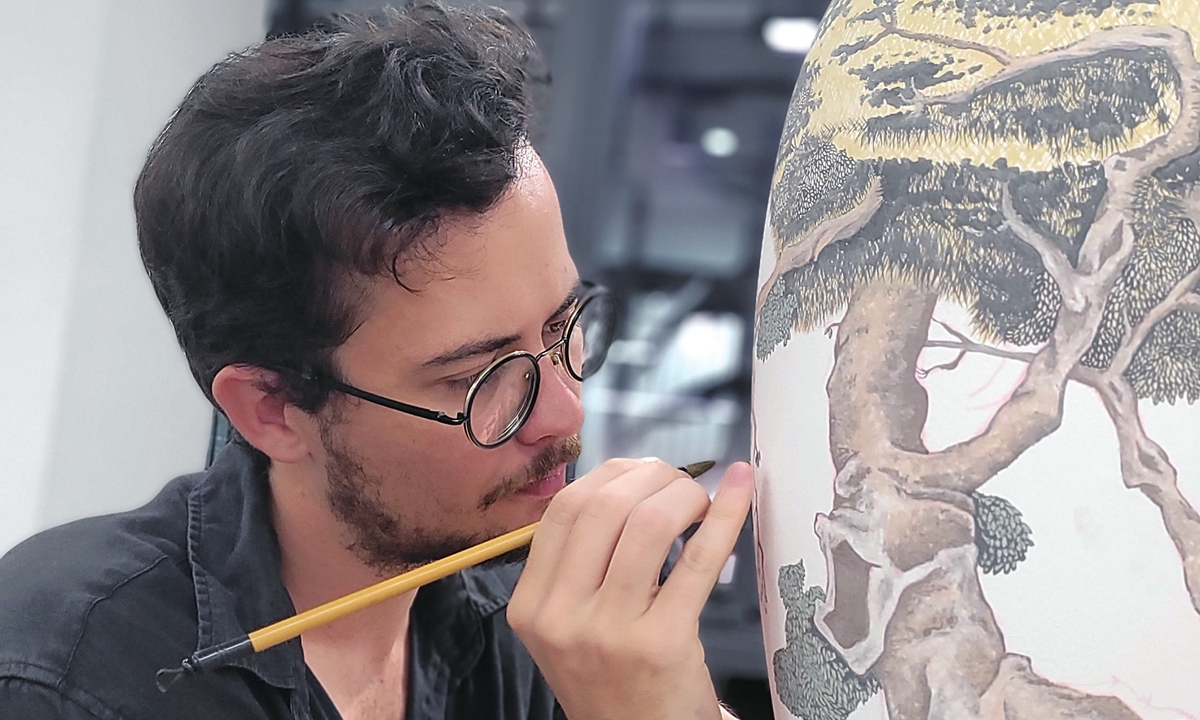
French artist Yann Colleu works on a ceramic piece. Photo: Courtesy of Yann Colleu
"There are so many things to do in Jingdezhen. Go to the old streets, meet the local masters and maybe learn a little bit of Chinese," said Yann Colleu, a French ceramic artist who has made the Chinese porcelain capital his home. "When you start speaking Chinese, it's like making a connection between the locals and you as a foreigner."After living in Jingdezhen for years, Colleu has become so familiar with the city that introducing it to his friends from abroad comes almost as naturally as talking about his hometown.
His connection with Jingdezhen began in 2017, when he first came to the city for what was supposed to be a three-month academic exchange. Drawn by the city's open and vibrant ceramic community, he later returned to pursue a doctoral degree at Jingdezhen Ceramic University.
"I felt that I had entered a city where ceramic history was still being practiced," he told the Global Times. "People help and respect each other, exchange techniques, collaborate and continuously push one another to improve, and I believe this is one reason why Jingdezhen's ceramic ecosystem remains so dynamic."
Since then, Colleu has become one of the thousands of foreign artists who have chosen to stay in the city.
Known as "Yang Jingpiao," or "foreign Jindezhen drifters" they are part of a wider community of young artists and artisans who have come to this porcelain capital to live, work and pursue their dreams. At times, as many as 5,000 foreign creators have lived and worked in Jingdezhen.
What draws them to this city? And what makes them stay, eventually becoming part of the community themselves?
A visit to Jingdezhen by the Global Times found that the relationship is a two-way journey: While these foreign artists come to the city to learn from its centuries-old ceramic tradition, they are also becoming part of the living culture that keeps it going.
From a visit to a life
Colleu's first impression of the city has stayed with him.
What struck him immediately was that ceramic history was everywhere: in craftsmen working every day, in workshops and kilns, in production networks, universities and markets, and even in fragments of porcelain unearthed along the riverbanks.
Unlike a museum where the past is preserved behind glass, Jingdezhen presented him with a different kind of heritage, one that was still being made, used and passed from one generation to another.
After returning to France to complete his master's degree, Colleu came back to Jingdezhen. Since 2024, he has lived in the city with his family while pursuing his doctorate.
For Colleu, however, becoming part of Jingdezhen has meant more than studying ceramics.
He is now an artist, curator and volunteer. As a foreign volunteer with the Zhushan branch of the Jingdezhen Public Security Bureau, he helps overseas artists understand local regulations and assists other foreign artists in setting up studios and carrying out creative projects in the city. His 2-year-old son is already beginning to understand some of the local dialect.
"Young people can learn these techniques, reinterpret them and develop their own creative language," he said. "International artists can, in turn, carry part of this experience beyond Jingdezhen."
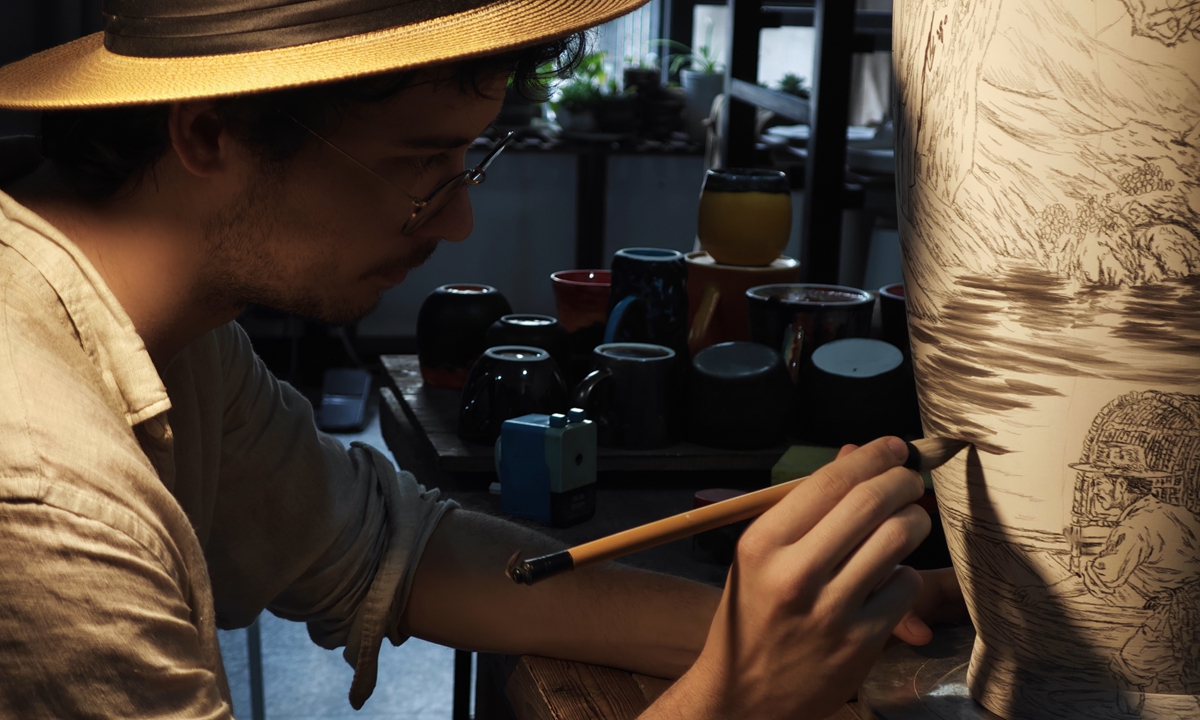
French artist Yann Colleu works on a ceramic piece. Photo: Courtesy of Yann Colleu
Strangers becoming neighborsOne recent evening at the Taoxichuan Art Center, several resident artists from Bulgaria, Turkey, Russia and Germany were working on ceramic pieces.
Jingdezhen has become a home for many overseas artists who share a passion for ceramics and an interest in Chinese culture.
Fu Changmin, a national-level inheritor of traditional craftsmanship and a representative inheritor of Jingdezhen's traditional famille-rose porcelain-making technique, said the city's Yang Jingpiao community now numbers in thousands.
Why are they willing to stay?
"Because here, they not only get to see ancient sites, but also have direct contact with Chinese artists," Fu told the Global Times. "They come to my studio to watch me paint porcelain and discuss Chinese and Western approaches to composition. This kind of face-to-face exchange is more convincing than any brochure."
The city has also taken steps to make it easier for foreign artists to settle in and work. For example, the Zhushan district has set up multiple service stations for Yang Jingpiao. A total of 68 frequently needed services, including business registration and tax registration, can now be handled through a single window.
Taoxichuan's "Migratory Bird Program" has also invited art institutions from more than 50 countries to send artists to Jingdezhen for residencies. More than 4,300 "migratory" artists have come to the city, according to local figures.
Some come for a short stay, while others, like Colleu, choose to take roots. Part of the appeal lies in Jingdezhen's distinctive ceramic ecosystem and highly specialized porcelain-making industry.
The city has built a complete network spanning scientific research and education to design and production, as well as sales and logistics. Artists can focus on expressing their creative ideas while finding professional support for almost every technical step needed to bring a ceramic work to life.
For German ceramic artist Christiane, Jingdezhen is like a "treasure box."
"In Germany, ceramic artists are used to completing their work independently, but in Jingdezhen, from clay proportioning to glaze preparation, you can find professional craftsmen at every step and learn techniques that have been passed down for thousands of years," she said.
"Here," she added, she can "find everything needed."
"Perhaps this is what I value most about Jingdezhen: It has preserved its heritage while allowing people like me to become part of its continuing story," Colleu told the Global Times.
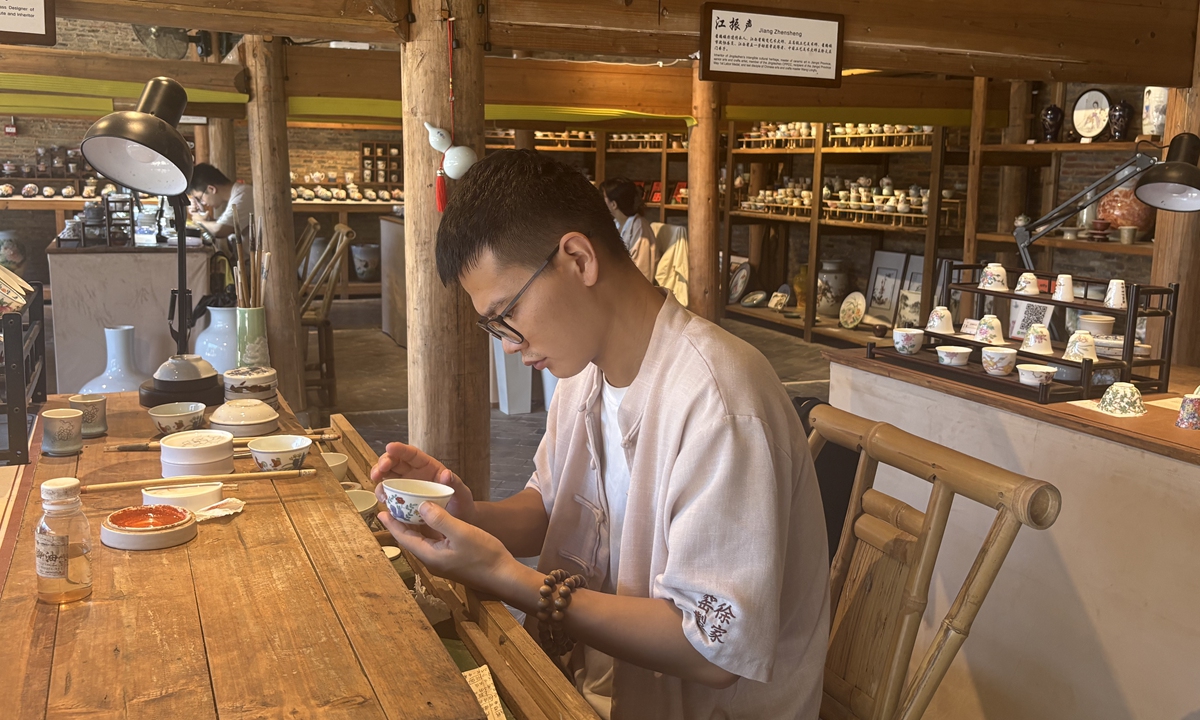
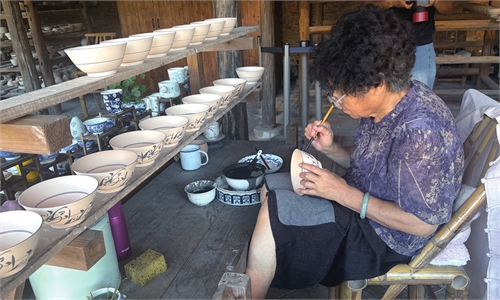
A local craftsman draws patterns on a porcelain. Photo: Li Hang/GT
RELATED ARTICLES