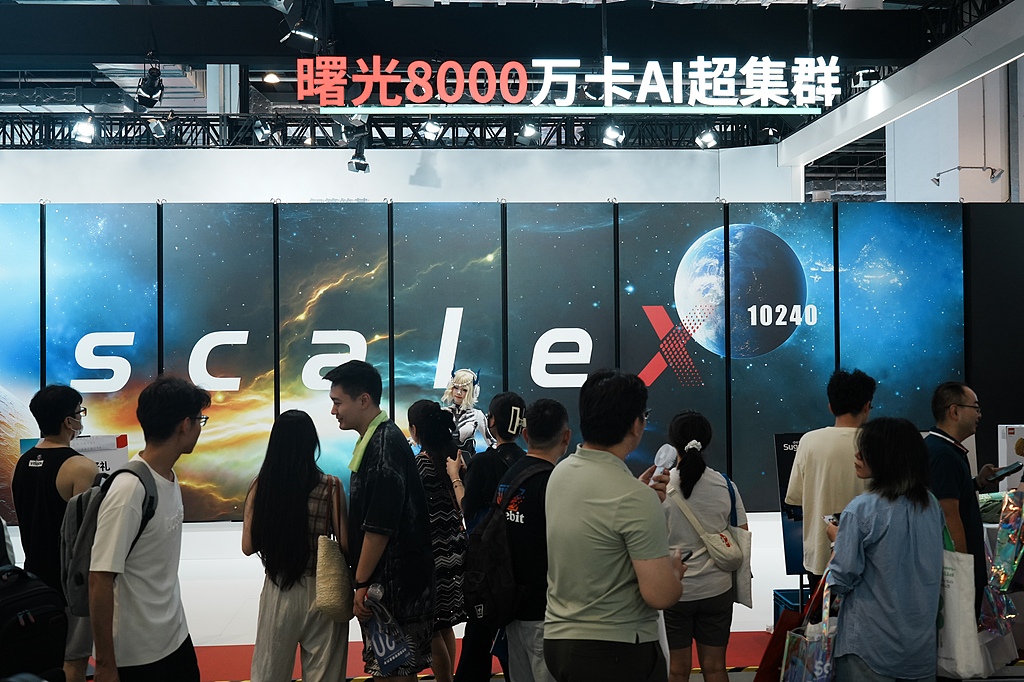
Visitors tour the exhibition hall of Sugon 8000, China's first fully homegrown 100,000-card AI supercluster, at the 2026 World Artificial Intelligence Conference in Shanghai on July 20, 2026. Photo: VCG
On a quiet afternoon in late August, a Global Times reporter, wearing an anti-static suit, walked into a russet building beside North Dragon Lake in Zhengzhou, Central China's Henan Province. Inside the building, the Sugon 8000 hall — China's first fully homegrown 100,000-card AI supercluster and an important node of the national supercomputing internet, had been operating for more than a month.
The facility could cover 5 to 10 percent of China's domestic token demand if given over entirely to inference, the Global Times learned. The on-site visit also delivered more than one surprise.
The first came at the door. China's new "compute engine" is un-monumental: the hall is only about 2,000 square meters, far smaller than other clusters of comparable scale. Across the Pacific, data centers built by US giants such as Google, Meta and Amazon tend to take the form of self-contained "compute towns," often sprawling over more than a million square meters beside generation they can lock down.
The second surprise was the air. It was less icy than in other data centers the reporter had visited. Staff said phase-change immersion liquid cooling helps achieve higher energy efficiency — meaning that almost all of the electricity consumed goes into computing rather than heat dissipation. In contrast, many US campuses still pour power into vast air-cooled halls — one reason they need so much land and so much electricity on the same site.
The Sugon architecture only works in China as power is concentrated in a national grid and can therefore be moved, balanced and delivered as a national system, a condition that the US firms cannot achieve taken account of the country's fragmented grid.
As demand for computing explodes with large models and agent applications, and electricity becomes a frontline issue in the global AI race, it is believed that whoever can secure abundant, cheap, reliable, efficient and high-quality power will hold not only a structural edge, but also secure an important ticket to the finals of the AI race. The contest between China and the United States is therefore also a story of how the two powers built their grids, and how they get that power to the rack.
The classic "wooden barrel theory" says that a wooden barrel holds only as much as its shortest stave. The same logic applies to the AI rivalry between China and the US: If power is the stave running short in the US, electricity shortages and grid constraints is limiting how fully it can utilize its advantages in high-end chip and frontier model. China, meanwhile, is lengthening its own reach with cheaper power, cheaper inference and faster rollout at home.
Hunting for power
Training a single large AI model can consume tens of millions of kilowatt-hours (kWh). In China, computing centers used about 170 billion kWh in 2025, or 1.6 percent of national electricity consumption. Official projections see this rising nearly fourfold to around 800 billion kWh by 2030, roughly 6 percent of total use.
According to Lawrence Berkeley National Laboratory, a US Department of Energy lab, American data centers used about 192 billion kWh in 2024, or 4.7 percent of national electricity. Its 2025 update puts a 2030 reference case at 649 billion kWh, or 11.8 percent of US power.
However, what matters is not only having enough electricity over a year, but a grid that can deliver the electricity at scale and at once — and at a quality chips can tolerate. Small swings in voltage or frequency can throw errors or knock equipment offline. In this context, industry insiders pointed out that China currently holds a clearer edge than the US on certain grid standards.
"China's nationally unified grid, long-distance ultra-high-voltage (UHV) transmission network and rapidly expanding renewable energy bases provide a systemic answer to the surging power demand in AI era," Zhang Xiaorong, director of the Beijing-based Cutting-Edge Technology Research Institute, told the Global Times.
That answer is visible in the construction boom in Hohhot and Ulanqab, two cities in North China's Inner Mongolia that are rich in wind and solar resources and thus able to provide green, lower-cost, stable electricity at large quantity.
At the 2026 Green Computing Power Conference in late August, the two cities signed 13 projects worth 136.1 billion yuan ($20.3 billion) with firms including ByteDance's Volcano Engine, Cambricon and CATL, covering chip testing, equipment manufacturing, computing centers and token factories. The Chinese companies' bet is to put clusters beside the low-cost green generation, so as to further bring down the inference cost that better helps Chinese large models expand worldwide more easily.
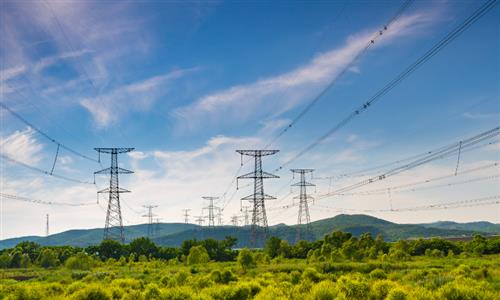
Meanwhile, the surplus power can then be wheeled onto China's nationally unified grid. By July 2026, China has 43 ultra-high-voltage lines, or dubbed as the country's power expressways in service, moving cheaper electricity from energy-rich provinces toward load centers and making nationwide coordination more efficient. Inter-regional transmission capacity has exceeded 380 gigawatts, according to a release by the State Grid.
This underpins nation's west-to-east power transmission and the "Eastern Data, Western Computing" project, allowing energy-intensive training workloads to be located in western regions with abundant, low-cost wind and solar power, Zhang said.
Across the Pacific, the US data-center growth is also a boom. Amazon has been developing a large AI data center at the GW Ranch site — an 8,000-plus-acre off-grid power generation campus — in Texas, powered by a private7.65-gigawatt natural gas generation plant built on the same site, according to media reports.
So the American build-out is also trying a different approach from the Chinese one: rather than hunting for cheaper powers, hyperscalers plant self-contained campuses next to generation they can control. Such way could enable efficient on-site matching, and it gives them a tighter grip on price and supply at that one site.
Yet one site is not whole system. In the US, on-site generation still cannot cover the load now arriving, and new plants take years to permit and build — with some are already being delayed due to growing public resistance.
A Wood Mackenzie analysis also showed that US grid operators are expected to serve only about 28 percent of the more than 1,000 gigawatts of data-center interconnection requests currently on the books. Research by Data Center Watch and Carbon Direct indicated that community resistance blocked or delayed tens of billions of US dollars in projects in 2025 alone, with the figure rising to more than $130 billion in the first quarter of 2026.
Transmission is another other half of the same bind: unlike China's unified system, the US system is divided into three largely independent interconnections with hundreds of private utilities and operators. And fragmented, aging lines and multi-year interconnection queues mean cheap power a few states away often cannot be delivered in time.
"The ability to move electricity across thousands of kilometers at high voltage means that computing load can follow the cheapest clean power, rather than being trapped near congested urban grids," Zhang added.
According to S&P, the US' existing cross-regional transmission capacity is about 84.4 million kilowatts, roughly half of China's based on the Global Times' calculation. Around 70 percent of US transmission lines have been in service for more than 25 years, close to their designed lifespan, according to a report by the American Society of Civil Engineers.
Clear competitive advantage
With the impressive debut of a range of open-source Chinese homegrown AI models from DeepSeek-R1, GLM-4.5 and Kimi K3, the rapid development of Chinese frontier models has already ramped up competition pressures on US peers. And a certain number of US AI providers, such as OpenAI, have reportedly cut some inference prices by 20-80 percent, according to several media reports.
Industry insiders said electricity, which often accounts for more than 60 percent of data centers' operating costs, could be one of the biggest deciding factors in an increasingly white-hot AI contest between China and the US.
China's AI models can be several times cheaper per million tokens than US flagships of similar measured quality. "Lower-cost electricity is one of the reasons China holds such advantage. China's unified-grid model offers lower costs and lower carbon intensity; the US on-site generation approach prioritizes local matching efficiency but requires heavy capital investment," an industry insider, told the Global Times.
According to the industry insider, China's advantage is set to strengthen further with more top-down planning and further improvement in national power mobility.
The 2026 Government Work Report for the first time highlighted coordinated development of computing capacity and electricity supply as a key new infrastructure priority, per Xinhua. The 15th Five-Year Plan (2026-30) calls for coordinated green power and computing layouts, and China has set a target that newly built data centers in major hubs use no less than 80 percent green power. Meanwhile, under the plan, China is also promoting a national computing network as one of China's six key infrastructure networks.
In May, China's first large-scale "computing-electricity coordination" project with direct green-power supply entered operation in Zhongwei, Northwest China's Ningxia. The delivered price is 0.36 yuan per kilowatt-hour, about 45 percent of levels in eastern China. On a back-of-the-envelope basis, 10,000 400-watt-class GPUs running at full load for a year would save the Zhongwei site about 16.4 million yuan in electricity costs alone versus an eastern data center.
While direct green-power supply further brings down the cost and expand capacity, Chinese companies have also been integrating generation, storage, load and grid within single computing campuses to improve the usage efficiency.
"These power advantages are feeding into AI competition. China's lower-cost green power can further reduce training and inference costs, supporting open-source paths and global expansion. Cheap, reliable electricity makes it possible to run massive inference fleets and offer low-cost API services, extending the reach of Chinese models," said Zhang.
If Chinese firms can run inference clusters at half the electricity cost of US rivals, they can pass part of that saving on to developers worldwide. Lower prices, Zhang said, would make Chinese open-source models easier to adopt.
In contrast, the US grid is increasingly strained. Recent policy moves have added another layer of risk: the Trump administration announced a ban on some foreign equipment in US power grids, according to a White House announcement.
"The US relies heavily on imports of power inverters and other essential equipment, and domestic manufacturing capacity is insufficient, which could worsen power supply bottlenecks — especially as the White House has linked AI development to electricity availability," Xiang Ligang, a veteran telecom and tech policy observer, told the Global Times.
Analysts also point to the US' remaining staves in the AI contest. The US still leads on the most advanced training chips and their software stack, on the benchmark ceiling of its top closed models, as well as on the density of capital and elite talent.
"China's edge is not that it aims to close that gap in the short term," Xiang said. "It is that electricity, open-weight pricing and domestic deployment let it use more of the chips it already has — and fill more of the barrel while the other side waits on power."